Monday, 26 October 2015

Caught In The Web

The internet has transformed how public intellectuals engage, as AC Grayling’s writings testify


Title: The Challenge of Things: Thinking Through Troubled Times
Author: AC Grayling
Publisher: Bloomsbury
Price: ₹499


Democracy and technology nourish each other and are mutually dependent forces. Modernity brought in its wake the concept of nation-state and the notion of democracy. This required dismantling some antediluvian privileges, such as access to education, or barriers to simple tasks such as writing and reading. It also gave technology room to expand and explore.

In the late 20th century, this symbiotic relationship morphed into the form of the internet, a technological tool which can potentially democratise information and knowledge. The internet (through mobile technology) was the spark that fired a mini-revolution in North Africa and parts of West Asia in recent years. It fanned self-governance bushfires across artificial political boundaries, somewhat like the mistral on a hope-filled spring evening.

Change Agent


Facilitator, and perhaps agent provocateur , the internet is changing lives in science laboratories, school classrooms, farmer cooperatives and virtual chatrooms. It has even democratised the notion of a public intellectual: anybody with access to the internet and in possession of rudimentary knowledge of its content is qualified to comment on pretty much any subject in the universe. There are no eligibility requirements; no entry barriers. Have keyboard, can comment.

This does compel us to revisit the identity and role of the traditional “public intellectual”. Roughly sketched, a public intellectual is an academic, or a person from the creative pursuits, who reaches out to a non-specialist public on matters of importance, especially on issues related to public policy.

Names such as Bertrand Russell, Christopher Hitchens, Edward Said, Noam Chomsky, Richard Dawkins spring readily to mind when pushed for examples. The past 20 or so years has seen a mushrooming of public intellectuals as the internet spread its web of influence across society and liberated sections of academia stifled by the suffocating cloisters of academe, as academic activity no longer restricts itself to classroom pedagogy but engages in a wider debate, as combative Op-Eds in newspapers fill the time and spaces between the arcane stuff written for turgid, specialist journals.

Philosopher AC Grayling is the consummate example of a modern-day public intellectual and thanks the internet for reviving the grand old Hellenic tradition of public debates, though elsewhere he even derisively calls it as “biggest toilet wall in history.”

Trained and schooled in philosophy and pursuing teaching as a full-time vocation, Grayling has also segued into the traditional adjoining spaces of public advocacy and public debate, through the use of modern media (print, radio, television, internet). A prolific writer, Grayling has authored over 30 books, including a series on Things: The Meaning of Things , The Reason of Things , The Mystery of Things , The Heart of Things , and The Form of Things . The 2015 addition to Things , under review here, is a collection of Op-Eds and articles from a variety of newspapers and magazines, including transcripts of conversations in television studios.

As such, this ragtag collection lacks a central theme, though Grayling’s grudging acknowledgment of the fact comes laden with a qualifier in the Introduction: “The essays that follow are a miscellany unified by the effort to do that: to explore, and to suggest perspectives upon, different facets of this time in our world.”

This fleeting, common thread is often lost; what comes across is the urgency of variegated ideas with the sharp (but evanescent) pungency of a wasabi-coated snack — quick to hit the roof of the head but forgotten in the next instant.

Short And Lost


An Op-Ed is the modern-day public intellectual’s weapon of choice in the battle for mind-space, but it also has a short range and illusory kill-power; it can zap but it doesn’t leave any lasting effects. This shortcoming is inherent in the nature of the beast: lack of space forces brevity and a disappointing lack of depth. Grayling’s collected Op-Eds in the first half of the book wrestle with some interesting ideas but never quite go beyond just the two opening rounds, leaving readers thirsting for more.

The essays in the second half of the book are more engaging, designed like a gourmet meal that runs through all the zones of the palate — rejecting popular notions, arguing a point, bargaining for recognition of grey areas, dissing shallow and popular beliefs, constructing a logical sequence of thoughts.

Grayling offers another interesting but slightly disquieting distinction between the two segments: the first half deals with some of the “negatives” of our circumstances and the second with some “positives”.

But there is another distressing trend creeping up on internet-heavy public intellectuals: a tendency to view the non-Western world (including Russia) through cracked and grime-caked lenses.

This is a recurring flaw with most Op-Eds in the western media: they perpetuate highly prejudiced views, implicitly implying that Western society is superior, rational and developed. Grayling too succumbs to this unipolar and monochromatic view occasionally.

But he seeks redemption almost immediately: in grappling with history and the history of ideas, Grayling adopts a humanist approach to most issues tormenting this fragile world, places ethics in the middle of the room.

But, more importantly, Grayling performs one exemplary service: he initiates a pubic debate on multiple vexed topics, forcing people to think, search for answers, question established canons. That, and that alone, makes this book worthwhile.


This book review was published in the Business Line: http://www.thehindubusinessline.com/todays-paper/tp-opinion/caught-in-the-web/article7803791.ece

Wednesday, 7 October 2015

New Concepts For BRICS

At a recent international seminar on BRICS Studies, in addition to the predictable themes such as building a multipolar world order and the One Belt One Road project, fresh ground was also covered, including the contours of the New Development Bank and the potential impact of the refugee crisis on BRICS countries.


The focus of the conference was to deliberate and discover new development paradigms that are markedly different from the Bretton Woods doctrine, and how BRICS members can embed these in practice.

The opening day included numerous speeches, mostly by former Chinese ministers and diplomats. The overall thrust was predictable: the Bretton Woods’ ideological unipolarity has to end, a new development canon has to be developed, China is interested in fostering a new multipolar world order along with other BRICS countries (as well as other developing and emerging economies), and the world’s (especially western economies’) mistaken notions of China’s global ambitions need to be corrected urgently.

Another recurring theme was bewilderment at India’s inexplicable reluctance to partner in the One Belt One Road initiative.

One of the notable keynote speakers, Leslie Maasdorp, vice president, BRICS New Development Bank (NDB), made three critical points: the NDB will be driven by pragmatism and all changes to the existing paradigm of development financing will be gradual; the Bank will embrace innovation and unlock new technologies with help from civil society and young graduates; and it was working with a long-term horizon of 25-30 years.

Maasdorp also sought to allay three popular misconceptions—that the NDB will compete with the World Bank and the International Monetary Fund, that it will be dominated by China, and that its governance structures will be lax.

Among all the interjections, three stood out. In light of the refugee influx into Europe, BRICS members were requested to also frame a policy on migration. BRICS cannot remain insulated from this humanitarian issue, especially when the growth rate of some members is higher than that of their neighbouring countries. Second, if China wants to partner with BRICS and other emerging economies in articulating a new development theology, it will have to address internal social infirmities such as restrictive human rights, the bar on freedom of speech, and lax safety standards at its industrial complexes. Finally, China was advised to retrospect about why it was misunderstood by other countries, especially India, and make the necessary course corrections.


The seminar, titled ‘New Thinking on Development and BRICS Cooperation’, was organised by the Center for BRICS Studies at Fudan University, Shanghai, on 4-5 September 2015. The text of the full paper follows this blog post. 
The paper was originally published in Gateway House. Here is the link to my paper at the conference: http://www.gatewayhouse.in/wp-content/uploads/2015/10/Rishi_Fudan-full-report.pdf

NDB: A Pivot To Financial Alternatives

The BRICS Bank wants to complement existing multilateral arrangements while simultaneously creating an alternative architecture; it can begin by tying up with existing Asian liquidity support systems and forging a non-dollar clearing system 

Introduction 

The global financial crisis (GFC) of 2008 exposed numerous faultlines in the international monetary system and in the global financial architecture (GFA). In addition, globally trusted benchmarks, such as Libor and Brent, were found susceptible to manipulation and distortion. Also, the global financial system was subjected to unilateral geopolitical objectives, like the U.S.-imposed economic sanctions against Iran. 

Consequently, in 2008, the G20, an existing multilateral grouping, was transformed and upgraded—from an annual meeting of finance ministers and central bankers to a leaders’ summit—to handle the GFA’s infirmities[1]. However, the G20 has achieved only partial success, with no noticeable progress on either reducing global imbalances or on addressing the GFA’s weaknesses, as was promised in 2009. 

As a result, untrammelled portfolio capital flows from developed economies to emerging markets—considered dangerous, volatile, and unregulated—have now driven many emerging nations to seek regional initiatives. 

BRICS is such an initiative, though it is distinctive from other similar groupings—its member countries are not geographically contiguous. Another unique feature is the low intensity of trade and investment among each other, [2] even though economics was a primary motive for these countries forging a common platform. The other compulsion was to seek an alternative to the dominant GFA and the concomitant governance structure in various multilateral development banks. 

The formation of BRICS and its leaders’ intentions were initially met with scepticism. However, these leaders have delivered on some of their promises—BRICS nations formally launched the New Development Bank (NDB) and the Contingency Reserve Arrangement (CRA) at the Fortaleza Summit in 2014, [3] fulfilling a long-held promise. 

The NDB and the CRA are delivery platforms for development finance and emergency liquidity support, respectively. Both are designed to provide an alternative to the multilateral governance orthodoxy prevalent at the International Monetary Fund (IMF) and World Bank. All BRICS leaders (as well as newly-appointed NDB president K.V. Kamath) have emphasised that the NDB does not purport to replace the existing multilateral institutions, but will complement them, while offering an alternative financing model for sustainable development. 

The first steps to intensify economic relations have already been taken. The NDB has signed, in Ufa, Russia, a memorandum of understanding with five national development banks [4] from each BRICS country; it also signed agreements, in Fortaleza, with five export credit guarantee companies. The agreements are expected to “…enhance trade and economic relations between member countries”. 

The individual pieces 

The agreement to set up NDB, signed by the five BRICS leaders, states the bank’s mission: “The Bank shall mobilize resources for infrastructure and sustainable development projects in BRICS and other emerging economies and developing countries, complementing the existing efforts of multilateral and regional financial institutions for global growth and development.” [5] 

This has three components: one, the NDB will finance infrastructure and sustainable development projects; two, the financing will be done in BRICS and “other emerging economies and developing countries;” three, the NDB will complement the efforts of existing multilateral institutions. 

Each of these components encapsulates BRICS’s philosophy and strategy. It is important to note that, apart from infrastructure projects, there is an emphasis on financing sustainable development—and on this front western financial institutions and civil society in emerging economies diverge widely in terms of approaches and ideologies. Perhaps the NDB will provide a different approach to financing sustainable development. 

The CRA agreement—expected to provide liquidity support to BRICS members during balance of payments crises, a service that even the IMF provides—echoes similar sentiments: “…this contingent reserve arrangement shall contribute to strengthening the global financial safety net and complement existing international monetary and financial arrangements.” [6] 

Interestingly, both agreements contain phrases that subscribe to furthering the global cooperation framework while simultaneously trying to create alternative arrangements. 

What are the potential new frameworks and how they can be strengthened further? 

First leg: a monetary union 

Challenging the governance framework will require creating an alternative to the existing international monetary system, including the reserve currency mechanism. BRICS summit communiques also mention this. The Durban Declaration of March 2013 states: “We support the reform and improvement of the international monetary system, with a broadbased international reserve currency system providing stability and certainty. We welcome the discussion about the role of the SDR [special drawing rights] in the existing international monetary system including the composition of SDR's basket of currencies.” [7] 

It might be worth examining whether the concept of an Asian monetary union or a single Asian currency are options that can be revived. This currency, if it materialises, could rank alongside the dollar and euro as a globally significant unit, given the underlying trade volume. Many scholarly discussions have toyed with the idea of currency internationalisation and what it will mean for BRICS in general and for all emerging economies in particular. In reality, an Asian currency union is still some distance away, but some building blocks have already been put in place. 

There is, for example, a move to form an ASEAN Economic Community (AEC) which, according to the ASEAN’s website, will have the following characteristics: a single market and production base, a highly competitive economic region, a region of equitable economic development, and a region fully integrated into the global economy. [8] According to audit and consulting firm KPMG: “The AEC project could lead to an even more effective integration into the global value chains. And this will continue to make ASEAN a strategic economic region that is expected to exceed the global growth average for the foreseeable future.” [9] 

The AEC was a reaction to the 1997-98 financial crisis. The crisis also prompted some additional structural changes. ASEAN+3 [10] implemented a liquidity support mechanism, the Chiang Mai Initiative Multilateralisation (CMIM) and, in the process of multilateralising the arrangement, it created the ASEAN+3 Macro-economic Research Office (AMRO). These two initiatives are discussed later in this paper. 

Two other initiatives were added as a fallout of 1997-98: the Asian Bond Markets initiative (ABMI), supported by the Asian Development Bank, which also now includes a Credit Guarantee and Investment Facility (CGIF). The ABMI was born at a 2003 meeting of ASEAN+3 finance ministers, primarily to avoid the 1997-98 currency and maturity mismatches from short-term foreign currency borrowings. [11] The CGIF was established in November 2010 to provide credit guarantees for local currency denominated bonds issued by investment grade companies in ASEAN+3 countries. [12] 

The Asian crisis also prompted the Japanese government’s Research Institute of Economy, Trade and Industry [13] to moot an Asian currency union. Since then, much has been written and debated about the proposal, though little progress was made. 

The U.S. and Europe had opposed the idea when it was first proposed. Numerous other hurdles—such as the lack of an institutional framework (for example, an external independent central bank like the European Central Bank, which might require member countries to cede control of their monetary and fiscal powers)—have delayed implementation of the currency union. 

A political consensus is also missing. Plus, while the currency union model encompasses ASEAN+6 (ASEAN+3 along with India, Australia and New Zealand), all the other institutions or mechanisms—CMIM, AMRO, ABMI, CGIF, or even plans for AEC—are still stuck at ASEAN+3. Therefore, the integration of Asia’s economic community is still partial, and not representative of the region’s economic flows. 

Even if launched in the near future, it is unlikely that all BRICS members will be in a position to, or agree to, adopt a common Asian currency. There are three other choices: 

One, BRICS countries launch their own currency, which would be used exclusively by the five members. But this is not without its attendant problems. A common BRICS currency will also require the setting up of an institutional framework like the Asian currency union. This is unlikely to be favoured soon. In addition, the spectre of Eurozone’s current economic travails is likely to be a big deterrent. 

The second option, widely favoured, is to expand the scope of IMF’s Special Drawing Rights (SDR) and make it representative of the world’s changing trade and economic imperatives. But the IMF’s recent review to include the Chinese renminbi—in addition to the dollar, euro, yen, and pound sterling—once again ended in status quo, with a decision postponed to September 2016. [14] Unless the IMF decides to review its eligibility criteria for including other currencies, the objective of reforming the SDR mechanism and using it as an alternative international reserve currency will remain elusive. 

The interim answer may, therefore, lie in trading and settling in local currencies. [15] ABMI and CGIF have already created the infrastructure for the launch, subscription, and trading of local currency bonds. The infrastructure for settlement of local currencies also exists, though it might need some resuscitating: the Asian Clearing Union (ACU), which saw diminished volumes after economic sanctions were imposed on Iran, could be the right vehicle. Some academics, such as monetary theorist Ashima Goyal, also favour the idea of reviving regional payments systems like the ACU, which can then provide a counterbalance to the dollar. [16] 

The NDB may explore the option of creating an infrastructure for settlement of local currency trading beyond the current ACU members, or provide a thought leadership role in expanding the ACU mechanism to a larger catchment area, even though its current mandate does not explicitly mention it. But there are clauses in the agreement that also implicitly allow the NDB to interact with other regional institutions. 

In any case, the NDB agreement empowers the institution to also lend in local currency: “The Bank in its operations may provide financing in the local currency of the country in which the operation takes place, provided that adequate policies are put in place to avoid significant currency mismatch.” [17] Combined with the Delhi Summit decision to start invoicing intra-BRICS trade in local currencies, there is a potential for dovetailing this effort with the work already done by the ACU. 

The NDB then should later explore methods of integrating its local currency settlement framework, bond issuance platform and credit guarantee programme with non-BRICS ASEAN+6, as well as with other similar platforms in Africa and South America, such as the South African Development Community (involving South Africa, Lesotho, Namibia and Swaziland). 

This might help create some momentum in non-dollar and non-euro trade, which will lead to lower transaction costs. This is critical for increasing global trade and investment volumes. 

Second leg: strengthening the safety net 

The second leg of a future NDB-based governance structure involves the liquidity support mechanisms, CRA and CMIM. Both owe their birth to similar needs and analogous concerns raised by East Asian countries and BRICS nations. In sum, both are similar in intent and design. There is another similarity: an inability to sever the umbilical cord with the IMF. In that sense, the CRA continues with the ASEAN trend of using plurilateral monetary arrangements to complement, and not supplant, the IMF. 

Both the arrangements allow countries to borrow only a small percentage without entering into an arrangement with the IMF. [18] In CMIM and CRA, only 30% can be borrowed from the pool without reference to the IMF. The CMIM is believed to be working towards increasing this to 40%. Over time, this has to obviously grow further till the IMF-linked portion becomes insignificant. 

The reasons for the IMF linkage have not been explained. There are conjectures though: that a liquidity crisis in any country is likely to be triggered by structural problems and not speculative forces, which would then require structural adjustments that the IMF is best qualified to provide. Another view is that the CMIM does not have the capacity to differentiate between a liquidity and a solvency problem. [19] 

There is another probability: the CMIM as well as CRA not only lack the fundamental capability to assess structural flaws in an economy, but both might also be diffident about dictating a structural adjustment programme to another sovereign. The two arrangements are plurilateral groupings and lack the political or moral authority to impose conditions, especially after criticising the IMF for frequently undermining sovereignty. The IMF, on the other hand, is still seen as an independent multilateral organisation despite the lack of shareholding reforms in the institution. 

However, both CMIM and CRA also have an equal chance of failure given their inherent structural flaws. The CMIM has already faltered once—in the aftermath of the 2008 GFC —even though it has been in existence since 2000. South Korea approached the U.S. and Japan, instead of tapping the CMIM, for liquidity swaps post-2008. The problem was a proliferation of bilateral swap lines; that has now been replaced with a multilateral structure, under which all the different swap lines are governed by a single agreement. In cognisance, CRA has started off by pooling its funds. But the efficacy of both will be tested during the next global crisis; and, given the general unpredictability of financial upheavals, the two arrangements will have to be prepared for all eventualities. 

There is, thus, an urgent need to make both CMIM and CRA relevant and battle-ready. This can be achieved if some kind of bridging arrangement is drawn up between both the schemes—an agreement that allows members to access both pools in a crisis. At a later stage, this arrangement can be extended to other new members as well. 

The first reason for the bridging arrangement is the insufficient size of the IMF-delinked funds. In a payments crisis, the non IMF-linked amount will not be adequate to achieve stabilisation. This defeats the purpose of the framework. It is probably early days to judge the CRA’s efficacy on the basis of the initial funds; it is likely that there is a tacit agreement to induct more members later, like the NDB, and enhance the pool. The agreement with CMIM should then form the first stage of that proposed expansion. 

China is a common member in both CMIM and CRA. India is a part of ASEAN+6, the logical extension path for CMIM, which started off with ASEAN and was later extended to ASEAN+3. Pooled together, the CMIM and CRA combine will have $340 billion ($240 billion plus $100 billion), making it a formidable alternative to other existing multilateral arrangements. 

There is another reason for the CRA to seek combined pooling: the CMIM has already created a regional macro-economic surveillance unit, AMRO. Its purpose, according to AMRO’S website, is “…to monitor and analyse regional economies and to contribute to early detection of risks, swift implementation of remedial actions and effective decision-making of the CMIM.” AMRO can become a credible surveillance unit, and deliver independent macro-economic surveillance and analysis, only if its membership expands, leading to deeper diversity and capacity. [20] Therefore, expanding with the CRA makes eminent sense since the structure is already in place. 

The pooling of resources will, of course, not be easy; there will be numerous political obstacles. Even assuming some kind of linkage is achieved, associated headaches could arise. Friction is bound to grow between what is a regional grouping (ASEAN+3) and the growing role of BRICS as the sole representative of emerging economies and the visible face of an alternative governance architecture. However, if the BRICS leadership has so far managed to overcome its own inherent incompatibility through consensus and discussions, it should also be able to manage contradictions with the CMIM. Also, as mentioned above, China is a common member; it can play a vital role in bringing the two together. 

In conclusion, there are no set formulae or established norms. The NDB will have to debate and discuss internally—as well as cooperate, coordinate, and consult with civil society—for building an alternate financial architecture, even if it has to be done within the confines of the existing framework. This is its mandate, this is what the developing countries require from the NDB. 

References

[1] G20 Information Centre, G20 Research Group, Munk School of Global Affairs, University of Toronto, http://www.g20.utoronto.ca/g20whatisit.html

[2] Singhal, Rajrishi, How Culture and Education Can Bind BRICS, Gateway House, 7 July 2015, http://www.gatewayhouse.in/brics-needs-new-binding-factors/

[3] BRICS Information Centre, Treaty for the Establishment of a BRICS Contingent Reserve Arrangement, 15 July 2014, Fortaleza, Brazil, http://brics.utoronto.ca/docs/140715-treaty.html

[4], Banco Nacional de Desenvolvimento Econômico e Social, Bank for Development and Foreign Economic Affairs, Export-Import Bank of India, China Development Bank Corporation, http://www.brics.utoronto.ca/docs/150709-NDB-memorandum-en.pdf

[5] BRICS Information Centre, Agreement on the New Development Bank, 15 July 2014, Fortaleza, Brazil, http://www.brics.utoronto.ca/docs/140715-bank.html

[6] BRICS Information Centre, Treaty for the Establishment of a BRICS Contingent Reserve Arrangement, 15 July 2014, Fortaleza, Brazil, http://brics.utoronto.ca/docs/140715-treaty.html

[7] BRICS Information Centre, BRICS and Africa: Partnership for Development, Integration and Industrialisation; eThekwini Declaration, 27 March 2013, Durban, South Africa, http://brics.utoronto.ca/docs/130327-statement.html

[8] Association of Southeast Asian Nations, ASEAN Economic Community, 7 August 2003, http://www.asean.org/communities/asean-economic-community

[9] Zhao, Abe and Vinod Kalloe, The ASEAN Economic Community 2015: On the road to real business impact KPMG Asia Pacific Tax Centre, , June 2014, https://www.kpmg.com/SG/en/IssuesAndInsights/ArticlesPublications/Documents/TaxItax-The-ASEAN-Economic-Community-2015.pdf

[10] Bangko Sentral ng Pilipinas, Chiang Mai Initiative Multilateralization, June 2015, http://www.bsp.gov.ph/downloads/publications/faqs/cmim.pdf 

[11] Ministry of Finance, government of Japan, Chairman’s Press Release on Asian Bond Markets Initiative, http://www.mof.go.jp/english/international_policy/convention/asean_plus_3/20030807_02 .htm

[12] Credit Guarantee and Investment Facility, Catalyzing more stable and efficient mobilization of Asian savings in the Region, http://www.cgif-abmi.org

[13] Research Institute of Economy, Trade & Industry, Asian Monetary Unit & AMU Deviation Indicators, http://www.rieti.go.jp/users/amu/en/

[14] International Monetary Fund, SDR Basket—Proposed Extension of the Valuation of the SDR, August 2015, http://www.imf.org/external/np/pp/eng/2015/080415.pdf

[15] Mathur, Akshay, Incubating A Non-Dollar Architecture, Gateway House, 18 July 2014, http://www.gatewayhouse.in/incubating-a-non-dollar-architecture/

[16] Goyal, Ashima, Payment systems to facilitate South Asian integration, WP-2015-021, July 2015, Indira Gandhi Institute of Development Research, Mumbai, http://www.igidr.ac.in/pdf/publication/WP-2015-021.pdf

[17] BRICS Information Centre, Annex, Art24, Provision of Currencies, Agreement on the New Development Bank, 15 July 2014, Fortaleza, Brazil, http://brics.utoronto.ca/docs/140715-bank.html

[18] Joyce, Joseph P, BRICS and the Bretton Woods Twins: Capital Ebbs and Flows, 29 July 2014, https://blogs.wellesley.edu/jjoyce/2014/07/29/the-brics-and-the-bretton-woodstwins/

[19] Cattaneo, Nicolette, Mayamiko Biziwick and David Fryer, The BRICS Contingency Reserve Arrangement and Its Position In The Emerging Global Financial Architecture, South African Institute of International Affairs, Policy Insights 10, Economic Diplomacy Programme, March 2015, http://www.saiia.org.za/doc_view/752-policy-insights-10-thebrics-contingent-reserve-arrangement-and-its-position-in-the-emerging-global-financialarchitecture

[20] Hill, Hal and Jayant Menon, Financial Safety Nets in Asia: Genesis, Evolution, Adequacy, and Way Forward, Working Papers in Trade & Development, No 2012/17, Arndt-Corden Department of Economics, Crawford School of Public Policy, Australian National University; September 2012, https://crawford.anu.edu.au/acde/publications/publish/papers/wp2012/wp_econ_2012_17 .pdf

This was originally published in Gateway House: http://www.gatewayhouse.in/wp-content/uploads/2015/10/Rishi_Fudan-full-report.pdf

Thursday, 24 September 2015

Don't Bank On It

Decoding Raghuram Rajan's antipathy towards industrial conglomerates.


Finally, India is on its way to hosting a differentiated set of banks, each of which will perform a set of pre-determined functions. Central bank Reserve Bank of India (RBI) granted in-principle approval on September 16 to 10 entities for launching a "small bank". In August, it approved 11 institutions for activating "payments banks". In 2014, RBI had granted approval to two private sector organisations for launching "universal banks".

These "in-principle" approvals will be converted into licences after 18 months from grant of approval once the regulator is satisfied that the institution has met all conditions.

So far, so good. But a few issues need clarity.

One, different bank categories already exist in the system — cooperative banks (there are five kinds under this head), local area banks and regional rural banks. Add to that the universal banks which can broadly be slotted under four heads, according to ownership — State Bank of India and its associate banks, public sector banks, old generation private banks, new generation private banks and, finally, foreign banks. So, while competition is good, is it still unclear how the new banks will make any dent.

Let me explain.

Let's start with the payments banks. According to RBI's guidelines, these banks can only accept deposits, provide remittance services, issue ATM/debit cards (not credit cards), act as a business correspondent of another universal bank, distribute third-party investment products (another company's mutual fund, insurance or pension fund products), among other things. But there's one big difference: payments banks cannot lend. On top of which, they have to invest 75 per cent of their deposits in government securities or treasury bills with a maximum maturity of one year, and the balance 25 per cent in fixed deposits or current account of another scheduled commercial bank.

This brings us to the second point: The pathway to a respectable rate of return for payments banks seems ridden with multiple potholes. As per the guidelines, payments banks have four key areas of business opportunity, all of which yield fee-based incomes: fee from remittances, fee from transaction services (such as debit cards), fees from sale of third party investment products, fees for providing business correspondent services.

But given the capital cost, the network roll-out expenses and the cost of managing operational risks, this revenue source might not be enough to provide adequate returns. Or, the volumes that will be required to generate adequate returns might be difficult to achieve. Plus, given the demographic profile of a payments bank's core constituency, ticket sizes are likely to be small and perhaps misaligned with acquisition costs. This is despite use of technology solutions to lower costs.

On top of this, the payments bank will have some genuine dilemmas. One, how does it price deposits? If it's lower than universal banks, it could raise issues of discrimination. Also, if it has to make a spread from investing in gilts, then deposit rates have to be lower than the sovereign yield rates. Will anybody bite at these rates? It will, therefore, have to rely on high-yield fees, such as those paid on sale of insurance or pension products. Some kind of regulatory framework might be necessary here, given the scope for mis-selling.

The telecom operators, though, may have a slight edge. They might be in a position to leverage their network and customer base for remittances and other related services. This not only lowers their acquisition costs immediately but also obviates the need for brick-and-mortar network substantially.

That might explain why Aditya Birla Nuvo (Idea Telecom), Reliance Industries Ltd (Jio), Airtel M Commerce Services Ltd and Vodafone m-pesa Ltd have got an approval for launching payments banks. The other interesting candidate is individual Vijay Shekhar Sharma, who started popular mobile wallet company Paytm. Aditya Birla Nuvo is the holding company for the AV Birla Group's financial and telecom services. Reliance, on the other hand, has tied up with India's largest bank State Bank of India, apart from launching its nation-wide 4G telecom network Jio.

Many large corporates had earlier expressed a desire to obtain universal banking licences, but were quietly discouraged by RBI. Many large business houses owned banks pre-nationalisation and, for some of them, obtaining a banking licence is like re-acquiring a business that was snatched away. But, the payments bank guidelines do not spell out a clear migration path to universal banking.

On the other hand, the guidelines for small banks do have a clear transition route, which includes a five-year track record as a small bank. But, here's the rub: the guidelines also say, "…proposals from large public sector entities and industrial and business houses, including from NBFCs promoted by them, will not be entertained."

So, this is the third leg of RBI's bank licensing process: keeping corporates out of banking, specifically the lending business, through an elaborate route.

RBI allows small banks to migrate to universal banks, but precludes industry houses from applying for small banks. It lets corporates apply for payments banks, but locks the door leading to universal banking. Even among payment bank applicants, companies or industrial groups which did not have a clear advantage in payments banking — such as Kalpataru Corporation or Videocon d2h Ltd — were not considered.

In its press release announcing names of successful applicants for small banks, RBI stated: "…the Reserve Bank intends to use the learning from this licensing round to appropriately revise the Guidelines and move to giving licences more regularly, that is, virtually 'on tap'." It's still unclear whether on-tap licensing is only for small banks or will be extended to universal banks also, and whether there will be some thawing in RBI's antipathy towards industrial conglomerates.

We might have to first wait for the NPA tide to ebb before RBI warms up to the idea of banks launched by industrial houses.

Originally published in Outlook magazine (http://www.outlookindia.com/article/dont-bank-on-it/295433#comments) under column "Man About Mumbai"  

Monday, 21 September 2015

Byte But No BIT

Behind the hullabaloo and grand optics that will accompany PM Narendra Modi’s visit to the U.S. will be laser-focused discussions on enhancing the strategic trade and investment relationship

The agenda for Prime Minister Narendra Modi’s 5-day visit to the U.S. starting September 24, much like his previous trip, is brimming with activity. Apart from attending the United Nations General Assembly, he is travelling to San Francisco to burnish his Digital India credentials, then returning to New York to meet President Barack Obama for a bilateral dialogue and closing by catching up with key U.S. businessmen and CEOs for a closed-door conversation.

But behind Modi’s headline-grabbing California spectacle are other Indian ministers and businessmen who will be rolling up their sleeves and getting down to business in Washington DC.

High on the list is the first meeting of the newly-crafted India-USA Strategic and Commercial Dialogue (S&CD) on September 22, which was upgraded from India-USA Strategic Dialogue this January during Obama’s Republic Day visit[i]. The moniker change reflects the strategic importance of trade, economic and investment to the bilateral ties. The roll-call of the meeting attendees also reveals what will be discussed and what’s off-the-table.

On the Indian end of the table will be External Affairs Minister Sushma Swaraj and Commerce and Industry Minister Nirmala Sitharaman, with Secretary of State John Kerry and Secretary of Commerce Penny Pritzker on the U.S. side. On September 21, a day before the Dialogue, Vice President Joe Biden, Kerry and Swaraj will address the U.S.-India Business Chamber’s anniversary celebrations. Other ministers, including energy minister Piyush Goyal, will be present and when the Dialogue commences the next day, Goyal will meet his U.S. counterpart, Ernest Moniz, for the Sixth India-U.S. Energy Partnership Summit.

U.S. Vice President Joe Biden will be present at the bilateral talks between Modi and Obama. If Biden does indeed make a bid for the presidency, as has been widely rumoured, his involvement becomes significant.

So far, one thing is clear from the agenda: the Bilateral Investment Treaty (BIT) is not in the picture. That inference arises from Finance Minister Arun Jaitley’s absence from the proceedings. The hypothesis becomes even more compelling because the finance ministry has crafted India’s model draft agreement and placed it in the public domain for stakeholder inputs. There are numerous sticking points between India and the U.S. over the draft that will take time to discuss, debate and disentangle. Among them are the investor-state dispute system, intellectual property rights (IPR) and expropriation. Given that the Obama presidency is fast entering the “lame-duck” zone, the BIT might have been kept out because it is still a work-in-progress.

The Dialogue will focus on four areas, according to undersecretary of commerce for international trade, Stefan M Selig’s briefing to reporters September 16 at the American Chamber of Commerce in New Delhi in August 2015[ii]:

Building tomorrow’s smart cities in India and the related infrastructure: The U.S. will participate in “smartening up” three cities — Ajmer, Allahabad and Vizag — and the talks will identify U.S. companies that can deliver on the promise.

Participating in strengthening India’s business climate to the benefit of both Indian and American businesses: This is an euphemism for tackling all the current pain-points in the relationship, especially for the U.S.: IPR, contract laws, the Indian legal system. Strangely, pre-Dialogue chatter seems to centre only on the business climate in India, without any mention of the non-tariff barriers and curbs on movement of skilled people from India to the U.S.

Harmonizing product standards to increase trade and further deepen our industries’ integration into global supply chains: Creating and developing common standards – safety, environmental or labour – in manufacturing that will help integrate India’s trade outreach with both the Asia Pacific Economic Community (APEC) and the Trans Pacific Partnership (TPP). India is not a member of either grouping. Included will also be trade in agricultural goods and the future of the Doha Round at the upcoming WTO ministerial at Nairobi.

Developing best practices around innovation and entrepreneurship: Among the many issues on the table, renewable energy will likely find mention.

What’s different this time is that the talks could depart from the transactional nature of previous rounds and instead identify credible milestones, especially ones that help stretch the annual bilateral trade volume from $100 billion currently to $500 billion. Beyond that, both sides will look to elevate trade into a strategic and diplomatic tool, one that aligns Modi’s “Look East, Act East” policy with Obama’s Asia Rebalance strategy. The nuts and bolts of this tool are likely to be identified on September 22.

Another clue to the future direction of the bilateral and the Dialogue is the equal, if not larger, role that the private sector is expected to play over the public sector in strengthening mutual ties. That’s why the USIBC event has been scheduled a day prior to the Dialogue, so U.S. corporations can voice concerns that can be discussed at the Dialogue the next day.

A disconcerting element: apart from the fanfare around Modi’s public appearances, there hasn’t been much forthcoming from the Indian delegation, the exception being a recent and bare-bones press release from the Ministry of External Affairs[iii]. For the moment then, policy-watchers we will have to remain content with Modi’s grand shows.

ENDNOTES

[i] Department of Commerce, Statement from U.S. Commerce Secretary Penny Pritzker on U.S.-India Strategic and Commercial Dialogue; January 26, 2015; <https://www.commerce.gov/news/press-releases/2015/01/statement-us-commerce-secretary-penny-pritzker-us-india-strategic-and>

[ii] International Trade Administration, Speech (as prepared for delivery) by Under Secretary of Commerce for International Trade, Stefan M Selig; August 11, 2015; New Delhi; <http://www.trade.gov/press/speeches/2015/selig-081115.asp>

[iii] Ministry of External Affairs, Press Releases, September 18, 2015 <http://www.mea.gov.in/press-releases.htm?dtl/25817/First_Ministerial_of_the_IndiaUS_Strategic_and_Commercial_Dialogue>

Originally published in Gateway House (http://goo.gl/13YfW4)


Thursday, 20 August 2015

Shopping For Inequity

The government's policy on FDI in e-commerce is designed to protect the welfare of a smaller political constituency…


India's exuberant e-commerce industry was recently hit by a known unknown, or an existing risk that had been left unattended. Delivery boys associated with two or three companies stopped working, demanding better working conditions — such as toilets in offices or a motorcycle maintenance allowance — and better pay.

This not only led to a predictable pile-up of delivery packages but also focused attention on an industry that's in news for conflicting reasons: soaring valuations and rapidly multiplying wealth of the founders counteracted by absence of regulatory oversight leading to dodgy governance structures and business practices.

What's interesting is that the strike — the delivery boys were organised under the banner of Raj Thackeray's Maharashtra Navnirman Sena banner — came soon after government officials finished separate consultations with industry representatives and state governments on whether to revise the existing rules on foreign direct investment (FDI) in e-commerce. The government was, of course, nudged into this stakeholder consultation process by the Delhi High Court. The states are expected to submit their views to the Centre soon. 

There is no evidence to suggest that the strike was related to, or timed to coincide with, the government's rounding up of opinions on retail FDI. But, given the close procession of events, it does pivot public gaze towards the government's anomalous policy on FDI in retail, as well as the familiar national malady of regulatory processes lagging industry development.

The government's policy on FDI in retail, like previous episodes of politically-driven policy-making, is designed to protect the welfare of a smaller political constituency over furthering the welfare of the general public, a much larger but dispersed political constituency. It has also spawned a convoluted business strategy designed to side-step regulatory barriers. Here's how.

The government's FDI policy in the retail sector is divided into four parts — single brand retail, multi-brand retail, cash-and-carry operations and e-commerce. Single-brand retail and cash-and-carry operations allow 100% FDI, though the investment freedom is circumscribed by conditions which encourage evasive action — such as, a procurement stipulation requiring compulsorily sourcing of 30% stock from Indian suppliers, or the numerous approvals mandated in the policy.

In multi-brand retail, only 51% FDI is allowed. Policy here is weighed down by formidable conditions, which seem to have been designed to deter rather than encourage investments. Provisos include a minimum investment of $100million, 50% of the investment has to be mandatorily invested in "back-end" infrastructure (defined in the policy document as "investment made towards processing, manufacturing, distribution, design improvement, quality control, packaging, logistics, storage, ware-house, agriculture market produce infrastructure etc"), obligatory 30% procurement conditions, geographical and locational restrictions.

Finally there is e-commerce, where 100% FDI is allowed only for business-to-business trade, but not for business-to-consumer. Even 51% investors in multi-brand retail are barred from indulging in e-commerce. Conversely, anybody with an e-commerce business in India cannot access any FDI. Despite these restrictions, Indian e-commerce businesses have employed ingenious subterfuge to absorb copious amounts of FDI. 

The device is simple: they have created what is known as the "marketplace" model under which e-commerce sites use technology to drive a transaction platform that matches buyers and sellers. These sites, therefore, are only technology platforms and not necessarily, or technically, e-commerce sites selling to retail customers. This is slightly disingenuous: it allows e-commerce promoters to invite large sums of foreign capital while carrying on the business of multi-brand retail through the internet. 

The marketplace model is in contrast to the "inventory" model under which the e-commerce promoter buys all the goods, stocks them and then eventually sells them to the retail customer. There are obvious costs involved in this business structure, making it disadvantageous when compared with the marketplace model.

What's bizarre is that the government's policy architecture has been directly responsible for spawning this perplexing workaround. The desire to protect a vocal political constituency — the traditional corner shops — has forced the government to create artificial divisions in the retail trade (between single-brand and multi-brand) and simultaneously lump two markedly distinctive trade practices (multi-brand and e-commerce) into the same category. The resultant confusion and marketplace distortion is now all too visible.

This skewed policy framework has another direct outcome — regulatory gaps. It is indeed ironic that despite a vocal policy environment — dominated by the strident and misguided debate on FDI — a regulatory structure for safeguarding consumer rights in e-commerce has been delegated to the sidelines. Stories about leading e-commerce companies disregarding consumer fulfillment promises with impunity have been rising due to lack of a regulatory structure. 

It is now self-evident that the executive has to sort out the knotted strands of retail FDI policy before the judiciary steps in — as has happened in many other cases — and genuine e-commerce becomes a casualty of the egregious policy tangle. Unfortunately, public policy history in India is replete with stories of how the need to gratify niche vote-banks has eclipsed decisions that could benefit public at large. This government now has an electoral imprimatur to correct this historical aberration.

Published originally in Outlook Magazine: http://www.outlookindia.com/article/shopping-for-inequity/295108

Saturday, 1 August 2015

Busting Myths Around Raghuram Rajan's RBI

There is no definitive proof that lower interest rates will lead unquestionably to higher economic growth.

The revised Indian Financial Code, put in the public domain by Finance Ministry, has divided economists, observers and experts into two distinct, sharply-delineated camps. On one side are those who are desperate to clip the Reserve Bank governor’s wings, and on the other are those who want his unspoken, uncovenanted autonomy to remain untouched, uncompromised. 

In the midst of this brouhaha, discussions about reforming the central bank’s governance framework has fallen through the cracks. While the debate about reducing the Governor’s powers rages endlessly, there is little attention being paid to what happens even after the change is effected. The Governor will still be answerable only to Finance Minister, and not to Parliament or a select committee of Parliament, as is the practice in many countries and as it should be in India too. It is surprising that this aspect of central bank reforms has failed to merit any discussion.

The revised code, among other things, has suggested that monetary policy, the exclusive preserve of central banks all over the world, should be decided by a monetary policy committee. Today, the final decision vests with the governor who, after consulting multiple bodies and committees, then has the sole discretionary power to take any monetary action. It is the composition of this recommended committee that has got people worked up. According to the revised code, the committee should have the RBI governor in the chair, two more RBI employees and four “persons appointed by the Central Governor”. Moreover, each member will have one vote and decisions will be taken on the basis of majority vote. 

With four votes, the government’s nominees immediately constitute a majority. Even more sinister is Article 257 in the code, which enjoins the Central government to nominate one representative to the meeting. This representative will not have a vote but will participate in the committee’s deliberations and will read out a statement from the government at the meeting. The import of this is not lost: with a representative watching the proceedings and delivering the central government’s message at the meeting, will any government nominee dare go against New Delhi’s wishes?

Arguments have been made that, in a democracy, the executive should have some say over a critical economic function like monetary policy. There is a basic flaw with this argument; separation of powers is a fundamental tenet of democracy, especially where the government’s actions can have an abiding impact on people’s lives. The inflationary stickiness arising from the 2008-09 stimulus programme is still haunting the Indian economy. Unlike the thick, Constitutional boundary separating the legislature from the judiciary, the line segregating the executive and the central bank is thin and rooted more in convention and common economic sense. 

It has become fashionable for economists of a certain orientation to demand reduced powers for the central bank governor. There are a couple of problems with that. First, under the new contract signed between RBI and the government, RBI is responsible for ensuring that consumer inflation remains within a pre-determined band. If the Governor ’s powers to use monetary tools to achieve that objective are taken away, then it somehow nullifies the inflation contract.

Second, the Indian economy has always been marked by fiscal dominance, which has been cogently explained by Niranjan Rajadhyaksha (http://goo.gl/3uwpz4) in his column for newspaper Mint. In simple words, monetary policy in India has always followed fiscal policy. The government’s fiscal policy, resulting in fiscal deficits, has forced the central bank to fashion monetary policy with the objective of tackling the after-effects of fiscal excesses. The RBI has worked hard over the past 25 years to minimise the deleterious impact of government’s profligacy on monetary policy. The government, in seeking to control both fiscal and monetary policies now, will negate all that has been achieved in stabilising the economy.

At the heart of the demand to shift the reins of monetary policy is a popular myth: reducing interest rates will automatically stimulate economic growth. Like all myths, especially those relating to flying machines of antiquity, there is no definitive scientific — or statistical — proof that lower interest rates will lead unquestionably to higher economic growth. Interestingly, another prevalent myth about the Indian economy being “decoupled” from the global economy evaporated quite rapidly after 2009. 

Many economists and industry lobbies have been incensed by RBI’s refusal to lower interest rates. Former RBI governor D Subbarao raised interest rates 13 times in quick succession. It was hoped his successor, Raghuram Rajan, would be divorced from such “anti-growth” orthodoxies. And, even though he has lowered interest rates, the pace has not been found too satisfactory. 

Beyond myths, a softer interest rate regime definitely has some side benefits: lower interest rates will automatically reduce the debt servicing burden of many large corporates which have borrowed way beyond their digestive capacities. While the RBI has been critical about the mounting levels of sticky loans in bank books and the behavioural patterns displayed by corporate borrowers, the government believes the investment cycle — especially “Make In India” — will not revive unless this staggering debt mass is sorted out.

Finally, the revised code employs some rather curious appellations: for example, it keeps referring to the RBI governor as “chairperson”. For example, Article 256(2)(a) says the monetary policy committee will comprise “the Reserve Bank Chairperson as its chairperson”. Last time I checked, RBI had no chairperson. He doesn’t exist even in the RBI Act.

Courtesy Outlook magazine: http://goo.gl/V1IALu 

Wednesday, 22 July 2015

Security Cover As Status Symbol

It's admittedly weird. But, for many Indians, the level of security provided by the state is a prestige issue, to be worn like a badge of honour.

The Minister of State for Home Affairs, Haribhai Parathibhai Chaudhary, in a written reply to a question by Om Birla in Lok Sabha on Wednesday, July 22, 2014, gave details of people provided varying levels of security by the Central government. Here are the details provided by the minister:

“Z+” category – 31 
“Z” category – 77 
“Y” category – 136 
“X” category – 31 
Total – 275 

I feel that the number of people provided "Z+" cover at 31 seems to be quite high. I wish the government discloses who these people are and places its "assessment-of-threat" in the public space. I don't want to sound too indelicate, nor question the security cover provided to the President, the Vice-President or the Prime Minister; but it's my gut feeling that many have been provided "Z+" as a mark of honour, to provide them with a higher perch on the slippery social totem pole. 

People's representatives: Former Bihar chief minister Lalu Prasad Yadav (above) and former Uttar Pradesh chief minister Mayawati; (pix courtesy Reuters & Livemint) 

In recent times, Manohar Bhagwat, chief of Rashtriya Swayamsevak Sangh (with the official title of "Sarsanghchalak"), was provided "Z+" cover based on an fresh risk assessment. 

Ordinarily, "law and order" is a state subject, according to the federalism formula provided in the Constitution. But, the Centre also makes its own assessment and also provides security cover, based on "...assessment of threat to some individuals. The security provided is subject to periodic review, based on which security is continued/ withdrawn/ downgraded/upgraded. Thus the number of protected in the Central List varies from time to time."

And, the cost? This what the home minister's statement in Lok Sabha said, "...(it) is difficult to determine precisely as it would include salary and allowances to security personnel, communication, transport vehicles etc. which are acco
unted for under respective budget heads of different security agencies, including State Government agencies, involved in providing security cover. Such details are not compiled centrally and so cannot be provided." 

The details can be accessed here: http://pib.nic.in/newsite/PrintRelease.aspx?relid=123481

Friday, 5 June 2015

India-China Deficit: Beyond Iron Ore

A distinguished Chinese scholar, speaking at a BRICS forum in Moscow recently, ascribed the growing India-China trade deficit to India’s ban on iron exports. While this contention is partially true, the data does not validate this argument, and nor does his view account for the other reasons for the deficit


India’s growing trade deficit with China has become a permanent fixture in all bilateral discussions held between the two countries. The gap has been increasing and, according to provisional data for 2014-15 presented to the Rajya Sabha, the gap is now over $48 billion. [1]

This concern was also voiced at the VIIth BRICS Academic Forum held recently in Moscow, especially during a break-out session on ‘Trade: Integrity of the Rules-Based Trade Regime and BRICS Role’.

The Chinese scholar on the panel for this session—Zhao Zhongxiu, dean of the School of International Trade at the University of International Business and Economics, Beijing— provided a rationale for the large trade deficit. He said the deficit was due to India’s ban on exports of iron ore.

Zhao’s contention is valid to some extent—courts in India have been imposing varying levels of embargo—either area-specific or by occasionally capping output—on iron ore mining and exports since 2010, aimed at curbing illegal mining and clandestine exports.

But Zhao’s explanation is only partially true—various other reasons have been adduced in the past for the growing trade deficit between the two countries.

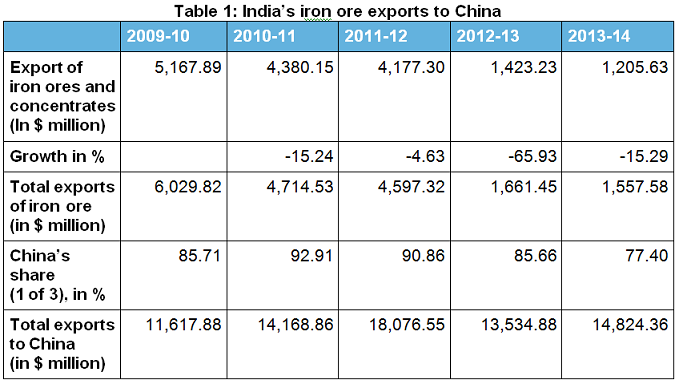
Source: Ministry of Commerce, Government of India [2];

As Table 1 shows, India’s exports of iron ores and concentrates to China have been falling steadily, with the sharpest drop in 2012-13. This was the year that India’s overall iron ore exports also plummeted as a consequence of an expert panel shutting down all 93 mines in Goa after finding serious “irregularities and illegalities”. This came on top of a Supreme Court-mandated blanket ban on private sector iron ore mining in three Karnataka districts (Bellary, Tumkur, and Chitradurga) in the previous year, which was followed up by the Centre imposing a 30% export tax.

In 2014, the Supreme Court lifted the Goa mining ban partially by imposing an annual output cap of 20 million tonnes. The Centre also reduced the export tax for low quality iron ore to 10% in April 2015. The impact of these decisions on exports will become evident over the next few months.

However, Zhao’s contention seems a little laboured when viewed through the lens of overall India-China trade figures. The data doesn’t seem to validate his argument.


As Table 2 shows, India’s exports to China suffered a severe setback in 2012-13 and dropped by $4,541.67 million. This is also the year that iron ore exports to China suffered a pronounced drop. On first look, therefore, the fall in overall exports can be attributed to a drop in iron ore exports.

But that would be a mistake. That’s because the drop in ore exports to China is only $2,754.07 million—and this means that China did not buy $1,787.6 million of other goods that year.

India’s exports have continued to languish thereafter, with the provisional data for 2014-15 showing a precipitous drop in export receipts from China: overall exports are unfortunately back to 2009-10 levels. However, there has not been a concomitant drop in China’s exports to India; in fact, it is quite the opposite, with provisional numbers showing a sharp recovery in China’s exports to India.

So, if India’s exports have been falling each passing year, while China’s have grown apace, leading to an unsustainable trade deficit, surely it has to do more with reasons other than dwindling iron ore exports.

It would have been only fair if Zhao had also mentioned India’s abiding contention: the tariff and non-tariff barriers (such as phytosanitary standards) that China imposes on Indian exports of pharmaceuticals, agri-products, or IT enabled services. Zhao should have also enlightened the Forum about India’s insistent demands for simplification and greater transparency in China’s procedures related to registration, inspection, and approvals of imports from India. Otherwise Zhao is presenting only half the picture.

References

[1] Parliament Questions to Department of Commerce, Ministry of Commerce and Industry, Government of India, P 10, 13 May 2015, <http://commerce.nic.in/pquestion/RS20150513.pdf>

[2] Department of Commerce, Ministry of Commerce and Industry, Government of India, Export Import Data Bank, < http://commerce.nic.in/eidb/ecomxcnt.asp>

[3] Department of Commerce, Ministry of Commerce and Industry, Government of India, Total Trade, <http://www.commerce.nic.in/eidb/iecnt.asp>

This article was originally published in Gateway House (http://goo.gl/ff02Nv)

Wednesday, 27 May 2015

Is the ‘Modi Premium’ Wearing Off in the Stock Markets?

As Modi completes one year in office, a sense of despondency pervades the customary reviews that ritually accompany such an event. Rumblings of discontent have emerged from various stakeholders and stock markets have taken the lead in signalling disappointment with his performance.


As Prime Minister Narendra Modi completes one year in office, a sense of despondency pervades the customary reviews that ritually accompany such an event. Rumblings of discontent have emerged from various stakeholders, including Corporate India. But it is the stock markets that seem to have taken the lead in signalling disappointment with his performance.

The bellwether index S&P BSE Sensex, comprising 30 stocks, has witnessed a major erosion in values over the past few weeks. From its all-time peak of 29,681.77 points achieved on January 29, 2015, the Sensex hit a low of 26,599.11 on May 7: a sharp drop of 3082.66 points (or 10.38%) in slightly over three months.

The capital market’s rebuff is symbolic: it tries to aggregate what’s going on in different parts of the economy and transmits its sentiment through one single number. And going by its recent behaviour, there seems to be plenty that is wrong, or perceived to be wrong.

Foreign portfolio investors, an influential investor segment in the capital markets, are a visibly disgruntled lot and they have been letting off steam by selling en masse. In the first 10 trading days in May (till May 18), FPIs were net sellers to the extent of $2.306 billion. FPIs enjoy disproportionate influence over Indian capital markets, primarily because they bring larger volumes to bear than domestic institutions. Low retail participation in the capital markets — either directly or indirectly — also keeps Indian markets shallow.


Tax uncertainties


These FPIs decided to head for the exit because of continuing tax uncertainty. Finance minister Arun Jaitley’s 2015-16 Budget had unequivocally clarified that tax will not be levied on the capital gains of FPIs in the current year. But, unfortunately, there was no assurance that past cases won’t be re-assessed. And, true to form, tax authorities sent notices to various FPIs to pay up for past gains. That precipitated widespread resentment, with some FPIs even going to court and, of course, venting their spleen by selling Indian stocks.

The minister, presumably rattled by the exodus and the bad publicity all this was generating, has gone out of his way to placate FPIs. Apart from putting all reviews and fresh cases on hold, he resorted to the time-tested stalling tactic: he appointed a committee. In effect, he has kicked the can down the road and bought some time. This incident also illustrates how FPIs have emerged as a crucial constituency, with an uneven share-of-voice.

Unsatisfactory corporate results is the other reason why Sensex is volatile. Many companies — especially in the mid-cap segment — have reported disappointing results for 2014-15, signifying that demand for goods and services continues to remain weak. A report in Mint has highlighted how Q4FY15 sales of 142 companies included in BSE-500 (and for which results were available) has grown at the slowest pace in 16 quarters since Q1FY11.

This is evidence that the economy is still far from recovery. The Index for Industrial Production has grown by only 2.8% during 2014-15. Consumer durables manufacturing contracted by 12.5% during the year, compared with 2013-14, signifying the lack of purchasing power in the economy.

Matters have been made worse by the unseasonal rain in many parts of the country this year, destroying hectares of standing crop, which typically comes to the farm markets in April. This is likely to further dampen demand for consumer goods in the rural areas. The stock markets are also trying to capture this trend.


Oil prices fall opportunity lost


One can argue that this is sheer bad luck and the government cannot be held responsible for this catastrophe. While that is true, it is also a fact that the government didn’t rush to reap the dividends of fortuitously low oil prices when it came to power. Since then oil prices have climbed 50%, spooked by the continuing West Asian crisis and some shale oil wells in USA shutting down.

There could be another charitable explanation for the unusually turbulent Sensex: that expectations from PM Modi might have raced way ahead of reality, especially after the depressing paralysis that gripped the economy in UPA-II’s second term. The common beef (pun intended) is that even the current BJP-led government has plumped for incrementalism, rather than bold policy measures they had promised.

There are two sides to this debate and both can be deemed valid. But, what is undeniably true is that the stock market has already started discounting PM Modi’s premium, even before he completes a full year in office. And, though the Sensex is still up 14.78% from where it was a year ago — it closed at 27,687 on May 18, 2015, compared with 24,121.74 on May 16, 2014 — it seems that market participants have already watered down their expectations and moderated their hopes about a magical, almost fantastical, turn-around in the economy.


Courtesy:


Published first in The Wire (http://thewire.in/2015/05/19/is-the-modi-premium-wearing-off-in-the-stock-markets/) on May 19,

and then subsequently reprinted in 

Gateway House (http://www.gatewayhouse.in/is-the-modi-premium-wearing-off-in-the-stock-markets/) on same day.