Showing posts with label Rajya Sabha. Show all posts

Wednesday, 5 April 2017

NPAs: The New Wedge in Centre-State Relations

NPAs are expected to acquire a two-tier, federal character with enormous implications for Centre-state relations

There was jubilation in stock markets recently after finance minister Arun Jaitley hinted at a scheme to sort out the messy tangle of bad loans in the banking sector. The equity market’s optimism beggars belief because NPAs—or non-performing assets, as bad loans are called technically—have remained impervious to an alphabet soup of previously attempted schemes. And now, NPAs are expected to acquire a two-tier, federal character with enormous implications for Centre-state relations.

In the post-1991 era, multiple schemes have been conceived and launched to tackle the menace of NPAs: DRTs (debt recovery tribunals, as suggested by Narasimham Committee-I and then subsequently amended in 2012), CDR (corporate debt restructuring), SARFAESI Act (Securitisation and Reconstruction of Financial Assets and Enforcement of Security Interest), CRILC and JLF (Central Repository of Information on Large Credits and Joint Lenders’ Forum), 5/25 scheme, ARC restructuring (asset reconstruction companies, formed as a consequence of DRTs), SDR (strategic debt restructuring), AQR (asset quality review), S4A (scheme for sustainable structuring of stressed assets) and finally the IBC (Insolvency and Bankruptcy Code).

There are multiple reasons for many of these schemes failing, which includes an inadequate legal framework for pursuing resolution; however, the one reason that remains unchanged from pre-reforms period is final policy design always providing corporate borrowers enough protection so that they can reprise the same act all over again. And while public attention has focused on Vijay Mallya—deservedly of course—there are other larger industrial groups which are habitual offenders but manage the system adroitly. Former Reserve Bank of India (RBI) governor Raghuram Rajan was compelled to state: “…it is extremely important that banks do not use the new flexible schemes for promoters who habitually misuse the system (everyone knows who these are) or for fraudsters.”

This raises issues of “moral hazard”; in the Indian context, moral hazard has taken the form of corporates or public sector banks undertaking increasingly riskier behaviour because they know the government is underwriting that risk or bearing the cost of that risk. Post the 2008 financial crisis, moral hazard has acquired some flexibility globally: it has become acceptable to bail out institutions if government feels such failure can lead to widespread systemic risk.

This may have inspired finance ministry’s chief economic advisor Arvind Subramanian to blithely suggest that government should perhaps bail out large corporate borrowers because that is how “capitalism works”. He feels only write-offs can sort out the “mountain of debt” sitting on bank books, or settle the twin-balance sheet problem (over-leveraged companies and NPA burdened banks). 

Interestingly, Subramanian has also contributed to the NPA soup cauldron: the annual economic survey recommends the creation of PARA, or Public Sector Asset Rehabilitation Agency. Not to be left behind, even RBI’s recently appointed deputy governor Viral Acharya has gamely added his two-bit: PAMC (Private Asset Management Company) and NAMC (National Asset Management Company).

So, while attempts are being made to untangle the knotted skein of corporate bad loans, albeit through an ever-growing thicket of acronyms, Jaitley has at the same time flatly turned down requests for farm loan waivers. He has received wide support. State Bank of India chairman Arundhati Bhattacharya has warned that fulfilling such pre-election promises might lead to dilution of credit discipline: borrowers might tend to defer repayment till the next elections in the hope of loan waivers. This newspaper also recently pointed out that the Indian agricultural sector needs long-term structural investments, not short-term exchequer-funded loan waivers. There is merit in each of these arguments.

But, here’s a catch: the ruling Bharatiya Janata Party also promised farm loan waivers in its Uttar Pradesh assembly election manifesto. Having won the elections and faced with the prospect of fulfilling that promise now, Jaitley has used an escape hatch to wriggle out of the commitments. Answering the debate on Finance Bill in Rajya Sabha, he has asked individual states to foot the bill for farm loan waivers. He has effectively created a two-tier, federal, moral hazard framework: Centre’s responsibility to bail out large corporates and states get to write off farm loans.

This further complicates attempts at creating a long-term, sustainable set of solutions for controlling and resolving the financial system’s NPAs. It also adds new headaches to the already vexed Centre-state relations. Competitive waiver promises have already weakened the fragile balance sheets of Andhra Pradesh and Telangana. 

It also raises issues of discrimination. If the Centre wants to bail out some 30-40 large corporate borrowers on the pretext that their debt misery was the outcome of external shocks, does not the same logic or argument apply to farm loans, especially since many states have been victims of droughts, inadequate monsoons and crop failures? There is no doubt the NPA mess needs to be resolved urgently to kick-start investments and the growth process. But then, that solutions framework cannot be built on the foundation of discrimination and selective relief.

The above article was published in Mint newspaper and can also be read here

Thursday, 11 August 2016

Key GST Lessons From The World

The long march to implement the long-awaited Good and Services Tax in India has just begun. It is instructive to understand how other countries introduced this tax and cherry-pick lessons from their experiences


As India gets ready to celebrate the 70th anniversary of its independence, it is also preparing for another important milestone. Great hopes have been pinned on the Goods and Services Tax (GST), which will liberate Indian citizens from the tyranny of multiple levies and tax rates. This tax will unite almost all state and central indirect taxes into one single category, thereby creating a true single market in the country.

The passage of the Constitution (122nd amendment) Bill on 3rd August in the Rajya Sabha marks the crossing of the first hurdle in implementing the transformational GST regime. However, there is still substantial legislative work to be done – apart from the amendment (which will now travel to the Lok Sabha, the President’s office and state assemblies for ratification), Parliament will have to vote in two further bills to make GST a reality.

Beyond the legislative workload, Indian administrators and businesses will need to do their homework before this reality sets in. There are approximately 140 countries in the world that have introduced GST (also called VAT, or Value Added Tax), and there are manifold lessons to be drawn from their respective implementations.

Malaysia was the most recent country to implement GST in 2015, having announced its intention to do so in 2009. Malaysia’s experience highlights how inadequate preparation can hamstring the tax’s speedy implementation from the outset.[i]Malaysian businesses and tax authorities had a harrowing time adjusting to the new system, which was riddled with uncertainties and teething problems. The Malaysian government had to contend with street protests by small businesses and traders who were confused by the new system—whether in calculating the correct value-added rates, or in seeking tax credit refunds. Unsurprisingly, opposition political parties found it opportune to fish in these troubled waters, adding to the government’s mounting operational woes.[ii]

There was another layer of complexity. Malaysia had a multiple GST rate structure, much like the one proposed in India. A 6% GST (among the lowest in the world) was introduced, with some essential goods exempted and some goods attracting a zero rate i.e they were not exempt and could be taxed later. India too has proposed a multi-tiered structure, which will be finalised by the GST Council whenever it is set up.

Two clear lessons emerge from the Malaysian experience. Under pressure to launch GST as soon as possible, the Indian government must resist temptations to truncate the implementation process, which will include the training of tax officers and business executives. A presentation by revenue secretary Hasmukh Adhia estimates that 60,000 tax officials in both central and state governments will need to be trained.[iii] GST is a tectonic shift in the indirect tax architecture: the point of taxation shifts from producers to consumers, requiring a significant reorientation in philosophy and perspective. This overhaul cannot be completed unless the technology backbone is in place and all the relevant economic agents are registered. That alone is a mammoth task. There should, therefore, be no compulsion to implement GST by April 2017 if either the system is not fully tested or all the pieces are not firmly in place.

A related issue almost tripped up Malaysia’s GST experiment: the timely payment of input tax credit refunds.[iv] Unless the necessary technology infrastructure is installed, it can take months to refund tax credits, thereby creating cash flow problems for all links in a supply chain. This can easily convert GST supporters into detractors. Delaying tax credit refunds leads to protracted litigation and provides perverse incentives for the supply chain to stay outside of the organised system.

A second set of lessons can be drawn from Singapore. The city-state introduced GST in 1994 but witnessed a sharp rise in inflation soon after its introduction, mirroring the experience of many other countries.[v] Although inflation rates tend to moderate after a couple of years, the Indian government must be prepared for an initial surge because of India’s unique supply-side pressures, which tend to firmly embed inflationary expectations in households and businesses. India can consider what many countries did: initiate anti-profiteering measures at the retail level to protect consumers from price gouging.

Subsequently, the Singapore government faced other predicaments, like t the need to increase GST rates without stoking inflationary pressures. Eventually Singapore did increase GST rates (from 3% in 1994 to 7% currently), but simultaneously cut income tax rates (both at the individual and corporate levels) and accelerated the delivery of welfare benefits to lower income sections.[vi] While GST is efficient, it can also be regressive, especially for low income workers or pensioners. The Indian government therefore needs to be cognisant of this, and act cautiously.

The final set of lessons come from Canada, which introduced GST in 1991 amidst great internal conflict and disagreement. In fact, at the tax’s introduction, three provinces–Alberta, Ontario and British Columbia–even sued the federal government for violating constitutional agreements and limits. But over the years, Canada has pioneered a unique system that allows for three different models to co-exist.[vii] [viii]For example, Quebec is permitted to administer its own value-added tax alongside a federal GST. Quebec is responsible for all tax administration in the state, independently determining its tax base, independently fixing the state VAT rate, and even remitting federal GST collected in the state to the central government for a fee.

Compared to Canada, India has been able to forge a broad consensus among most states through a process of negotiation and compromises. The only point of disagreement remains the GST rate, which has been entrusted to the GST Council. This may lead to intense political manoeuvring with demands for special status or special rates. Tamil Nadu has already expressed its dissatisfaction with GST.

These examples clearly illustrate that the GST battle has barely begun: there are many mountains to climb, and multiple fires to extinguish along the way. The process of bipartisan consultation and consensus-building with states and various stakeholders must continue to make GST a cornerstone of successful and sustainable fiscal federalism.

This feature was exclusively written for Gateway House: Indian Council on Global Relations. You can also read it here.

References

[i] Pachisia, Vivek; Lessons from countries that have implemented goods and services tax; Financial Express; July 28, 2016;http://www.financialexpress.com/economy/gst-lessons-from-countries-that-have-implemented-the-goods-and-services-tax/331289/

[ii] Dey, Sudipto; Some Lessons From Malaysia That India Can Use; Business Standard; New Delhi; June 13, 2015; http://www.business-standard.com/article/economy-policy/gst-some-lessons-from-malaysia-that-india-can-use-115061300748_1.html

[iii] Adhia, Hasmukh; Goods and Services Tax: Next Steps; Department of Revenue, Ministry of Finance, Government of India; New Delhi; August 4, 2016;http://finmin.nic.in/press_room/2016/GST_nextstep_04082016.pdf

[iv] Beh, Yvonne & Tan Yi Lin; GST In Malaysia: One Year On; Wong and Partners; April 2016;http://www.wongpartners.com/files/Uploads/Documents/Type%202/WP/al_kulalumpur_gstmalaysia_apr16.pdf

[v] Ilias, Suhaimi with Zamros Dzulkafli, Ramesh Lankanathan and William Poh; Malaysia: GST- Early Impact Assessment; Maybank KimEng; April 2015;http://info.maybank2u.com.sg/pdf/investment-insurance/misc/misc-15-04-15-3.pdf

[vi] Singapore Government; How Is the Government Helping to Mitigate Inflation in Singapore; December 14, 2012; https://www.gov.sg/factually/content/how-is-the-government-helping-to-mitigate-inflation-in-singapore

[vii] Kumar, Sanjay with ML Sukhpal, Sandeep Rawal, Ashok Kr Pandey, Samar Nanda; Policy Paper on Role of Central Board of Excise and Customs in GST; National Academy of Customs, Excise and Narcotics;http://nacen.gov.in/inspire/uploads/downloads/569887ea212d1.pdf

[viii] Sharma, Radheshyam with JK Simte, MK Sarangi, KGVN Surya Teja, Sydney D’Silva and Manish Thapliyal; How to achieve administrative harmony between centre and states in the GST regime; National Academy of Customs, Excise and Narcotics; January 6, 2016;http://nacen.gov.in/inspire/uploads/downloads/56989a961d524.pdf

Friday, 5 June 2015

India-China Deficit: Beyond Iron Ore

A distinguished Chinese scholar, speaking at a BRICS forum in Moscow recently, ascribed the growing India-China trade deficit to India’s ban on iron exports. While this contention is partially true, the data does not validate this argument, and nor does his view account for the other reasons for the deficit


India’s growing trade deficit with China has become a permanent fixture in all bilateral discussions held between the two countries. The gap has been increasing and, according to provisional data for 2014-15 presented to the Rajya Sabha, the gap is now over $48 billion. [1]

This concern was also voiced at the VIIth BRICS Academic Forum held recently in Moscow, especially during a break-out session on ‘Trade: Integrity of the Rules-Based Trade Regime and BRICS Role’.

The Chinese scholar on the panel for this session—Zhao Zhongxiu, dean of the School of International Trade at the University of International Business and Economics, Beijing— provided a rationale for the large trade deficit. He said the deficit was due to India’s ban on exports of iron ore.

Zhao’s contention is valid to some extent—courts in India have been imposing varying levels of embargo—either area-specific or by occasionally capping output—on iron ore mining and exports since 2010, aimed at curbing illegal mining and clandestine exports.

But Zhao’s explanation is only partially true—various other reasons have been adduced in the past for the growing trade deficit between the two countries.

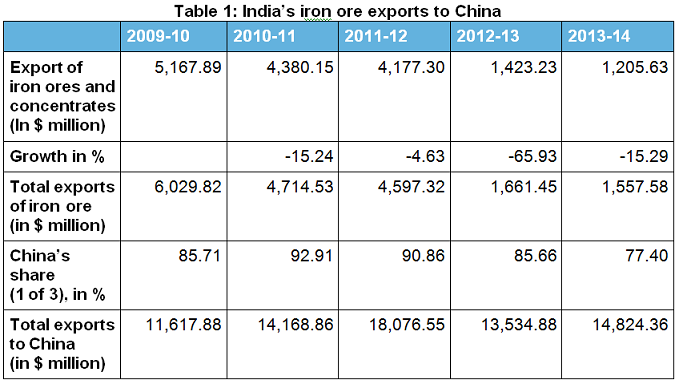
Source: Ministry of Commerce, Government of India [2];

As Table 1 shows, India’s exports of iron ores and concentrates to China have been falling steadily, with the sharpest drop in 2012-13. This was the year that India’s overall iron ore exports also plummeted as a consequence of an expert panel shutting down all 93 mines in Goa after finding serious “irregularities and illegalities”. This came on top of a Supreme Court-mandated blanket ban on private sector iron ore mining in three Karnataka districts (Bellary, Tumkur, and Chitradurga) in the previous year, which was followed up by the Centre imposing a 30% export tax.

In 2014, the Supreme Court lifted the Goa mining ban partially by imposing an annual output cap of 20 million tonnes. The Centre also reduced the export tax for low quality iron ore to 10% in April 2015. The impact of these decisions on exports will become evident over the next few months.

However, Zhao’s contention seems a little laboured when viewed through the lens of overall India-China trade figures. The data doesn’t seem to validate his argument.


As Table 2 shows, India’s exports to China suffered a severe setback in 2012-13 and dropped by $4,541.67 million. This is also the year that iron ore exports to China suffered a pronounced drop. On first look, therefore, the fall in overall exports can be attributed to a drop in iron ore exports.

But that would be a mistake. That’s because the drop in ore exports to China is only $2,754.07 million—and this means that China did not buy $1,787.6 million of other goods that year.

India’s exports have continued to languish thereafter, with the provisional data for 2014-15 showing a precipitous drop in export receipts from China: overall exports are unfortunately back to 2009-10 levels. However, there has not been a concomitant drop in China’s exports to India; in fact, it is quite the opposite, with provisional numbers showing a sharp recovery in China’s exports to India.

So, if India’s exports have been falling each passing year, while China’s have grown apace, leading to an unsustainable trade deficit, surely it has to do more with reasons other than dwindling iron ore exports.

It would have been only fair if Zhao had also mentioned India’s abiding contention: the tariff and non-tariff barriers (such as phytosanitary standards) that China imposes on Indian exports of pharmaceuticals, agri-products, or IT enabled services. Zhao should have also enlightened the Forum about India’s insistent demands for simplification and greater transparency in China’s procedures related to registration, inspection, and approvals of imports from India. Otherwise Zhao is presenting only half the picture.

References

[1] Parliament Questions to Department of Commerce, Ministry of Commerce and Industry, Government of India, P 10, 13 May 2015, <http://commerce.nic.in/pquestion/RS20150513.pdf>

[2] Department of Commerce, Ministry of Commerce and Industry, Government of India, Export Import Data Bank, < http://commerce.nic.in/eidb/ecomxcnt.asp>

[3] Department of Commerce, Ministry of Commerce and Industry, Government of India, Total Trade, <http://www.commerce.nic.in/eidb/iecnt.asp>

This article was originally published in Gateway House (http://goo.gl/ff02Nv)