Showing posts with label China. Show all posts

Monday, 5 March 2018

One Local and Three Global Risks Facing India

As India lurches towards the 2019 general elections, it might be appropriate to list some of the risks that confront the country


The beginning of a new year usually sees think tanks and insurance companies list their version of perceived global risks over the next 12 months. As India lurches towards the 2019 general elections, it might be appropriate to list some of the risks that confront the country.

India’s numerous direct and indirect geopolitical challenges are well known. Some of these are: problems with a mendacious neighbour on the western border; China’s aggressive expansionism and its belligerent posturing in the South China Sea; smouldering conflicts between Saudi Arabia and Iran and Qatar aggravating; the proxy war in Syria coming to a boil; and tensions further escalating in the Korean peninsula.

War and geopolitical conflicts have persisted throughout modern history and 2018 is unlikely to be an exception. But, India’s primary concerns spring from geo-economics, traditionally neglected in future risk scenarios and risk mitigation frameworks.

Three large risks dominate the landscape and they all impinge on both the fiscal and current account deficits.

The first one is uncertainty over oil prices and India, a large net importer, is directly exposed to this volatility. Slow but certain recovery in the global economy has pushed oil prices from the 2015 lows of $30 per barrel to over $60 now. The future direction of oil prices will be decided in a power play between USA-based shale producers and the informal alliance between the Organization of Petroleum Exporting Countries (Opec) and Russia.

The unofficial Opec-plus arrangement has been successful in cutting oil production and slashing overstocked inventories. As oil prices have risen, record volumes have gushed from the US, threatening to eclipse production from the world’s two largest producers—Russia and Saudi Arabia. There are apprehensions that as prices further appreciate, some other South American oil producers might add to the US flood. This might force the Opec-plus grouping to push for further production cuts which could eventually threaten the agreement. Added to the mix is the risk that energy prices and flows might become the next weapon in the renewed US-Russia conflict.

As things stand, the Opec-plus agreement is scheduled to be reviewed soon and is likely to be extended. Even if they agree to wind down the arrangement, it has to be done in an orderly fashion, without disrupting markets. India is exposed to these volatilities through its reliance on oil imports, and its recent agreement with the United Arab Emirates to construct strategic oil reserves might be a bit too late.

India’s second geo-economic risk emanates from the wave of protectionism that threatens the global economy, particularly the ongoing trade war between the US and China. Apart from real and threatened tariff measures affecting India’s exports to the US, there are indirect consequences also.

The Economist Intelligence Unit notes in a recent publication, Cause for Concern: “Any ramp-up in protectionism would certainly have repercussions beyond North America and China. Prices and availability for US and Chinese products in the supply chains of companies from other nations would be badly affected. Consequently, global growth would be notably curtailed as investment and consumer spending fall back.”

India’s third geo-economic risk originates from a person: Jerome H. Powell, the Federal Reserve chairman. Based on his recent testimony to Congress, markets are sensing greater aggression compared with his immediate predecessor (Janet Yellen) and, consequently, expecting three to four interest rate increases during 2018. This could inject a new degree of turmoil in the markets, especially in the face of what many find unsustainable asset markets. The Reserve Bank of India’s sixth bi-monthly monetary policy statement noted: “Financial markets have become volatile in recent days due to uncertainty over the pace of normalisation of the US Fed monetary policy…The volatility index (VIX) has climbed to its highest level since Brexit.“

India, like many other emerging markets, is particularly vulnerable, given that recent asset market developments are predicated on global capital flows. Any reversal of these flows could spell trouble for not only asset valuations but also future capital raising. The World Economic Forum’s The Global Risks Report 2018 states: “…economic and financial risks are becoming a blind spot: business leaders and policy-makers are less prepared than they might be for serious economic or financial turmoil.”

It would be negligent not to account for risks on home terrain: various state assembly elections in 2018 and general elections in 2019. Governments, on the eve of elections, are tempted to loosen policy restraints, succumb to populist forces and spend more. Another election-related threat looms. Risk Map 2018 from specialist risk consultancy Control Risk states: “A political environment in which parties leverage emotive and controversial social issues for electoral support could foster the spread of adverse nationalist rhetoric, potentially posing risks for foreign businesses in 2018.”

That said, with 16 general elections already under India’s belt, the next one also falls in the business-as-usual category. Therefore, in the balance of risks confronting India, the beyond-border challenges remain trickiest as they run the risk of derailing India’s twin deficits and, as a consequence, critical macro variables like inflation and growth.

The above article was originally published in Mint newspaper and can also be read here

Wednesday, 12 July 2017

The Chinese Encirclement: Within and Without

The recent geopolitical dispute highlights the fraught and schizophrenic nature of the India-China relationship


The recent border dispute has again raised the spectre of Chinese encirclement. It comes close on the heels of India’s boycott of the ambitious Belt and Road Initiative (BRI) summit in China. What is unfortunate, though, is that the dreaded encirclement may have already occurred and, if anything, the recent dispute highlights the fraught and schizophrenic nature of the India-China relationship.

The fresh skirmish at the tri-junction of India, Bhutan and China is part of on-going border tensions. The stand-off continues with both sides raising the temperature gradually, much like the dial on a thermostat; apart from incendiary statements, China recently increased its fleet presence in the Indian Ocean Region. In the past, many similar border misunderstandings were resolved quietly. The latest one burst into the headlines with impeccable timing during Prime Minister Narendra Modi’s visit to the US.

India ignored the BRI summit because it objects to the China Pakistan Economic Corridor (CPEC) which passes through Pakistan-occupied disputed territory. India’s contention is that CPEC is a unilateral validation of Pakistan’s claim on disputed territory. There are other reasons for India’s nervousness. China’s BRI is viewed as a strategic encirclement of India: Hambantota port in Sri Lanka, CPEC traversing west China via Gilgit-Baltistan all the way to Gwadar port in Balochistan, a road from Yunan province cutting through Myanmar to end at a deep-sea port in Kyaukpyu.

But, apart from the geopolitical squeeze, developments seem to indicate that a Chinese geo-economic encirclement may have already happened. While there is popular concern over the overwhelming presence of China-made idols of Indian gods or cheap toys, these are the proverbial iceberg’s tip. What seems to have gone unnoticed is an insidious China creep within the Indian trade, business and financial landscape.

News from the cricket world provides a glimpse: Chinese handset manufacturer Vivo won rights to cricket tournament Indian Premier League (IPL). Vivo will pay Rs2,199 crore for the next five years, which works out to 267% premium over base price of Rs120 crore a year. The next closest bidder was Oppo, which bid Rs1,430 crore for five years. Vivo’s bid is impressive, when compared to Oppo’s bid or the base price, or even amounts paid by previous sponsors (such as, DLF or Pepsi).

But it’s hard to miss the irony. Brands Vivo and Oppo are actually siblings and manufactured by the same Chinese company, BBK Electronics (which also owns brand One Plus). The IPL bidding process should have treated them as parties acting in concert, though that seems to have been overlooked in the general brouhaha over the money on the table. Chinese handset brands now command over 50% of the Indian smartphone market share.

Here’s another example. Chinese capital goods manufacturers have made deep inroads into India, with some critical sectors now highly dependent on Chinese spares and after-sales servicing. For instance, in the boiler-turbine-generator (BTG) segment, many Indian power producers have installed Chinese BTGs. In the 12th Plan alone, close to 30% of generating capacity was sourced from China, with the trend continuing in the 13th Plan as well. What tipped the scales, apart from shorter delivery windows, was cheap buyers’ credit (through Exim Bank of China), with installation crews and maintenance staff thrown in.

Chinese portfolio investors are the other angle in geo-economic encirclement. Among the list of banks managing the recent Central Depository Services Ltd initial public offering was a curious name: Haitong Securities India Pvt Ltd. Haitong, as per its website, is China’s second largest securities firm. Many of the firm’s senior management members hold, or have held in the past, organizational positions in the Communist Party of China. Haitong gained a toe-hold in the Indian market through its global acquisition of Espirito Santo. But, what is really interesting is that Haitong Securities was the book running lead manager in an IPO in which government-owned banks—State Bank of India and Bank of Baroda—were divesting their shareholding.

The Chinese footprint in the digital economy is also expanding rapidly. Numerous Chinese companies—Alibaba, Tencent, CTrip, Beijing Miteno Communication Technology, Bytedance—have made large investments in the Indian digital ecosystem, a mission-critical segment for Modi and his ministers.

India suffers a trade deficit with China which has increased over the years: from $38.7 billion in 2012-13 to $51 billion during 2016-17. One of the reasons for the large deficit are Chinese tariff and non-tariff barriers which constrain Indian exports; for example, Indian pharmaceutical exports have found it difficult to penetrate the Chinese market. Increased Chinese foreign direct investment was suggested to counter the rising trade deficit. But, there were no discussions on the nature of that investment: whether for manufacturing or for assembly jobs.

It would be hasty, and perhaps imprudent, to advocate slamming the doors or erecting barriers. But it is difficult to ignore the duality in rhetoric from both sides. The high decibel in security and strategic issues seems to be disengaged from trade and investment realities. One key question, therefore, needs to be answered: What kind of cost-benefit is involved in keeping engaged or in disengaging?

The above article was originally published in Mint newspaper and can also be read here

Wednesday, 3 May 2017

Rising Trade Walls and Shrinking Standards

Country after country, especially free trade evangelists, are erecting walls to stop the flow of professionals and human capital

Indian professionals are finding doors across the world shutting, shrinking opportunities to ply their trade. Weaned on a diet of free markets and globalization, they are finding that promise now ringing hollow. Country after country, especially free trade evangelists, are erecting walls to stop the flow of professionals and human capital.

US President Donald Trump carried out his campaign promise on 18 April by signing an executive order overhauling the H-1B visa regime, a programme allowing foreign professionals to work in the US for six years. Indian infotech companies such as Infosys, Wipro and Tata Consultancy Services (TCS) are among the biggest beneficiaries of this programme.

In less than 24 hours, Australia followed suit by revamping the immigration law which allows entry of professionals, titled “Subclass 457 visa”. Australian Prime Minister Malcolm Turnbull’s abrupt about-turn was unexpected. He was in India less than a week earlier, waxing eloquent about India-Australia ties and dispensing homilies about trade between the nations. He even signed off on a joint declaration with Prime Minister Narendra Modi which, among other things, welcomed “…progress in the flourishing knowledge partnership…building on the strong links in higher education, skills development and science, technology and innovation”. The icing was a memorandum of understanding signed with TCS for opening a new innovation lab in Australia, the fate of which could now be uncertain.

What could have happened in less than a week to force such a transformation? Could it be a follow-up to the now-infamous Trump-Turnbull telephone call? Turnbull’s measure, ostensibly designed to undermine rising nationalist right-wing forces at home, has now jeopardized progress on the Comprehensive Economic Cooperation Agreement (Ceca) being negotiated between India and Australia. A Ceca is wider in scope than a free-trade agreement—apart from trade in goods and services, a comprehensive treaty also includes issues like investment, government procurement and competition policy.

Three other prosperous nations have erected barriers of varying degrees—New Zealand, Singapore and the UK. New Zealand’s new work visa rules came a day after neighbour Australia’s. The UK has been tightening its visa rules for some time now. UK Prime Minister Theresa May recently further tightened visa rules for professionals by mandating minimum salary thresholds and language requirements.

India has a Ceca with Singapore which provides for trade in services between the two nations; to avoid breaching the agreement, Singapore has not denied work permits outright but has kept them in extended limbo.

This pandemic of border and behind-the-border barriers to services trade has compelled even World Trade Organization (WTO) director general Roberto Azevêdo to undergird his 2017 cheery trade prognosis with a caveat: “At the domestic level, policies are needed to help support the workers of today and train the workers of tomorrow. Closing the borders to trade would only worsen the situation—it would not bring the jobs back, it would make more jobs disappear.” WTO estimates world trade in 2017 will grow between 1.8-3.6%, but might settle at around 2.4% if world gross domestic product (GDP) growth sticks to projections. WTO also recognizes existence of multiple downside risks, including the sort of knee-jerk protectionist measures implemented by the US and Australia.

There could be a charitable explanation for why these countries are banding together against professional Indian talent. Australia, New Zealand and Singapore may have responded reflexively to the US and UK’s restrictive immigration laws; apprehensive of a spillover from these countries, the three countries might have responded impulsively and hastily.

The more plausible justification is that these moves—particularly by Australia and the US—are perhaps designed to blunt India’s attempts to introduce trade facilitation in services (TFS) agreement, somewhat identical to the trade facilitation agreement (TFA) in goods which came into force in February. According to India’s concept note—introduced in the WTO on 27 September 2016—like the TFA is intended to “…expedite the movement, release and clearance of goods as well as cooperation on customs compliance issues…”, the TFS can result in “…reduction of transaction costs associated with unnecessary regulatory and administrative burden on trade in services”.

India followed up the concept note with an “element paper” in November 2016 and a draft legal text in February 2017. The TFS is also now pitted directly against TiSA, or Trade in Services Agreement, currently being negotiated outside the WTO by 23 members comprising mostly developed countries. It is aiming for an ambitious overhaul of the General Agreement on Trade in Services (GATS), which it hopes will attract more members and eventually be ratified in the WTO. Both India and China (as well as many other emerging nations) are not members. It is, therefore, safe to expect that trade politics and diplomacy will probably focus a lot on services trade in the immediate future, especially at the WTO’s December ministerial in Buenos Aires.

Coincidentally, TiSA was initiated by the US and Australia. Which brings the discussion full circle: Is Australia’s long-term destiny to remain cat’s paw of the US? Its desire to also be identified as an Asia-Pacific community member will call for some tough balancing act then.


The above article was published in Mint newspaper and can also be read here
Wednesday, 22 March 2017

Caught Between The Dragon And The Elephant

India’s trade diplomats will need some deft footwork to manage two trade partners—China and the US

Two large beasts cramp our geostrategic mindspace. One, China’s dragon refuses to vacate our imagination. The second one stirring about in the same space is expected to further cramp room for manoeuvrability. The current US administration, much like the Republican Party’s elephant symbol, is steamrollering global multilateral negotiations. Both these heavyweights present India with a difficult balancing act.

The first inkling of India’s expected high-wire act came from Chile last week when 11 members of the floundering Trans-Pacific Partnership (TPP), all founding nations barring the US, met to revive the plurilateral agreement. An added twist was China’s presence at the meeting.

It is expected that China will step into the US’ large shoes. America’s withdrawal from the TPP was seen as a parting kiss of death since its stewardship had kept negotiations alive. Having invested time, resources and political capital—especially on beyond-the-border issues like labour standards, environment rules and intellectual property laws—many developing countries are loath to let all that work go to waste.

These developments point to the likelihood of an alternative Asia-Pacific trade agreement, perhaps without the trademark TPP markers. Importantly, China was not part of the TPP, which was seen as an instrument and extension of the US’ strategic power. While it is still early to predict how it will all shape up, hopes are the new pact will be built on the back of Latin America’s four-country Pacific Alliance and South-East Asia’s Regional Comprehensive Economic Partnership (RCEP).

India is part of the RCEP trade and investment initiative being negotiated between 16 countries—10 countries from the Association of South-East Asian Nations (Singapore, Malaysia, Thailand, Indonesia, Cambodia, Vietnam, Laos, Myanmar, Brunei and the Philippines) and six others with which the regional grouping has a free trade agreement (India, China, Japan, South Korea, Australia and New Zealand). Many of these nations are also TPP members. The RCEP provides India an opportunity to stamp its strategic and economic presence across the Asia-Pacific. It also provides India an opportunity to bring multilateralism back to centre stage.

But here’s the thing. With China assuming leadership of the RCEP and the putative Asia-Pacific alliance, the world will be keenly watching the shape of the new trade and investment agreement, especially who gets to set standards and the nature of standards finalized. The TPP’s insistence on standardized labour, environment and intellectual property right (IPR) regulations (apart from a host of other issues) conflicted with notions of sovereignty.

The question now is: Will China impose similar standards?

While China has publicly endorsed World Trade Organization (WTO)-compatible trade agreements, will it cherrypick rules? India and China share an uneasy geostrategic relationship, especially in trade. India’s three-tiered tariff proposal for the RCEP has already met with disapproval and India’s push for inclusion of trade in services faces multiple headwinds.

In the other corner, the US’ browbeating at the recently concluded G20 meeting in Germany provides a glimpse of forthcoming challenges to the existing world trade order and globalization. During the drafting of the final communiqué, the US bullied all members to drop pro forma references to free trade and protectionism. Not surprisingly, all members complied, though they did grumble in private.

US President Donald Trump’s administration has repeatedly emphasized that it prefers bilateral agreements over multilateral compacts. The 2017 Trade Policy Agenda makes it official: “The overarching purpose of our trade policy…will be to expand trade in a way that is freer and fairer for all Americans…these goals can be best accomplished by focusing on bilateral negotiations rather than multilateral negotiations—and by renegotiating and revising trade agreements when our goals are not being met.”

India does not have a free trade agreement with the US and negotiations over a bilateral investment treaty between the two countries is stuck over, among other things, the investor-state dispute system. IPR laws are the other thorn in the relationship: India claims its IPR regime is compliant with the WTO’s Agreement on Trade-Related Aspects of Intellectual Property Rights while the US insists on a WTO-plus framework. This has prompted the US to unilaterally include India in its “Priority Watch List” under Special 301.

The trade agenda outlines the future course of the bilateral: “Although existing Indian trade and regulatory policies have inhibited an even more robust trade and investment relationship, India’s economic growth and development could support significantly more US exports…In 2017, the United States will press India to make meaningful progress…on intellectual property rights, promoting investment in manufacturing, agriculture, and trade in goods and services.”

This, in short, is the dilemma. India’s geostrategic ambitions include RCEP membership but it will have to contend with China’s growing heft and increasing pressures to further reduce tariffs. India’s trade deficit with China is growing every year and shows no signs of reversing. On the other hand, India’s support for multilateralism will have to contend with the US’ insistence on bilateral treaties and a re-examination of all existing trade relations. Ironically, India enjoys a trade surplus with the US—in 2015, it touched $30 billion. India’s trade diplomats will need some deft footwork to manage these two trade partners and contradictions.

The above article was published in Mint newspaper and can also be read here 

Tuesday, 10 January 2017

Rex-T: Sharp Edge of Donald Trump’s Foreign Policy

Donald Trump’s choice for secretary of state, Rex Tillerson, is an old oil hand; do not be surprised if his statecraft leads to fresh geo-strategic conflagrations

A small spark can light up an entire forest and leave it wreathed in smoke and ashes for days. They say the flapping of a butterfly’s wings translates into weather changes halfway across the world. Nassim Nicholas Taleb pulled out a black swan from his risk bucket to explain hard-to-predict catastrophic events.

Will there be one careless spark, a languid butterfly or a black swan to distinguish 2017? Some events of 2016—Brexit, Donald Trump’s surprise election victory, oil prices creeping up, boardroom brawls at Bombay House and demonetization—will continue to influence developments in 2017. But this being the merry season for compulsive crystal gazing, here’s hazarding a wild guess about one risk element that might set 2017 apart.

It’s called Rex-T: US president-elect Trump’s choice for secretary of state, Rex Tillerson. He’s not to be mistaken for the Jurassic carnivorous dinosaur; but he’s also not quite the cardboard character from a Steven Spielberg movie set. An Exxon lifer and chief executive officer, Rex-T has been described, variously, as a deal-maker, a hard-boiled negotiator, an inveterate networker. In selecting Rex-T for the position, Trump is bringing the oleaginous mix of history and politics back to centre stage after almost a century.

Exxon Mobil CEO Rex Tillerson, Donald's Trump's choice for secretary of state. Photo credit: Reuters

Anthony Sampson’s classic The Seven Sisters: The Great Oil Companies And The World They Shaped describes how oil multinational corporations exercised inordinate heft in shaping early 20th century geopolitics: “The (US) government…preferred to use the oil companies, at a discreet distance, as the instruments of national security and foreign policy.” Texaco, Exxon, Standard Oil, BP, Shell, Gulf Oil and Mobil carved up vast territories in the Middle East, left behind by a retreating Ottoman empire, between themselves for oil concessions; occasionally, they even helped the US state department or British foreign office redraw political boundaries to suit business interests. Rex-T’s appointment rekindles suspicions of close links between oil and US statecraft.

The first risk arises when the US Senate foreign relations committee meets to confirm Rex-T’s appointment, which will then have to be endorsed by the entire Senate. It is speculated that this could be in jeopardy, given Rex-T’s Exxon background, the company’s business interests in Russia and the man’s proximity to Russian President Vladimir Putin. Many Republican senators have voiced their discomfort with Trump’s choice of the US’ future foreign policy architect: too compromised, too close to the enemy. If the confirmation falls through, events can take a different turn. That’s a risk in the unknown-unknown category because Trump’s backup choice is not known.

Assuming Rex-T obtains the confirmation, the state department can be expected to follow a certain policy trajectory. At this point, it might be safe to assume that part of Rex-T’s foreign policy design will be influenced by three chief factors: his oil background (having worked in Exxon all his life), his company’s Russian assets, rendered uneconomic by US-imposed economic sanctions, and his close friendship with Putin.

It might also be realistic to expect that Rex-T will bring two economic sanctions back into play: Russia and Iran. The US will probably relax economic sanctions against Russia, as Trump has hinted several times. The noose regrettably tightens in Iran’s case. A huge question mark looms over how Trump will follow through with the US’ recent extension of the Iran Sanction Act, which was expected to lapse at December-end. The renewal provides Trump with a window to reimpose punitive sanctions if he is convinced that Iran is violating the Joint Comprehensive Plan of Action signed with the US, France, Germany, China, Russia and the UK. Incensed by the renewal, Iran is already threatening to build a nuclear submarine.

Will Rex-T be the spark that ignites this risk? Consider this: The Organization of the Petroleum Exporting Countries’ (Opec’s) members and non-members (primarily Russia) recently agreed to cut oil output. This had an immediate impact: Oil prices moved up sharply. Also consider this: Trump has promised to revive the US’ shale oil and gas industry, asserting during his campaign that this will create two million jobs. This additional output could potentially depress prices again.

The only way to keep prices up is to take out a large producer from the equation. And that could be Iran. The country’s oil exports, which dropped to a low of almost 1.1 million barrels per day (mbd) in 2013, is now back to almost 2.5 mbd on the back of almost 4 mbd of production. However, low oil prices have deterred revenue from reaching pre-2011 levels. Iran, which has so far refused to heed any Opec call for production cuts, seems to have finally agreed during November’s 171st ministerial conference in Vienna to reduce production marginally.

On the stump, Trump repeatedly railed against Iran and carped about the nuclear deal; vice-president-elect Mike Pence even threatened to “rip” it up. Will Rex-T be the sharp edge of this machete, to keep oil prices high and revive his old company’s sunk investments in Russia? Closer home, high oil prices further compromise India’s fiscal fragility. 

There is an even chance that Rex-T will baulk and this risk won’t play out. But, then, Trump has introduced another known-unknown to the equation: Peter Navarro, a well-documented China-baiter, as head of the White House National Trade Council. If Trump’s administration does initiate the promised trade war with China, that’s another future wrinkle for the global economy.

On that note, wish you all a happy 2017!

The above article was first published in Mint newspaper on December 28, 2016. It can also be read here.

Wednesday, 5 October 2016

India’s Disenchantment with Multilateralism

India’s initial enthusiasm for multilateralism stemmed from the belief that the global economic governance system would take on board emerging economies’ concerns


India’s decision to pull out of the South Asian Association for Regional Cooperation (Saarc) summit in Islamabad marks a new milestone in the country’s growing disaffection with regional and multilateral groupings. This discontent was most visible at the G20 summit, which it used for some unsubtle political messaging. Its near-perfunctory chairmanship of the eighth Brics (Brazil, Russia, India, China, South Africa) summit raises further questions about its interest in multilateralism.

Is there an impending shift in India’s multilateral policy framework, in much the same way that the recent “surgical strikes” pushed the strategic restraint doctrine? Will the current administration give politics greater weightage in its external policies, which till now had an economic focus? Welcome to the post-Uri policy configuration.

The future of Saarc, perennially hostage to the hyphen dividing India and Pakistan, is now further jeopardized, with Bhutan, Bangladesh, Afghanistan and Sri Lanka joining India in boycotting the Islamabad summit in November.

The low-key run-up to the eighth Brics leadership summit, scheduled on 15-16 October in Goa under India’s chairmanship, further reveals the political leadership’s fatigue with such associations. Hopefully, this will be reversed when the Brics leaders get together.

India’s stand at the latest G20 summit in Hangzhou also betrayed frustration, with Prime Minister Narendra Modi highlighting Pakistan’s export of terror. This would have seemed logical at any other global gathering, but the G20’s purpose is fostering global financial stability and economic cooperation, not airing political differences. But then, isn’t economics also about politics?

Modi’s outburst against Pakistan at a China-curated G20 summit was strategic. China has repeatedly blocked India’s attempts to enforce a UN-sponsored ban on Jaish-e-Mohammad chief Masood Azhar. In addition, Beijing is going ahead with the China-Pakistan Economic Corridor, a vital component of the One Belt, One Road initiative, which plans to pass through contested territory in Pakistan-occupied Kashmir despite India’s reservations. The last straw perhaps was China’s public opposition to India’s entry into the Nuclear Suppliers Group. India also denied China some moments of glory in Hangzhou: It refused to ratify the Paris climate accord there.

There’s also growing global disenchantment with the G20, with the weak structural engineering of this alignment now becoming slowly visible. The Hangzhou summit communique reads much like its predecessors’. It included all the well-intentioned, oft-repeated noises about policy coordination, economic growth, governance, development, inequality. Here’s the problem: The communique lacks a credible path to policy action, or any quantifiable targets. Similar communiques in the past have also helped create an atmosphere of scepticism. For example, the 2014 Brisbane summit had announced a policy framework for increasing global gross domestic product by an additional 2% by 2018, predicated on large-scale infrastructure investments. The International Monetary Fund’s staff note for the 2016 summit says the target looks unattainable because of low investment rates in most advanced economies. Consequently, analysts are rushing to publish the G20’s untimely obituary (goo.gl/57hQsn).

The G20’s shaky foundations can be traced to the circumstances of its birth. It was created in 1999—primarily as a reaction to the 1997 Asian financial crisis—as a platform for finance ministers and central bankers to discuss international financial and monetary policies, global economic trends and reform of multilateral financial institutions. In November 2008, then US president George W. Bush invited global leaders to Washington, DC to discuss a coordinated global response to the financial crisis. This became the G20’s first leadership summit, and provided the defining character of its birth: a fire-fighting unit masquerading as a global policy coordination body.

Logically, therefore, once the immediate hump of the crisis was crossed, the G20’s utility seemed diminished. Some good examples are the US’ disregard for policy coordination preceding the taper tantrum, resulting in tough times for emerging economies—and the slow progress in reforming the shareholding of Bretton Woods institutions.

The director of Globality Inc., Rebecca Liao, writes in Foreign Affairs: “Instead of coordinating economic policy among the world’s wealthiest countries, it (G20) broadened its scope to include climate change, investment initiatives, and human rights. Since its members are largely unable to come to a meaningful consensus on this expanded range of issues, the G20 then became a think tank of sorts.”

India’s enthusiasm for multilateralism stemmed from the belief that the global economic governance system would take on board the concerns of emerging economies. That hope now looks dashed, with slow progress on most issues. Add to that India’s concerns on terrorism going unheeded on global multilateral platforms. Consequently, it is quite likely that India’s policy architecture might acquire a slight bias towards bilateralism, given Modi’s predilection for one-on-one engagement with world leaders. There are also some indications of the foreign policy needle shifting slightly towards politics.

This column was originally written as an Op-Ed for Mint newspaper and can be read here 

Thursday, 7 April 2016

Going Global? Study Tata Steel First

All Indian companies planning to go global should closely follow the saga of Tata Steel’s UK plants; it’s a masterclass on how intimately business is intertwined with geopolitics and geoeconomics


An epochal event, that should resonate for every globalised Indian business, brought down the curtains on an eventful 2015-16. In the last fortnight of March, Tata Steel declared[1] that it will sell off or mothball its U.K. steel plants. The event contains a lesson for every Indian business aspiring to go global; it also has immense geo-economic and geo-political repercussions.

Tata Steel’s momentous decision is in keeping with the general trend of Indian companies selling off overseas assets to either repay debt or exit low-yielding assets. Tata Steel’s decision seems to be a combination of both. Here are some other examples of Indian companies selling overseas assets:

* Reliance Industries sold its Eagle Ford shale oil field in the U.S.A. for $1.07 billion in June 2015.
* In October 2015, Bharti Airtel sold telecom tower assets – close to 8,300 towers — in seven of the 13 countries from its African operations. The proceeds: $1.7 billion.
* Suzlon sold German subsidiary Senvion (earlier known as Repower) to private equity company Centerbridge Partners for Rs 7,200 crore in January 2015.
* GMR Group sold three overseas operations during 2013: in March it sold a 70% stake in GMR Energy (Singapore) Pte Ltd for $520 million; in December it offloaded its 40% stake in Istanbul airport and another airline services company f0r a combined $305 million.
* Avantha Group’s Crompton Greaves has been selling its overseas power equipment assets.
* Healthcare company Fortis sold five overseas healthcare assets between 2013 and 2015

This is just an indicative list but does underline India Inc’s troubled liaison with globalisation. Economic reforms and competitive pressures forced many Indian companies to expand operations overseas through acquisitions with either (or a combination) of three objectives in mind – to acquire competitive supply chains, to access consumer markets, to buy into developed technology and intellectual property. However, the fault was not in going global but seemingly, in the timing.

But it also begs the question: how did Indian companies end up borrowing so much that it would subsequently force them to jettison their cherished global desires?1And, how come they never saw the approaching storm, because most of the loans were contracted either just before the crisis or during the slowdown?

Tata Steel’s UK outing is an example that provides an answer. It acquired British company Corus in April 2007, subsequently renaming it Tata Steel Europe. Tata paid over $12 billion for the purchase, most of it debt. Around the same time, the sub-prime mortgage crisis had started undermining global markets, leading to the cataclysmic closure of Lehman Brothers in September 2008 and the subsequent global financial crisis.

The economic slowdown and continuing weakness in European markets affected sales. What exacerbated matters were structural factors — global steel oversupply, increase in third-country exports into Europe, high manufacturing and environmental costs, continued weakness in domestic steel demand and a volatile currency.

Many other Indian companies with ambitions of acquiring a global footprint similarly borrowed heavily either in 2007 or, bizarrely, during 2011-12. A bloated appetite for foreign currency loans was fuelled by historically low interest rates in developed markets. There was also an element of hubris – a mistaken feeling that growth would continue unhindered, unaffected and untouched by global turmoil.

Unfortunately, this also reveals India Inc’s lack of strategic intent and a bewildering ignorance of geo-economic currents. The absence of an in-house risk-mitigating treasury process is exposed in numerous speeches by various Reserve Bank of India governors: most companies that borrowed overseas to finance acquisitions, left their foreign currency exposures unhedged. Consequently, the rupee’s depreciation since 2013 increased their loan-servicing burden.

Tata Steel’s woes, though, could have an additional set of triggers, which could include UK’s geo-political snuggling-up to China, or even the country’s vexed relationship with the European Union (EU).

China has been dumping cheaper steel in Europe after other large markets – including U.S.A. and India – increased tariff barriers. This has resulted in demands within Europe to increase import tariffs as well.

In a February 4, 2016 news release to disclose results for the quarter ending December 2015, Karl-Ulrich Köhler, MD & CEO of Tata Steel in Europe, stated: “Chinese steel shipments into Europe leapt more than 50% last year, while imports from Russia and South Korea jumped 25% and 30% respectively. The European steel association has identified that Chinese steel is being exported at prices below the cost of production…”[2]

In a separate statement, Roy Rickhuss, general secretary of the steelworkers’ trade union Community, said: “I would like to see evidence of the Prime Minister’s claims that they have increased procurement of British steel or tackled Chinese dumping of steel in Europe…The UK is one of the member states opposing the end of the lesser duty rule in Europe, which currently prevents higher tariffs being imposed.”[3]

But Europe is wary of jeopardising its relationship with China – it is the EU’s second-largest export market, and fourth-largest FDI destination.

The EU and the UK dithered on imposing higher import duties on steel because of apprehensions that it might render end-user industries uncompetitive. Higher tariffs present another predicament for the current Conservative government: weighing the cost-benefit of saving the 15,000 jobs at the Tata Steel works versus antagonising new-found friend China.

Tata Steel now involuntarily finds itself inserted into the Brexit campaign. Advocates of Britain’s exit (Brexit) from the EU are arguing that exiting the Union will allow the Cameron government to bail out the Tata Steel plants and save those 15,000 jobs. Currently, EU’s state-aid and procurement rules restrict state-sponsored lifelines to industry, which have been bolstered by two recent rulings[4].

A face-saving formula – which keeps Tata Steel and its workers, Britain, EU, and China happy — might still be in the works. EU Trade Commissioner Cecilia Malmstrom[5] ’s speech at a recent trade conference provided some clues to such a compromise.

Whatever the fate of Tata Steel plants and jobs, there is a learning in this for Indian companies which are looking abroad: before investing in any jurisdiction, India Inc must do well its homework about a country’s potential geo-economic tripwires – specifically, its bilateral and multilateral trade and investment agreements – and geo-political risks. This will require corporate India to develop a new strategic temper and a broader perspective, one that thinks more like a multinational leader with global – not just Western – ambitions, rather than rely only on the template advice proffered by international bankers and management consultants.

References

[1] Press Release, BSE Limited, Review of European Portfolio of Tata Steel, 29 March 2016, <http://corporates.bseindia.com/xml-data/corpfiling/AttachHis/EB0CC117_DBF1_47E0_8753_5DEA119FE8B6_082546.pdf>

[2] News Release, TATA Steel, Tata Steel reports Consolidated Financial Results for the third quarter and nine-months ended December 31, 2015, 4 February 2016, <http://www.tatasteel.com/investors/pdf/Q3-FY15-16.pdf>

[3] News & Views, Community, Community responds to Prime Minister’s statement on steel,31 March 2016, <http://www.community-tu.org/community-responds-prime-ministers-statement-steel/>

[4] Other news, European Commission, Vestager announces EU State aid decisions: Belgium and Italy, 20 January 2016, <http://ec.europa.eu/ireland/press_office/news_of_the_day/vestager-announces-eu-state-aid-decisions-belgium-and-italy_en.htm>

[5] Malmstrom, Cecilia, ‘Trade Defence and China: Taking a Careful Decision’, European Commission Trade defence Conference, 17 March 2016, <http://trade.ec.europa.eu/doclib/docs/2016/march/tradoc_154363.pdf>


This feature was exclusively written for Gateway House: Indian Council on Global Relations. You can find the article here.

Wednesday, 7 October 2015

New Concepts For BRICS

At a recent international seminar on BRICS Studies, in addition to the predictable themes such as building a multipolar world order and the One Belt One Road project, fresh ground was also covered, including the contours of the New Development Bank and the potential impact of the refugee crisis on BRICS countries.


The focus of the conference was to deliberate and discover new development paradigms that are markedly different from the Bretton Woods doctrine, and how BRICS members can embed these in practice.

The opening day included numerous speeches, mostly by former Chinese ministers and diplomats. The overall thrust was predictable: the Bretton Woods’ ideological unipolarity has to end, a new development canon has to be developed, China is interested in fostering a new multipolar world order along with other BRICS countries (as well as other developing and emerging economies), and the world’s (especially western economies’) mistaken notions of China’s global ambitions need to be corrected urgently.

Another recurring theme was bewilderment at India’s inexplicable reluctance to partner in the One Belt One Road initiative.

One of the notable keynote speakers, Leslie Maasdorp, vice president, BRICS New Development Bank (NDB), made three critical points: the NDB will be driven by pragmatism and all changes to the existing paradigm of development financing will be gradual; the Bank will embrace innovation and unlock new technologies with help from civil society and young graduates; and it was working with a long-term horizon of 25-30 years.

Maasdorp also sought to allay three popular misconceptions—that the NDB will compete with the World Bank and the International Monetary Fund, that it will be dominated by China, and that its governance structures will be lax.

Among all the interjections, three stood out. In light of the refugee influx into Europe, BRICS members were requested to also frame a policy on migration. BRICS cannot remain insulated from this humanitarian issue, especially when the growth rate of some members is higher than that of their neighbouring countries. Second, if China wants to partner with BRICS and other emerging economies in articulating a new development theology, it will have to address internal social infirmities such as restrictive human rights, the bar on freedom of speech, and lax safety standards at its industrial complexes. Finally, China was advised to retrospect about why it was misunderstood by other countries, especially India, and make the necessary course corrections.


The seminar, titled ‘New Thinking on Development and BRICS Cooperation’, was organised by the Center for BRICS Studies at Fudan University, Shanghai, on 4-5 September 2015. The text of the full paper follows this blog post. 
The paper was originally published in Gateway House. Here is the link to my paper at the conference: http://www.gatewayhouse.in/wp-content/uploads/2015/10/Rishi_Fudan-full-report.pdf

Friday, 5 June 2015

India-China Deficit: Beyond Iron Ore

A distinguished Chinese scholar, speaking at a BRICS forum in Moscow recently, ascribed the growing India-China trade deficit to India’s ban on iron exports. While this contention is partially true, the data does not validate this argument, and nor does his view account for the other reasons for the deficit


India’s growing trade deficit with China has become a permanent fixture in all bilateral discussions held between the two countries. The gap has been increasing and, according to provisional data for 2014-15 presented to the Rajya Sabha, the gap is now over $48 billion. [1]

This concern was also voiced at the VIIth BRICS Academic Forum held recently in Moscow, especially during a break-out session on ‘Trade: Integrity of the Rules-Based Trade Regime and BRICS Role’.

The Chinese scholar on the panel for this session—Zhao Zhongxiu, dean of the School of International Trade at the University of International Business and Economics, Beijing— provided a rationale for the large trade deficit. He said the deficit was due to India’s ban on exports of iron ore.

Zhao’s contention is valid to some extent—courts in India have been imposing varying levels of embargo—either area-specific or by occasionally capping output—on iron ore mining and exports since 2010, aimed at curbing illegal mining and clandestine exports.

But Zhao’s explanation is only partially true—various other reasons have been adduced in the past for the growing trade deficit between the two countries.

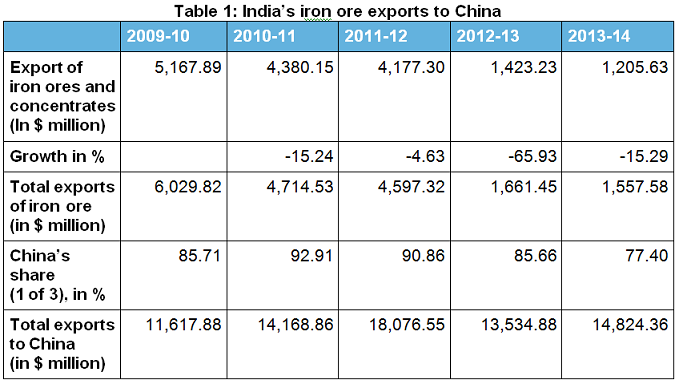
Source: Ministry of Commerce, Government of India [2];

As Table 1 shows, India’s exports of iron ores and concentrates to China have been falling steadily, with the sharpest drop in 2012-13. This was the year that India’s overall iron ore exports also plummeted as a consequence of an expert panel shutting down all 93 mines in Goa after finding serious “irregularities and illegalities”. This came on top of a Supreme Court-mandated blanket ban on private sector iron ore mining in three Karnataka districts (Bellary, Tumkur, and Chitradurga) in the previous year, which was followed up by the Centre imposing a 30% export tax.

In 2014, the Supreme Court lifted the Goa mining ban partially by imposing an annual output cap of 20 million tonnes. The Centre also reduced the export tax for low quality iron ore to 10% in April 2015. The impact of these decisions on exports will become evident over the next few months.

However, Zhao’s contention seems a little laboured when viewed through the lens of overall India-China trade figures. The data doesn’t seem to validate his argument.


As Table 2 shows, India’s exports to China suffered a severe setback in 2012-13 and dropped by $4,541.67 million. This is also the year that iron ore exports to China suffered a pronounced drop. On first look, therefore, the fall in overall exports can be attributed to a drop in iron ore exports.

But that would be a mistake. That’s because the drop in ore exports to China is only $2,754.07 million—and this means that China did not buy $1,787.6 million of other goods that year.

India’s exports have continued to languish thereafter, with the provisional data for 2014-15 showing a precipitous drop in export receipts from China: overall exports are unfortunately back to 2009-10 levels. However, there has not been a concomitant drop in China’s exports to India; in fact, it is quite the opposite, with provisional numbers showing a sharp recovery in China’s exports to India.

So, if India’s exports have been falling each passing year, while China’s have grown apace, leading to an unsustainable trade deficit, surely it has to do more with reasons other than dwindling iron ore exports.

It would have been only fair if Zhao had also mentioned India’s abiding contention: the tariff and non-tariff barriers (such as phytosanitary standards) that China imposes on Indian exports of pharmaceuticals, agri-products, or IT enabled services. Zhao should have also enlightened the Forum about India’s insistent demands for simplification and greater transparency in China’s procedures related to registration, inspection, and approvals of imports from India. Otherwise Zhao is presenting only half the picture.

References

[1] Parliament Questions to Department of Commerce, Ministry of Commerce and Industry, Government of India, P 10, 13 May 2015, <http://commerce.nic.in/pquestion/RS20150513.pdf>

[2] Department of Commerce, Ministry of Commerce and Industry, Government of India, Export Import Data Bank, < http://commerce.nic.in/eidb/ecomxcnt.asp>

[3] Department of Commerce, Ministry of Commerce and Industry, Government of India, Total Trade, <http://www.commerce.nic.in/eidb/iecnt.asp>

This article was originally published in Gateway House (http://goo.gl/ff02Nv)

Friday, 8 May 2015

Geopolitics & Byomkesh Bakshi

Novelist Sharadindu Bandopadhyay created fictional detective Byomkesh Bakshi in exciting geo-political times, in Calcutta, then an interesting global city. The movie Detective Byomkesh Bakshi , directed by Dibakar Banerjee, tries to capture some of these fragments

Dibakar Banerjee’s film, Detective Byomkesh Bakshi, has split passions down the middle. But, this whodunnit is remarkable for other reasons: its desire to locate the story in turbulent geopolitical times and its portrayal of murky corridors of contraband trade.

The movie—apart from multiple directorial mis-steps (such as, an inability to re-imagine Calcutta’s streets of yore)—is a bit like a smouldering pot, blending not only interesting and menacing geopolitical fragments of those fraught times but also flavouring the brew with dark hints of suspicion targeted at the city’s Chinese and Japanese citizens.

The film is set in the Calcutta of 1942. The city was then a hub for the Allied forces, an oasis of rest and recreation for the battle-weary soldiers of World War II. The British naval forces were in retreat from the Indian Ocean theatre of war, pounded by a stronger Japanese fleet. As Emperor Hirohito’s Imperial forces marched across the Asian continent, having already captured strategic staging posts — such as, Penang, Singapore, Burma and Port Blair in Andaman Islands — the next logical stop was Calcutta. Japanese planes rained bombs on the city in 1942 (and also in 1944).

Here was a city occupied by foreigners and under attack from another set of foreigners. It was in pause mode, just months before the Allied forces would launch a massive counter-offensive in South-east Asia, under the command of Admiral Lord Louis Mountbatten. Intrigue, conspiracy, suspicion, black-market dealings were the daily norm. Throw in a couple of murders and a cross-border blood trail, and then detective-fiction meets geopolitics. Add to the mix opium smuggling to Shanghai and the setting for a noir narrative is complete. Into this combat zone, Dibakar Banerjee parachutes fictional detective Byomkesh Bakshi.

The director has simply followed the script. Writer Sharadindu Bandopadhyay had sired detective Byomkesh Bakshi in cosmopolitan Calcutta (the first story was published in 1924), a city at the crossroads of Asian commerce and trade, an entrepot brimming with Anglo-Indians, Chinese, Jews, Armenians, Muslims and Parsis, in addition to the Hindus. A riverine port—the country’s oldest operating port—barely 200km from the sea, Japanese bombers repeatedly tried to undermine Calcutta’s geostrategic position.


Sharadindu styled Byomkesh as a dilettante, an amateur sleuth, perhaps fashioned loosely on Dorothy Sayers’s creation Lord Peter Wimsey. But, more than a detective, he is a satyanveshi (truth-seeker) and pursues leads, clues and hunches with dogged determination, without regard for remuneration or recompense. His reward is solving the crime and apprehending the guilty; and earning a bit of fame (or perhaps notoriety) in the process is always welcome.

Byomkesh is astute, well-read and able to connect multiple dots. He untangles a sordid skein of seemingly disparate events—the murder and mysterious return of an opium smuggling kingpin, a disrupted Calcutta-Shanghai opium supply chain, crepuscular Chinese denizens moving in the shadows of legendary Tiretta Bazaar, the disappearance and murder of an innovative Bengali chemist, a coquettish Bengali-Burmese seductress floating ethereally in a silk-brocade cheongsam, the furtive goings-ons at a Japanese dentist’s clinic, the deathly pall of bombings hanging over a fetid Calcutta skyline, a British police commissioner concerned with a missing opium consignment.

In his books and stories on Byomkesh, Sharadindu was able to depict Calcutta as a modern city, where education, commerce, arts, literature, culture and religion thrived together. The Calcutta of 1942 — as represented by either Sharadindu in his books or by Dibakar Banerjee’s movie — is doubly likeable because of the stark contrast with present-day conditions. Today’s charged atmosphere of bigotry stands in sharp relief to that nonchalant air of tolerance, that comfortable sense of cosmopolitanism that has long been eroded by the steady flight of citizens, its culture of wide scholarship replaced by rote learning. Calcutta Port—renamed Kolkata Port Trust in recent years—is now encumbered by tonnes of silt brought in by the river from upstream and plays host to only lighter and smaller vessels,.

Sharadindu’s rendering of Calcutta as a global city will, sadly, remain encapsulated only in memories. That’s probably true of many other Indian cities.

Monday, 20 April 2015

Do Trade Targets Work?

India has used two-way trade targets as a proxy for judging the temperature of its key bilateral and plurilateral relationships. But a deeper understanding is needed of the extent to which physical targets can help accomplish qualitative objectives

The government of India’s new Foreign Trade Policy (FTP) for 2015-2020 has set a $900-billion goods and services export target, to be achieved by 2020. Compared with the $465.9 billion achieved during 2013-14, the target is almost double of current levels.

The policy document prefaces the target with a rare pithy statement: “A vision is best achieved through measurable targets.”[1] But the fact is, most of India’s key diplomatic engagements—at bilateral, plurilateral, or even multilateral levels—are defined by targets.

Targets are ubiquitous in India’s economic diplomacy. There are many ways to judge the breadth and depth of a relationship between two countries, including cultural exchanges, defence cooperation, people-to-people interaction, and historical ties. But trade and investment targets lay out vector paths for future growth, and set concrete milestones against which progress can be gauged.

The target-driven approach is now spreading to bilateral ties with even smaller nations; for example, India and Vietnam recently agreed to a trade target of $15 billion, to be met by 2020. [2]

But targets are essentially cut-and-dry, and temporal. There is no definitive research showing whether targets have succeeded in imparting additional meaning to an existing relationship, or whether they have been effective in bringing two disparate nation-states closer. In other words, there’s no conclusive evidence showing that quantifiable bounds improve the qualitative facet of an engagement.

India’s Free Trade Agreement (FTA) with ASEAN is a good example. It has been a source of anxiety within government and key stakeholders. India signed the FTA for goods in 2009, but the one on services and investment—arguably India’s strong point—is yet to come into force. Even in the goods trade, India suffers a chronic trade deficit with ASEAN: it imports more than it exports.

In the face of this, the target for India-ASEAN bilateral trade—$100 billion by 2015—looks unattainable, especially since two-way trade (exports plus imports) between the two regions amounted to only $70.5 billion during April-February 2014-15. [3]

Confronted by this glacial pace of trade growth, India has done the next best thing: it has stretched out both the physical target as well the end-date. The India-ASEAN relationship will now be measured by a new target without having to necessarily address performance vis-a-vis the earlier target. External affairs minister Sushma Swaraj announced the new target at the inaugural session of Delhi Dialogue VII on March 11: “However, we need to make a special effort to achieve our target of enhancing trade to $100 billion by 2015, and our aspiration is to double it to $200 billion by 2022.” [4]

India has recast other targets in other strategic relationships as well. During Prime Minister Narendra Modi first state visit to the U.S. in September 2014, the joint statement he issued with President Barack Obama stated: “Noting that two-way trade has increased five-fold since 2001 to nearly $100 billion, President Obama and Prime Minister Modi committed to facilitate the actions necessary to increase trade another five-fold.” [5] In other words, to take trade to $500 billion, though the statement refrained from mentioning a target year.

In the other strategic relation with neighbour China, there is some clarity of objectives on both investments and trade. A joint statement issued by Modi and President Xi Jinping in September 2014 announced: “The Chinese side would also endeavour to realise an investment of $20 billion in India in the next 5 years in various industrial and infrastructure development projects”. [6] During the same trip, a five-year Trade and Economic Development Plan signed between the two countries has, among other targets, an unquantified over-riding objective: reduce the trade imbalance India suffers in its $65-billion bilateral trade with China. [7]

Even with Africa, the $90-billion target set for 2015 is likely to be missed. [8] It is also quite likely that the target will be bumped up—both the volume as well the year. This might be announced at the Third India-Africa Summit scheduled for October 2015.

When the foreign trade and investment landscape is suffused with a surfeit of targets, the logical questions are: How are targets fixed? What is the strategy for meeting them? No one knows the answers.

For one, there is no clarity on who should set and announce targets—the commerce ministry or the external affairs ministry? While think tanks and academic experts are known to have been engaged by both ministries to finalise targets, the research output is not available to civil society, either for viewing or for providing inputs. Inviting public comments before finalising targets, or even to assess the methodology used, can probably infuse some realism into these exercises.

Second, once the targets are announced, there is no detailed analysis of how these will be met, and no outlining of strategy, at least not in the public domain.

Finally, this year’s Foreign Trade Policy also raises a crucial issue that has bedevilled India’s trade practices: the lack of coordination between different economic agents as well as ministries operating in silo-like structures. But then the policy stops short of mentioning how “Make in India” or “Digital India” or even the policy on smart cities can be integrated with the FTP to deliver higher exports of both goods and services. That remains the biggest challenge for India’s trade regime.


References


[1] Ministry of Commerce and Industry, Government of India; Foreign Trade Policy Statement, <http://dgft.gov.in/exim/2000/FTPstatement2015.pdf>, p.14

[2] Ministry of External Affairs, Government of India, Joint Statement by Indian Prime Minister Narendra Modi and Vietnamese Prime Minister Nguyen Tan Dung,28 October 2014, <http://www.mea.gov.in/Speeches-Statements.htm?dtl/24143/Media+Statements+by+Prime+Minister+of+India+and+Prime+Minister+of+Vietnam+in+New+Delhi+October+28+2014>

[3] Ministry of Commerce and Industry, Government of India, Trade Statistics, <http://commerce.nic.in/ftpa/cntq.asp>

[4] Swaraj, Sushma, Keynote Address at Inaugural Session of Delhi Dialogue VII,Ministry of External Affairs, Government of India, 11 March 2015,

<http://www.mea.gov.in/Speeches-Statements.htm?dtl/24899/Keynote_Address_by_External_Affairs_Minister_at_the_Inaugural_Session_of_Delhi_Dialogue_VII_New_Delhi>

[5] Ministry of External Affairs, Government of India, Joint statement by Indian Prime Minister Narendra Modi & U.S.A. President Barack Obama, 30 September 2014,

<http://www.mea.gov.in/bilateral-documents.htm?dtl/24051/Joint_Statement_during_the_visit_of_Prime_Minister_to_USA>

[6] Ministry of External Affairs, Government of India, Joint Statement between the Republic of India and the People’s Republic of China on Building a Closer Developmental Partnership, 19 September 2014,

<http://www.mea.gov.in/bilateral-documents.htmdtl/24022/Joint_Statement_between_the_Republic_of_India_and_the_Peoples_Republic_of_China_on_Building_a_Closer_Developmental_Partnership>


[7] Ministry of External Affairs, Government of India, List of Documents signed during the State Visit of Chinese President Xi Jinping to India, 18 September 2014, <http://www.mea.gov.in/incoming-visit-detail.htm?24012/List+of+Documents+signed+during+the+State+Visit+of+Chinese+President+Xi+Jinping+to+India>

[8] Singhal, Rajrishi; Indian Banks in Africa: Change Agents; Policy Perspective No 8, Gateway House: Indian Counmcil on Global Relations, 9 January 2015, 
<http://www.gatewayhouse.in/wp-content/uploads/2015/01/Policy-Perspective_Economic-diplomacy-with-Africa.pdf>


Monday, 22 September 2014

Time To Put Substance Before Style

China now views itself as an emerging superpower rather than a ‘developing’ country. India should take this into account

Long after President Xi Jinping has flown back to Beijing, there will remain a host of prickly issues that senior ministers and diplomats on both sides will need to bang heads over. During President Xi’s 48-hour whistle-stop through Ahmedabad and Delhi, the climate-controlled atmospherics, the fastidiously choreographed diplomatic pas de deux on Sabarmati, the thunderous rhetoric and the flurry of MoUs made for good optics. But action is always a poor substitute for achievement.

One of the visible thorns in the blossoming relationship is border uncertainty and both President Xi and Prime Minister Narendra Modi did reiterate a need to settle it. But beyond the omnipresent irritation of a virtual border, it is in India’s interest to resolve numerous pending geo-economic issues with China.

Shifts and moves

Start with World Trade Organisation (WTO) first. India invited universal censure after blocking safe passage of Trade Facilitation Agreement (TFA) at WTO’s General Council meeting in Geneva on July 31, 2014. However, China’s unprincipled floor-crossing on that day was truly shocking, after having supported India’s stand in many multilateral fora (such as G-33, G-20) and in bilateral meetings.

China’s mercurial shift could be understandable if India was found to be acting irrationally. But, on closer analysis, it seems India’s actions were justified. Having agreed at the Bali ministerial to approve TFA, on condition that developing countries not be penalised for food security imperatives till a permanent solution is formalised by 2017, India discovered that all discussions thereafter were focused on only TFA. This was contrary to the post-Bali work programme and gave India (and some other developing countries) grounds to believe that once TFA was out of the way, rich countries didn't care much for the Doha Development Agenda, including food security measures.

But, there are some other valid reasons for India’s principled action. For one, India has a sovereign right to provide food security for its citizens, just as US has the right to buy and stockpile crude oil to provide its citizens with energy security. Two, TFA will cause a spike in infrastructure costs for poor countries; the rich nations were to provide budgetary assistance to help them tide over this unplanned expense, but the amount finalised is too low and the modalities are still vague.

Finally, benefits from TFA are ambiguous, with most gains likely to go to the developed world.

China’s sovereign objectives are somewhat aligned with India on this issue, particularly since it too has to provide food at reasonable prices for large sections of its population. Also, China has been a signatory to all the food security negotiations by G-33, a grouping of developing countries with convergent trade issues.

A change of heart?

While it’s not known if Modi-Xi talks included China’s breach of trust, the joint statement issued by both governments was patently anodyne: “As developing countries, India and China have common interests on several issues of global importance like climate change, Doha Development Round of WTO, energy and food security, reform of the international financial institutions and global governance. This is reflected in close cooperation and coordination between the two sides within the BRICS, G-20 and other fora.”

One reason for China’s change of heart could be India’s lackadaisical communications strategy; also, India’s parleys could have conveyed a message that it’s interested in cherry-picking only food stockpiling from a multitude of other development issues. This might have even influenced some of the other large emerging nations, such as Brazil and South Africa, to isolate India.

But there’s another significant development. There's probably a radical shift in how China views itself: as a world superpower and a trade behemoth, competing with the developed countries. Hence, in keeping with this new-found status, TFA makes more sense rather than hankering for food security. While China is indeed a trade colossus, India needs to keep in mind this change in China’s self-perception when negotiating with President Xi’s men in future.

The border incursion, intriguingly timed to coincide with President Xi’s visit, is a reminder of China’s foreign policy dualism: an extended hand of economic friendship to mask the ugly face of geographic expansionism.

The second issue is climate change and India would do well to keep the new Chinese psyche in mind in future multilateral deliberations.

On the surface, both India and China seem to be on the same page. Apart from a common historical stand, both President Xi and PM Modi have also excused themselves from the UN Climate Summit on September 23.

But that’s where the similarities end. China has already signed a separate climate change agreement with US. While these agreements reduce the climate policy distance between the two superpowers, there are still some sticking points. While China and US agree that that rich countries must provide developing nations with wherewithal to upgrade technology, the divergence is whether the old labels of “developing” or “developed” need to be upgraded.

In essence, the rest of the world’s identity — including India’s — is hostage to progress of talks between two superpowers. The initiative seems to be slipping away from India’s grasp; a climate change strategy is required before the big climate summit in Paris next year. While China’s stand may be driven by thickening smog over its cities, India may have to fashion its own position consistent with its economy and stage of development.

Myriad issues

There are many other unresolved issues on the table — using renminbi as a alternative currency, India’s membership in multilateral institutions (such as Asian Investment Infrastructure Bank) and groupings (Shanghai Cooperation Organisation, for example), discussions on how to take the BRICS Bank ahead, enhanced market access for Indian goods and services, are just some of them.

The lessons for Modi are clear: with China what you see is never what you get. Modi will have to take every opportunity to create an independent policy space for india, even if that requires striking trade and investment deals with Japan, USA, EU, Russia or Australia.

The writer is a journalist and senior fellow with Gateway House

Courtesy: The Hindu BusinessLine, edition dated September 22, 2014 (The original can be read here:goo.gl/Cbm3Ex