Monday, 21 September 2015

Byte But No BIT

Behind the hullabaloo and grand optics that will accompany PM Narendra Modi’s visit to the U.S. will be laser-focused discussions on enhancing the strategic trade and investment relationship

The agenda for Prime Minister Narendra Modi’s 5-day visit to the U.S. starting September 24, much like his previous trip, is brimming with activity. Apart from attending the United Nations General Assembly, he is travelling to San Francisco to burnish his Digital India credentials, then returning to New York to meet President Barack Obama for a bilateral dialogue and closing by catching up with key U.S. businessmen and CEOs for a closed-door conversation.

But behind Modi’s headline-grabbing California spectacle are other Indian ministers and businessmen who will be rolling up their sleeves and getting down to business in Washington DC.

High on the list is the first meeting of the newly-crafted India-USA Strategic and Commercial Dialogue (S&CD) on September 22, which was upgraded from India-USA Strategic Dialogue this January during Obama’s Republic Day visit[i]. The moniker change reflects the strategic importance of trade, economic and investment to the bilateral ties. The roll-call of the meeting attendees also reveals what will be discussed and what’s off-the-table.

On the Indian end of the table will be External Affairs Minister Sushma Swaraj and Commerce and Industry Minister Nirmala Sitharaman, with Secretary of State John Kerry and Secretary of Commerce Penny Pritzker on the U.S. side. On September 21, a day before the Dialogue, Vice President Joe Biden, Kerry and Swaraj will address the U.S.-India Business Chamber’s anniversary celebrations. Other ministers, including energy minister Piyush Goyal, will be present and when the Dialogue commences the next day, Goyal will meet his U.S. counterpart, Ernest Moniz, for the Sixth India-U.S. Energy Partnership Summit.

U.S. Vice President Joe Biden will be present at the bilateral talks between Modi and Obama. If Biden does indeed make a bid for the presidency, as has been widely rumoured, his involvement becomes significant.

So far, one thing is clear from the agenda: the Bilateral Investment Treaty (BIT) is not in the picture. That inference arises from Finance Minister Arun Jaitley’s absence from the proceedings. The hypothesis becomes even more compelling because the finance ministry has crafted India’s model draft agreement and placed it in the public domain for stakeholder inputs. There are numerous sticking points between India and the U.S. over the draft that will take time to discuss, debate and disentangle. Among them are the investor-state dispute system, intellectual property rights (IPR) and expropriation. Given that the Obama presidency is fast entering the “lame-duck” zone, the BIT might have been kept out because it is still a work-in-progress.

The Dialogue will focus on four areas, according to undersecretary of commerce for international trade, Stefan M Selig’s briefing to reporters September 16 at the American Chamber of Commerce in New Delhi in August 2015[ii]:

Building tomorrow’s smart cities in India and the related infrastructure: The U.S. will participate in “smartening up” three cities — Ajmer, Allahabad and Vizag — and the talks will identify U.S. companies that can deliver on the promise.

Participating in strengthening India’s business climate to the benefit of both Indian and American businesses: This is an euphemism for tackling all the current pain-points in the relationship, especially for the U.S.: IPR, contract laws, the Indian legal system. Strangely, pre-Dialogue chatter seems to centre only on the business climate in India, without any mention of the non-tariff barriers and curbs on movement of skilled people from India to the U.S.

Harmonizing product standards to increase trade and further deepen our industries’ integration into global supply chains: Creating and developing common standards – safety, environmental or labour – in manufacturing that will help integrate India’s trade outreach with both the Asia Pacific Economic Community (APEC) and the Trans Pacific Partnership (TPP). India is not a member of either grouping. Included will also be trade in agricultural goods and the future of the Doha Round at the upcoming WTO ministerial at Nairobi.

Developing best practices around innovation and entrepreneurship: Among the many issues on the table, renewable energy will likely find mention.

What’s different this time is that the talks could depart from the transactional nature of previous rounds and instead identify credible milestones, especially ones that help stretch the annual bilateral trade volume from $100 billion currently to $500 billion. Beyond that, both sides will look to elevate trade into a strategic and diplomatic tool, one that aligns Modi’s “Look East, Act East” policy with Obama’s Asia Rebalance strategy. The nuts and bolts of this tool are likely to be identified on September 22.

Another clue to the future direction of the bilateral and the Dialogue is the equal, if not larger, role that the private sector is expected to play over the public sector in strengthening mutual ties. That’s why the USIBC event has been scheduled a day prior to the Dialogue, so U.S. corporations can voice concerns that can be discussed at the Dialogue the next day.

A disconcerting element: apart from the fanfare around Modi’s public appearances, there hasn’t been much forthcoming from the Indian delegation, the exception being a recent and bare-bones press release from the Ministry of External Affairs[iii]. For the moment then, policy-watchers we will have to remain content with Modi’s grand shows.

ENDNOTES

[i] Department of Commerce, Statement from U.S. Commerce Secretary Penny Pritzker on U.S.-India Strategic and Commercial Dialogue; January 26, 2015; <https://www.commerce.gov/news/press-releases/2015/01/statement-us-commerce-secretary-penny-pritzker-us-india-strategic-and>

[ii] International Trade Administration, Speech (as prepared for delivery) by Under Secretary of Commerce for International Trade, Stefan M Selig; August 11, 2015; New Delhi; <http://www.trade.gov/press/speeches/2015/selig-081115.asp>

[iii] Ministry of External Affairs, Press Releases, September 18, 2015 <http://www.mea.gov.in/press-releases.htm?dtl/25817/First_Ministerial_of_the_IndiaUS_Strategic_and_Commercial_Dialogue>

Originally published in Gateway House (http://goo.gl/13YfW4)


Thursday, 20 August 2015

Shopping For Inequity

The government's policy on FDI in e-commerce is designed to protect the welfare of a smaller political constituency…


India's exuberant e-commerce industry was recently hit by a known unknown, or an existing risk that had been left unattended. Delivery boys associated with two or three companies stopped working, demanding better working conditions — such as toilets in offices or a motorcycle maintenance allowance — and better pay.

This not only led to a predictable pile-up of delivery packages but also focused attention on an industry that's in news for conflicting reasons: soaring valuations and rapidly multiplying wealth of the founders counteracted by absence of regulatory oversight leading to dodgy governance structures and business practices.

What's interesting is that the strike — the delivery boys were organised under the banner of Raj Thackeray's Maharashtra Navnirman Sena banner — came soon after government officials finished separate consultations with industry representatives and state governments on whether to revise the existing rules on foreign direct investment (FDI) in e-commerce. The government was, of course, nudged into this stakeholder consultation process by the Delhi High Court. The states are expected to submit their views to the Centre soon. 

There is no evidence to suggest that the strike was related to, or timed to coincide with, the government's rounding up of opinions on retail FDI. But, given the close procession of events, it does pivot public gaze towards the government's anomalous policy on FDI in retail, as well as the familiar national malady of regulatory processes lagging industry development.

The government's policy on FDI in retail, like previous episodes of politically-driven policy-making, is designed to protect the welfare of a smaller political constituency over furthering the welfare of the general public, a much larger but dispersed political constituency. It has also spawned a convoluted business strategy designed to side-step regulatory barriers. Here's how.

The government's FDI policy in the retail sector is divided into four parts — single brand retail, multi-brand retail, cash-and-carry operations and e-commerce. Single-brand retail and cash-and-carry operations allow 100% FDI, though the investment freedom is circumscribed by conditions which encourage evasive action — such as, a procurement stipulation requiring compulsorily sourcing of 30% stock from Indian suppliers, or the numerous approvals mandated in the policy.

In multi-brand retail, only 51% FDI is allowed. Policy here is weighed down by formidable conditions, which seem to have been designed to deter rather than encourage investments. Provisos include a minimum investment of $100million, 50% of the investment has to be mandatorily invested in "back-end" infrastructure (defined in the policy document as "investment made towards processing, manufacturing, distribution, design improvement, quality control, packaging, logistics, storage, ware-house, agriculture market produce infrastructure etc"), obligatory 30% procurement conditions, geographical and locational restrictions.

Finally there is e-commerce, where 100% FDI is allowed only for business-to-business trade, but not for business-to-consumer. Even 51% investors in multi-brand retail are barred from indulging in e-commerce. Conversely, anybody with an e-commerce business in India cannot access any FDI. Despite these restrictions, Indian e-commerce businesses have employed ingenious subterfuge to absorb copious amounts of FDI. 

The device is simple: they have created what is known as the "marketplace" model under which e-commerce sites use technology to drive a transaction platform that matches buyers and sellers. These sites, therefore, are only technology platforms and not necessarily, or technically, e-commerce sites selling to retail customers. This is slightly disingenuous: it allows e-commerce promoters to invite large sums of foreign capital while carrying on the business of multi-brand retail through the internet. 

The marketplace model is in contrast to the "inventory" model under which the e-commerce promoter buys all the goods, stocks them and then eventually sells them to the retail customer. There are obvious costs involved in this business structure, making it disadvantageous when compared with the marketplace model.

What's bizarre is that the government's policy architecture has been directly responsible for spawning this perplexing workaround. The desire to protect a vocal political constituency — the traditional corner shops — has forced the government to create artificial divisions in the retail trade (between single-brand and multi-brand) and simultaneously lump two markedly distinctive trade practices (multi-brand and e-commerce) into the same category. The resultant confusion and marketplace distortion is now all too visible.

This skewed policy framework has another direct outcome — regulatory gaps. It is indeed ironic that despite a vocal policy environment — dominated by the strident and misguided debate on FDI — a regulatory structure for safeguarding consumer rights in e-commerce has been delegated to the sidelines. Stories about leading e-commerce companies disregarding consumer fulfillment promises with impunity have been rising due to lack of a regulatory structure. 

It is now self-evident that the executive has to sort out the knotted strands of retail FDI policy before the judiciary steps in — as has happened in many other cases — and genuine e-commerce becomes a casualty of the egregious policy tangle. Unfortunately, public policy history in India is replete with stories of how the need to gratify niche vote-banks has eclipsed decisions that could benefit public at large. This government now has an electoral imprimatur to correct this historical aberration.

Published originally in Outlook Magazine: http://www.outlookindia.com/article/shopping-for-inequity/295108

Saturday, 1 August 2015

Busting Myths Around Raghuram Rajan's RBI

There is no definitive proof that lower interest rates will lead unquestionably to higher economic growth.

The revised Indian Financial Code, put in the public domain by Finance Ministry, has divided economists, observers and experts into two distinct, sharply-delineated camps. On one side are those who are desperate to clip the Reserve Bank governor’s wings, and on the other are those who want his unspoken, uncovenanted autonomy to remain untouched, uncompromised. 

In the midst of this brouhaha, discussions about reforming the central bank’s governance framework has fallen through the cracks. While the debate about reducing the Governor’s powers rages endlessly, there is little attention being paid to what happens even after the change is effected. The Governor will still be answerable only to Finance Minister, and not to Parliament or a select committee of Parliament, as is the practice in many countries and as it should be in India too. It is surprising that this aspect of central bank reforms has failed to merit any discussion.

The revised code, among other things, has suggested that monetary policy, the exclusive preserve of central banks all over the world, should be decided by a monetary policy committee. Today, the final decision vests with the governor who, after consulting multiple bodies and committees, then has the sole discretionary power to take any monetary action. It is the composition of this recommended committee that has got people worked up. According to the revised code, the committee should have the RBI governor in the chair, two more RBI employees and four “persons appointed by the Central Governor”. Moreover, each member will have one vote and decisions will be taken on the basis of majority vote. 

With four votes, the government’s nominees immediately constitute a majority. Even more sinister is Article 257 in the code, which enjoins the Central government to nominate one representative to the meeting. This representative will not have a vote but will participate in the committee’s deliberations and will read out a statement from the government at the meeting. The import of this is not lost: with a representative watching the proceedings and delivering the central government’s message at the meeting, will any government nominee dare go against New Delhi’s wishes?

Arguments have been made that, in a democracy, the executive should have some say over a critical economic function like monetary policy. There is a basic flaw with this argument; separation of powers is a fundamental tenet of democracy, especially where the government’s actions can have an abiding impact on people’s lives. The inflationary stickiness arising from the 2008-09 stimulus programme is still haunting the Indian economy. Unlike the thick, Constitutional boundary separating the legislature from the judiciary, the line segregating the executive and the central bank is thin and rooted more in convention and common economic sense. 

It has become fashionable for economists of a certain orientation to demand reduced powers for the central bank governor. There are a couple of problems with that. First, under the new contract signed between RBI and the government, RBI is responsible for ensuring that consumer inflation remains within a pre-determined band. If the Governor ’s powers to use monetary tools to achieve that objective are taken away, then it somehow nullifies the inflation contract.

Second, the Indian economy has always been marked by fiscal dominance, which has been cogently explained by Niranjan Rajadhyaksha (http://goo.gl/3uwpz4) in his column for newspaper Mint. In simple words, monetary policy in India has always followed fiscal policy. The government’s fiscal policy, resulting in fiscal deficits, has forced the central bank to fashion monetary policy with the objective of tackling the after-effects of fiscal excesses. The RBI has worked hard over the past 25 years to minimise the deleterious impact of government’s profligacy on monetary policy. The government, in seeking to control both fiscal and monetary policies now, will negate all that has been achieved in stabilising the economy.

At the heart of the demand to shift the reins of monetary policy is a popular myth: reducing interest rates will automatically stimulate economic growth. Like all myths, especially those relating to flying machines of antiquity, there is no definitive scientific — or statistical — proof that lower interest rates will lead unquestionably to higher economic growth. Interestingly, another prevalent myth about the Indian economy being “decoupled” from the global economy evaporated quite rapidly after 2009. 

Many economists and industry lobbies have been incensed by RBI’s refusal to lower interest rates. Former RBI governor D Subbarao raised interest rates 13 times in quick succession. It was hoped his successor, Raghuram Rajan, would be divorced from such “anti-growth” orthodoxies. And, even though he has lowered interest rates, the pace has not been found too satisfactory. 

Beyond myths, a softer interest rate regime definitely has some side benefits: lower interest rates will automatically reduce the debt servicing burden of many large corporates which have borrowed way beyond their digestive capacities. While the RBI has been critical about the mounting levels of sticky loans in bank books and the behavioural patterns displayed by corporate borrowers, the government believes the investment cycle — especially “Make In India” — will not revive unless this staggering debt mass is sorted out.

Finally, the revised code employs some rather curious appellations: for example, it keeps referring to the RBI governor as “chairperson”. For example, Article 256(2)(a) says the monetary policy committee will comprise “the Reserve Bank Chairperson as its chairperson”. Last time I checked, RBI had no chairperson. He doesn’t exist even in the RBI Act.

Courtesy Outlook magazine: http://goo.gl/V1IALu 

Wednesday, 22 July 2015

Security Cover As Status Symbol

It's admittedly weird. But, for many Indians, the level of security provided by the state is a prestige issue, to be worn like a badge of honour.

The Minister of State for Home Affairs, Haribhai Parathibhai Chaudhary, in a written reply to a question by Om Birla in Lok Sabha on Wednesday, July 22, 2014, gave details of people provided varying levels of security by the Central government. Here are the details provided by the minister:

“Z+” category – 31 
“Z” category – 77 
“Y” category – 136 
“X” category – 31 
Total – 275 

I feel that the number of people provided "Z+" cover at 31 seems to be quite high. I wish the government discloses who these people are and places its "assessment-of-threat" in the public space. I don't want to sound too indelicate, nor question the security cover provided to the President, the Vice-President or the Prime Minister; but it's my gut feeling that many have been provided "Z+" as a mark of honour, to provide them with a higher perch on the slippery social totem pole. 

People's representatives: Former Bihar chief minister Lalu Prasad Yadav (above) and former Uttar Pradesh chief minister Mayawati; (pix courtesy Reuters & Livemint) 

In recent times, Manohar Bhagwat, chief of Rashtriya Swayamsevak Sangh (with the official title of "Sarsanghchalak"), was provided "Z+" cover based on an fresh risk assessment. 

Ordinarily, "law and order" is a state subject, according to the federalism formula provided in the Constitution. But, the Centre also makes its own assessment and also provides security cover, based on "...assessment of threat to some individuals. The security provided is subject to periodic review, based on which security is continued/ withdrawn/ downgraded/upgraded. Thus the number of protected in the Central List varies from time to time."

And, the cost? This what the home minister's statement in Lok Sabha said, "...(it) is difficult to determine precisely as it would include salary and allowances to security personnel, communication, transport vehicles etc. which are acco
unted for under respective budget heads of different security agencies, including State Government agencies, involved in providing security cover. Such details are not compiled centrally and so cannot be provided." 

The details can be accessed here: http://pib.nic.in/newsite/PrintRelease.aspx?relid=123481

Friday, 5 June 2015

India-China Deficit: Beyond Iron Ore

A distinguished Chinese scholar, speaking at a BRICS forum in Moscow recently, ascribed the growing India-China trade deficit to India’s ban on iron exports. While this contention is partially true, the data does not validate this argument, and nor does his view account for the other reasons for the deficit


India’s growing trade deficit with China has become a permanent fixture in all bilateral discussions held between the two countries. The gap has been increasing and, according to provisional data for 2014-15 presented to the Rajya Sabha, the gap is now over $48 billion. [1]

This concern was also voiced at the VIIth BRICS Academic Forum held recently in Moscow, especially during a break-out session on ‘Trade: Integrity of the Rules-Based Trade Regime and BRICS Role’.

The Chinese scholar on the panel for this session—Zhao Zhongxiu, dean of the School of International Trade at the University of International Business and Economics, Beijing— provided a rationale for the large trade deficit. He said the deficit was due to India’s ban on exports of iron ore.

Zhao’s contention is valid to some extent—courts in India have been imposing varying levels of embargo—either area-specific or by occasionally capping output—on iron ore mining and exports since 2010, aimed at curbing illegal mining and clandestine exports.

But Zhao’s explanation is only partially true—various other reasons have been adduced in the past for the growing trade deficit between the two countries.

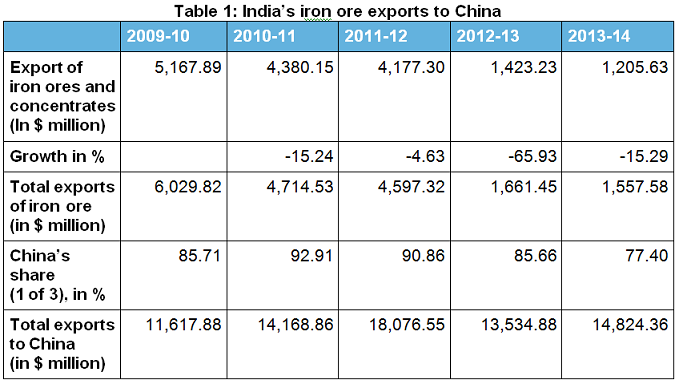
Source: Ministry of Commerce, Government of India [2];

As Table 1 shows, India’s exports of iron ores and concentrates to China have been falling steadily, with the sharpest drop in 2012-13. This was the year that India’s overall iron ore exports also plummeted as a consequence of an expert panel shutting down all 93 mines in Goa after finding serious “irregularities and illegalities”. This came on top of a Supreme Court-mandated blanket ban on private sector iron ore mining in three Karnataka districts (Bellary, Tumkur, and Chitradurga) in the previous year, which was followed up by the Centre imposing a 30% export tax.

In 2014, the Supreme Court lifted the Goa mining ban partially by imposing an annual output cap of 20 million tonnes. The Centre also reduced the export tax for low quality iron ore to 10% in April 2015. The impact of these decisions on exports will become evident over the next few months.

However, Zhao’s contention seems a little laboured when viewed through the lens of overall India-China trade figures. The data doesn’t seem to validate his argument.


As Table 2 shows, India’s exports to China suffered a severe setback in 2012-13 and dropped by $4,541.67 million. This is also the year that iron ore exports to China suffered a pronounced drop. On first look, therefore, the fall in overall exports can be attributed to a drop in iron ore exports.

But that would be a mistake. That’s because the drop in ore exports to China is only $2,754.07 million—and this means that China did not buy $1,787.6 million of other goods that year.

India’s exports have continued to languish thereafter, with the provisional data for 2014-15 showing a precipitous drop in export receipts from China: overall exports are unfortunately back to 2009-10 levels. However, there has not been a concomitant drop in China’s exports to India; in fact, it is quite the opposite, with provisional numbers showing a sharp recovery in China’s exports to India.

So, if India’s exports have been falling each passing year, while China’s have grown apace, leading to an unsustainable trade deficit, surely it has to do more with reasons other than dwindling iron ore exports.

It would have been only fair if Zhao had also mentioned India’s abiding contention: the tariff and non-tariff barriers (such as phytosanitary standards) that China imposes on Indian exports of pharmaceuticals, agri-products, or IT enabled services. Zhao should have also enlightened the Forum about India’s insistent demands for simplification and greater transparency in China’s procedures related to registration, inspection, and approvals of imports from India. Otherwise Zhao is presenting only half the picture.

References

[1] Parliament Questions to Department of Commerce, Ministry of Commerce and Industry, Government of India, P 10, 13 May 2015, <http://commerce.nic.in/pquestion/RS20150513.pdf>

[2] Department of Commerce, Ministry of Commerce and Industry, Government of India, Export Import Data Bank, < http://commerce.nic.in/eidb/ecomxcnt.asp>

[3] Department of Commerce, Ministry of Commerce and Industry, Government of India, Total Trade, <http://www.commerce.nic.in/eidb/iecnt.asp>

This article was originally published in Gateway House (http://goo.gl/ff02Nv)

Wednesday, 27 May 2015

Is the ‘Modi Premium’ Wearing Off in the Stock Markets?

As Modi completes one year in office, a sense of despondency pervades the customary reviews that ritually accompany such an event. Rumblings of discontent have emerged from various stakeholders and stock markets have taken the lead in signalling disappointment with his performance.


As Prime Minister Narendra Modi completes one year in office, a sense of despondency pervades the customary reviews that ritually accompany such an event. Rumblings of discontent have emerged from various stakeholders, including Corporate India. But it is the stock markets that seem to have taken the lead in signalling disappointment with his performance.

The bellwether index S&P BSE Sensex, comprising 30 stocks, has witnessed a major erosion in values over the past few weeks. From its all-time peak of 29,681.77 points achieved on January 29, 2015, the Sensex hit a low of 26,599.11 on May 7: a sharp drop of 3082.66 points (or 10.38%) in slightly over three months.

The capital market’s rebuff is symbolic: it tries to aggregate what’s going on in different parts of the economy and transmits its sentiment through one single number. And going by its recent behaviour, there seems to be plenty that is wrong, or perceived to be wrong.

Foreign portfolio investors, an influential investor segment in the capital markets, are a visibly disgruntled lot and they have been letting off steam by selling en masse. In the first 10 trading days in May (till May 18), FPIs were net sellers to the extent of $2.306 billion. FPIs enjoy disproportionate influence over Indian capital markets, primarily because they bring larger volumes to bear than domestic institutions. Low retail participation in the capital markets — either directly or indirectly — also keeps Indian markets shallow.


Tax uncertainties


These FPIs decided to head for the exit because of continuing tax uncertainty. Finance minister Arun Jaitley’s 2015-16 Budget had unequivocally clarified that tax will not be levied on the capital gains of FPIs in the current year. But, unfortunately, there was no assurance that past cases won’t be re-assessed. And, true to form, tax authorities sent notices to various FPIs to pay up for past gains. That precipitated widespread resentment, with some FPIs even going to court and, of course, venting their spleen by selling Indian stocks.

The minister, presumably rattled by the exodus and the bad publicity all this was generating, has gone out of his way to placate FPIs. Apart from putting all reviews and fresh cases on hold, he resorted to the time-tested stalling tactic: he appointed a committee. In effect, he has kicked the can down the road and bought some time. This incident also illustrates how FPIs have emerged as a crucial constituency, with an uneven share-of-voice.

Unsatisfactory corporate results is the other reason why Sensex is volatile. Many companies — especially in the mid-cap segment — have reported disappointing results for 2014-15, signifying that demand for goods and services continues to remain weak. A report in Mint has highlighted how Q4FY15 sales of 142 companies included in BSE-500 (and for which results were available) has grown at the slowest pace in 16 quarters since Q1FY11.

This is evidence that the economy is still far from recovery. The Index for Industrial Production has grown by only 2.8% during 2014-15. Consumer durables manufacturing contracted by 12.5% during the year, compared with 2013-14, signifying the lack of purchasing power in the economy.

Matters have been made worse by the unseasonal rain in many parts of the country this year, destroying hectares of standing crop, which typically comes to the farm markets in April. This is likely to further dampen demand for consumer goods in the rural areas. The stock markets are also trying to capture this trend.


Oil prices fall opportunity lost


One can argue that this is sheer bad luck and the government cannot be held responsible for this catastrophe. While that is true, it is also a fact that the government didn’t rush to reap the dividends of fortuitously low oil prices when it came to power. Since then oil prices have climbed 50%, spooked by the continuing West Asian crisis and some shale oil wells in USA shutting down.

There could be another charitable explanation for the unusually turbulent Sensex: that expectations from PM Modi might have raced way ahead of reality, especially after the depressing paralysis that gripped the economy in UPA-II’s second term. The common beef (pun intended) is that even the current BJP-led government has plumped for incrementalism, rather than bold policy measures they had promised.

There are two sides to this debate and both can be deemed valid. But, what is undeniably true is that the stock market has already started discounting PM Modi’s premium, even before he completes a full year in office. And, though the Sensex is still up 14.78% from where it was a year ago — it closed at 27,687 on May 18, 2015, compared with 24,121.74 on May 16, 2014 — it seems that market participants have already watered down their expectations and moderated their hopes about a magical, almost fantastical, turn-around in the economy.


Courtesy:


Published first in The Wire (http://thewire.in/2015/05/19/is-the-modi-premium-wearing-off-in-the-stock-markets/) on May 19,

and then subsequently reprinted in 

Gateway House (http://www.gatewayhouse.in/is-the-modi-premium-wearing-off-in-the-stock-markets/) on same day.

Friday, 8 May 2015

Geopolitics & Byomkesh Bakshi

Novelist Sharadindu Bandopadhyay created fictional detective Byomkesh Bakshi in exciting geo-political times, in Calcutta, then an interesting global city. The movie Detective Byomkesh Bakshi , directed by Dibakar Banerjee, tries to capture some of these fragments

Dibakar Banerjee’s film, Detective Byomkesh Bakshi, has split passions down the middle. But, this whodunnit is remarkable for other reasons: its desire to locate the story in turbulent geopolitical times and its portrayal of murky corridors of contraband trade.

The movie—apart from multiple directorial mis-steps (such as, an inability to re-imagine Calcutta’s streets of yore)—is a bit like a smouldering pot, blending not only interesting and menacing geopolitical fragments of those fraught times but also flavouring the brew with dark hints of suspicion targeted at the city’s Chinese and Japanese citizens.

The film is set in the Calcutta of 1942. The city was then a hub for the Allied forces, an oasis of rest and recreation for the battle-weary soldiers of World War II. The British naval forces were in retreat from the Indian Ocean theatre of war, pounded by a stronger Japanese fleet. As Emperor Hirohito’s Imperial forces marched across the Asian continent, having already captured strategic staging posts — such as, Penang, Singapore, Burma and Port Blair in Andaman Islands — the next logical stop was Calcutta. Japanese planes rained bombs on the city in 1942 (and also in 1944).

Here was a city occupied by foreigners and under attack from another set of foreigners. It was in pause mode, just months before the Allied forces would launch a massive counter-offensive in South-east Asia, under the command of Admiral Lord Louis Mountbatten. Intrigue, conspiracy, suspicion, black-market dealings were the daily norm. Throw in a couple of murders and a cross-border blood trail, and then detective-fiction meets geopolitics. Add to the mix opium smuggling to Shanghai and the setting for a noir narrative is complete. Into this combat zone, Dibakar Banerjee parachutes fictional detective Byomkesh Bakshi.

The director has simply followed the script. Writer Sharadindu Bandopadhyay had sired detective Byomkesh Bakshi in cosmopolitan Calcutta (the first story was published in 1924), a city at the crossroads of Asian commerce and trade, an entrepot brimming with Anglo-Indians, Chinese, Jews, Armenians, Muslims and Parsis, in addition to the Hindus. A riverine port—the country’s oldest operating port—barely 200km from the sea, Japanese bombers repeatedly tried to undermine Calcutta’s geostrategic position.


Sharadindu styled Byomkesh as a dilettante, an amateur sleuth, perhaps fashioned loosely on Dorothy Sayers’s creation Lord Peter Wimsey. But, more than a detective, he is a satyanveshi (truth-seeker) and pursues leads, clues and hunches with dogged determination, without regard for remuneration or recompense. His reward is solving the crime and apprehending the guilty; and earning a bit of fame (or perhaps notoriety) in the process is always welcome.

Byomkesh is astute, well-read and able to connect multiple dots. He untangles a sordid skein of seemingly disparate events—the murder and mysterious return of an opium smuggling kingpin, a disrupted Calcutta-Shanghai opium supply chain, crepuscular Chinese denizens moving in the shadows of legendary Tiretta Bazaar, the disappearance and murder of an innovative Bengali chemist, a coquettish Bengali-Burmese seductress floating ethereally in a silk-brocade cheongsam, the furtive goings-ons at a Japanese dentist’s clinic, the deathly pall of bombings hanging over a fetid Calcutta skyline, a British police commissioner concerned with a missing opium consignment.

In his books and stories on Byomkesh, Sharadindu was able to depict Calcutta as a modern city, where education, commerce, arts, literature, culture and religion thrived together. The Calcutta of 1942 — as represented by either Sharadindu in his books or by Dibakar Banerjee’s movie — is doubly likeable because of the stark contrast with present-day conditions. Today’s charged atmosphere of bigotry stands in sharp relief to that nonchalant air of tolerance, that comfortable sense of cosmopolitanism that has long been eroded by the steady flight of citizens, its culture of wide scholarship replaced by rote learning. Calcutta Port—renamed Kolkata Port Trust in recent years—is now encumbered by tonnes of silt brought in by the river from upstream and plays host to only lighter and smaller vessels,.

Sharadindu’s rendering of Calcutta as a global city will, sadly, remain encapsulated only in memories. That’s probably true of many other Indian cities.

Friday, 24 April 2015

Public Procurement: Policy Must Precede Law

Pressure for a unified public procurement framework is mounting on India from both within the country and internationally. While an integrated procurement structure is necessary, a broad policy architecture must precede the framing of any legislation

As India prepares to convert some of its free trade agreements into larger comprehensive agreements, it will have to re-examine some existing domestic rules and convert other rules into legislations. And in some cases, such as procurement by the government, it will have to first frame guiding principles that are aligned with global norms.

Comprehensive agreements usually include, apart from export and import rules, treaties on investment, intellectual property rights, and public procurement. All comprehensive agreements, and some bilateral investment treaties, demand that public procurement treat all vendors—foreign or domestic—equally. In keeping with these norms, India too will have to design a globally-aligned public procurement framework that is fair and equitable.

The Indian government’s annual procurement bill is enormous. If purchases by the Centre, states, local bodies, public sector organisations, and the armed forces are consolidated, various estimates put the total bill anywhere between 25% and 30% of the country’s GDP, amounting to over $600 billion. [1]

Despite this colossal bill, India does not have an over-arching policy to guide public procurement.

In theory, all public procurement is guided by General Financial Rules (1963) and Delegation of Financial Powers Rules of 1978, both framed (and occasionally updated) by the Ministry of Finance. [2, 3] The ministry has also published a manual called “Policies and Procedures for Purchase of Goods”. [4] On top of that, the centralised purchase department of the central government—the Directorate General of Supplies and Disposals—issues its own guidelines. Many ministries often tweak these rules, with government agencies developing their own rules, and framing model tender documents.

Defence procurement, on the other hand, is covered by a unique set of policies and procedures formulated by the National Security System, and the decisions are made by the Defence Acquisition Council. In addition, many states have legislated their own procurement Bills—for example, the Tamil Nadu Public Procurement Act, the Karnataka Public Procurement Act, and the Rajasthan Transparency in Public Procurement Act.

Given this wide variation in procurement rules within the government, regulation and supervision are casualties. While the Central Vigilance Commission provides supplementary regulations and oversight, with additional supervision by the Comptroller and Auditor General, there is no central authority that monitors public procurement to ensure compliance with existing rules.

A series of scandals—coupled with mounting pressure from international allies, trade partners, and multilateral organisations—forced the UPA-II government to draft a Public Procurement Bill in 2012. But that didn’t go anywhere, and the new government is now trying to resuscitate the Bill. The finance ministry has invited comments on the draft of the existing Bill. [5]

However, there is a problem with drafting legislation before articulating guiding principles, or a strategy architecture, or even a white paper. Such a model document can provide directional guidance to the Bill, and not vice-versa. Also, guiding principles enjoy greater longevity, which when incorporated into legislation, saves it from frequent, time-consuming amendments.

Tactically, such a document will help resolve numerous pending or unresolved policy-related issues in public procurement that a Bill cannot incorporate.

For starters, the proposed Bill applies to only procurement by the central government and its various organisations. Given the growing procurement costs of states and local bodies (such as municipal corporations or panchayats), this Bill then serves only a limited purpose. Any regulatory oversight over purchases by states and local bodies would need to be balanced with the tenets of federalism.

This can be debated in the guiding principles and an alternative solutions framework can be constructed. For instance, it might be instructive to integrate all public procurement—at whatever level—with the proposed technology backbone for the Goods and Services Tax (GST) regime. Aligning procurements with the GST backbone will also allow for fair comparisons between the pricing of similar goods and services procured elsewhere by private or public entities, thereby imparting transparency and accountability. This will then reduce divergence without the need to legislate a central bill.

Second, governments worldwide use public procurement strategically to drive their socio-economic agendas. In India, there is a 20% mandatory carve-out for the micro, small medium enterprises (MSME) segment. [6] This will raise questions about other exemptions, such as a legitimate gender-based quota—should it be part of the 20% or does it deserves separate reservation? With gender budgeting now well established, gender-based public procurement has the opportunity to improve female entrepreneurship, employment, and incomes. [7]

A reservation—known as offsets—has also been included in defence FDI to supplement the ‘Make in India’ programme, under which foreign companies manufacturing in India must source 30% of goods and services from local companies. Even the FDI policy on single brand retail mandates such a requirement. These exceptions might face opposition in comprehensive agreement negotiations. This reinforces the need for a national policy debate, and a broad strategy, which re-examines the extent of exemptions that can be allowed.

Any strategy’s most significant thrust will be in the geoeconomic sphere. For instance, India will probably want to exempt government’s procurement of foodgrains from Indian farmers from any comprehensive negotiations, at least till the Doha Round of discussions under the World Trade Organisation are concluded, or till the outdated WTO formula on agriculture support is overhauled.

Importantly, India also needs a strategy to gain greater market access for services in overseas markets, in exchange for a liberal, domestic public procurement policy in manufactured goods. Public procurement of services in most countries is restricted to citizens of a country, or a particular bloc (like Europe). India should leverage the growing clamour for access to its procurement market by seeking reciprocal access for its services.

This is a plan of action that cannot be included in a Bill, but needs to be outlined in a strategy document.

References

[1] United Nations Office on Drugs and Crime, India: Probity in Public Procurement,

<http://www.unodc.org/documents/southasia/publications/research-studies/India-PPPs.pdf>

[2] Ministry of Finance, Government of India, General Financial Rules, <http://finmin.nic.in/the_ministry/dept_expenditure/GFRS/index.asp>

[3] Ministry of Finance, Government of India, Delegation of Financial Power Rules, <http://finmin.nic.in/the_ministry/dept_expenditure/notification/dfpower/Purchase%20I.pdf>

[4] Department of Expenditure, Ministry of Finance, Government of India, Policies and Procedures for Purchase of Goods, <http://finmin.nic.in/the_ministry/dept_expenditure/acts_codes/MPProc4ProGod.pdf>

[5] Department of Expenditure, Ministry of Finance, Government of India, Notice: Public Procurement Bill, 6 April 2015, <http://finmin.nic.in/the_ministry/dept_expenditure/ppcell/PPDNotice180315.pdf>

[6] Ministry of Micro, Small and Medium Enterprises, Government of India, Public Procurement Policy Notification, <http://dcmsme.gov.in/notification.pdf>

[7] Kirton, Raymond Mark, Gender, Trade and Public Procurement Policy: Kenya, India, Australia, Jamaica. The Commonwealth, 2012, <http://assets.thecommonwealth.org/assetbank-commonwealth/action/viewAsset?id=22979&index=0&total=36&view=viewSearchItem#imageModal>

Monday, 20 April 2015

Do Trade Targets Work?

India has used two-way trade targets as a proxy for judging the temperature of its key bilateral and plurilateral relationships. But a deeper understanding is needed of the extent to which physical targets can help accomplish qualitative objectives

The government of India’s new Foreign Trade Policy (FTP) for 2015-2020 has set a $900-billion goods and services export target, to be achieved by 2020. Compared with the $465.9 billion achieved during 2013-14, the target is almost double of current levels.

The policy document prefaces the target with a rare pithy statement: “A vision is best achieved through measurable targets.”[1] But the fact is, most of India’s key diplomatic engagements—at bilateral, plurilateral, or even multilateral levels—are defined by targets.

Targets are ubiquitous in India’s economic diplomacy. There are many ways to judge the breadth and depth of a relationship between two countries, including cultural exchanges, defence cooperation, people-to-people interaction, and historical ties. But trade and investment targets lay out vector paths for future growth, and set concrete milestones against which progress can be gauged.

The target-driven approach is now spreading to bilateral ties with even smaller nations; for example, India and Vietnam recently agreed to a trade target of $15 billion, to be met by 2020. [2]

But targets are essentially cut-and-dry, and temporal. There is no definitive research showing whether targets have succeeded in imparting additional meaning to an existing relationship, or whether they have been effective in bringing two disparate nation-states closer. In other words, there’s no conclusive evidence showing that quantifiable bounds improve the qualitative facet of an engagement.

India’s Free Trade Agreement (FTA) with ASEAN is a good example. It has been a source of anxiety within government and key stakeholders. India signed the FTA for goods in 2009, but the one on services and investment—arguably India’s strong point—is yet to come into force. Even in the goods trade, India suffers a chronic trade deficit with ASEAN: it imports more than it exports.

In the face of this, the target for India-ASEAN bilateral trade—$100 billion by 2015—looks unattainable, especially since two-way trade (exports plus imports) between the two regions amounted to only $70.5 billion during April-February 2014-15. [3]

Confronted by this glacial pace of trade growth, India has done the next best thing: it has stretched out both the physical target as well the end-date. The India-ASEAN relationship will now be measured by a new target without having to necessarily address performance vis-a-vis the earlier target. External affairs minister Sushma Swaraj announced the new target at the inaugural session of Delhi Dialogue VII on March 11: “However, we need to make a special effort to achieve our target of enhancing trade to $100 billion by 2015, and our aspiration is to double it to $200 billion by 2022.” [4]

India has recast other targets in other strategic relationships as well. During Prime Minister Narendra Modi first state visit to the U.S. in September 2014, the joint statement he issued with President Barack Obama stated: “Noting that two-way trade has increased five-fold since 2001 to nearly $100 billion, President Obama and Prime Minister Modi committed to facilitate the actions necessary to increase trade another five-fold.” [5] In other words, to take trade to $500 billion, though the statement refrained from mentioning a target year.

In the other strategic relation with neighbour China, there is some clarity of objectives on both investments and trade. A joint statement issued by Modi and President Xi Jinping in September 2014 announced: “The Chinese side would also endeavour to realise an investment of $20 billion in India in the next 5 years in various industrial and infrastructure development projects”. [6] During the same trip, a five-year Trade and Economic Development Plan signed between the two countries has, among other targets, an unquantified over-riding objective: reduce the trade imbalance India suffers in its $65-billion bilateral trade with China. [7]

Even with Africa, the $90-billion target set for 2015 is likely to be missed. [8] It is also quite likely that the target will be bumped up—both the volume as well the year. This might be announced at the Third India-Africa Summit scheduled for October 2015.

When the foreign trade and investment landscape is suffused with a surfeit of targets, the logical questions are: How are targets fixed? What is the strategy for meeting them? No one knows the answers.

For one, there is no clarity on who should set and announce targets—the commerce ministry or the external affairs ministry? While think tanks and academic experts are known to have been engaged by both ministries to finalise targets, the research output is not available to civil society, either for viewing or for providing inputs. Inviting public comments before finalising targets, or even to assess the methodology used, can probably infuse some realism into these exercises.

Second, once the targets are announced, there is no detailed analysis of how these will be met, and no outlining of strategy, at least not in the public domain.

Finally, this year’s Foreign Trade Policy also raises a crucial issue that has bedevilled India’s trade practices: the lack of coordination between different economic agents as well as ministries operating in silo-like structures. But then the policy stops short of mentioning how “Make in India” or “Digital India” or even the policy on smart cities can be integrated with the FTP to deliver higher exports of both goods and services. That remains the biggest challenge for India’s trade regime.


References


[1] Ministry of Commerce and Industry, Government of India; Foreign Trade Policy Statement, <http://dgft.gov.in/exim/2000/FTPstatement2015.pdf>, p.14

[2] Ministry of External Affairs, Government of India, Joint Statement by Indian Prime Minister Narendra Modi and Vietnamese Prime Minister Nguyen Tan Dung,28 October 2014, <http://www.mea.gov.in/Speeches-Statements.htm?dtl/24143/Media+Statements+by+Prime+Minister+of+India+and+Prime+Minister+of+Vietnam+in+New+Delhi+October+28+2014>

[3] Ministry of Commerce and Industry, Government of India, Trade Statistics, <http://commerce.nic.in/ftpa/cntq.asp>

[4] Swaraj, Sushma, Keynote Address at Inaugural Session of Delhi Dialogue VII,Ministry of External Affairs, Government of India, 11 March 2015,

<http://www.mea.gov.in/Speeches-Statements.htm?dtl/24899/Keynote_Address_by_External_Affairs_Minister_at_the_Inaugural_Session_of_Delhi_Dialogue_VII_New_Delhi>

[5] Ministry of External Affairs, Government of India, Joint statement by Indian Prime Minister Narendra Modi & U.S.A. President Barack Obama, 30 September 2014,

<http://www.mea.gov.in/bilateral-documents.htm?dtl/24051/Joint_Statement_during_the_visit_of_Prime_Minister_to_USA>

[6] Ministry of External Affairs, Government of India, Joint Statement between the Republic of India and the People’s Republic of China on Building a Closer Developmental Partnership, 19 September 2014,

<http://www.mea.gov.in/bilateral-documents.htmdtl/24022/Joint_Statement_between_the_Republic_of_India_and_the_Peoples_Republic_of_China_on_Building_a_Closer_Developmental_Partnership>


[7] Ministry of External Affairs, Government of India, List of Documents signed during the State Visit of Chinese President Xi Jinping to India, 18 September 2014, <http://www.mea.gov.in/incoming-visit-detail.htm?24012/List+of+Documents+signed+during+the+State+Visit+of+Chinese+President+Xi+Jinping+to+India>

[8] Singhal, Rajrishi; Indian Banks in Africa: Change Agents; Policy Perspective No 8, Gateway House: Indian Counmcil on Global Relations, 9 January 2015, 
<http://www.gatewayhouse.in/wp-content/uploads/2015/01/Policy-Perspective_Economic-diplomacy-with-Africa.pdf>


Monday, 13 April 2015

Incredibly Indian, or the Travesty of Taj Tourism


The Taj Mahal is unarguably India's finest monument. It's a lover's dirge for his late beloved, set in timeless metre and rhythm. It's a lament in marble, a paean to love, that leaves visitors awestruck and enchanted.

It's, therefore, equally painful when the custodians of this great monument are callous and corrupt. A visit to the Taj is meant to be a homage to beauty, love, devotion. Instead, many visitors have come back angry and frustrated.

Arundhuti Dasgupta Singhal has written in Business Standard on the shameful appropriation of Taj Tourism by touts and how officials are aiding and abetting this. It's titled Incredibly Indian: How Taj Mahal Tourism Has Turned Into Harassment:
http://goo.gl/kUF7Hf

A snatch of a sentence from the above blog highlights the plight of ordinary tourists: "Feeling harassed, helpless and angry at the manner in which we have been dragged into a chain of unofficial payments and pay-offs..."