Thursday, 21 January 2016

Silver Lining to India’s Trade Blues


India’s merchandise exports have now contracted for 13 months in a row, reflecting the global slowdown and impact of China’s economic recalibration. But, therein lay new opportunities and challenges for India’s economic diplomacy


India’s exports of goods have now shrunk for 13 months in a row. Even as this presents a threat to the government’s “Make in India” programme, it also provides some clues to future focus areas for India’s economic diplomacy.

Data for December 2015[i] shows merchandise exports at $22.29 billion, 14.75% lower than exports booked in December 2014. Cumulative exports for the first nine months of 2015-16 (April-December 2015) amounted to $196.6 billion, down 18% over the comparable period of 2014-15. There is one silver lining though: the trade deficit for the first nine months of 2015-16 ($99.2 billion) is lower than the deficit in 2014-15 ($111.68 billion). This is primarily due to lower oil prices.

There are two ways of slicing this data to understand incipient trends; locating the geographical source of this demand compression and looking at performance of specific commodities.

According to Commerce Ministry’s database on exports by region[ii], in dollar terms, the three destinations showing maximum contraction in Indian exports (or areas that are buying much less from India than in the previous year) are Latin America (down by 36.73%), Commonwealth of Independent States (CIS) & Baltic region (down 32.4%) and Africa (25.59%). Clearly, India’s foreign policy practice and economic diplomacy needs to expend greater energy on these areas.

Granulated regional data provides better insights. In Asia, for instance, the sharpest fall in absolute terms has been in exports to the West Asian countries that are members of the Gulf Cooperation Council (Bahrain, Kuwait, Oman, Qatar, Saudi Arabia and United Arab Emirates). The second largest drop in absolute terms has been exports to the ASEAN countries, followed by North East Asia (which includes China). While the GCC phenomenon can be ascribed to shrinking oil revenues, leading to diminution of demand for Indian goods, it is the slowing of the Chinese economy that explains the North East Asian drop and a second round impact leading to dwindling of ASEAN demand.

Examining trade data through the lens of performance of specific commodities highlights stasis in India’s manufacturing industry and the need for providing stimulus. This can be either through “Make In India” initiative or through additional investments. The data clearly shows slowing demand overseas for agricultural (rice, other cereals, oil cakes and oil seeds) and oil-related commodities. However, more importantly, import data shows a huge spike in purchases of pulses, gold and silver–indicating higher consumption–but demand for fuel, mineral ores and metals, machinery and equipment remained in negative zone, reflecting static industrial and manufacturing demand.

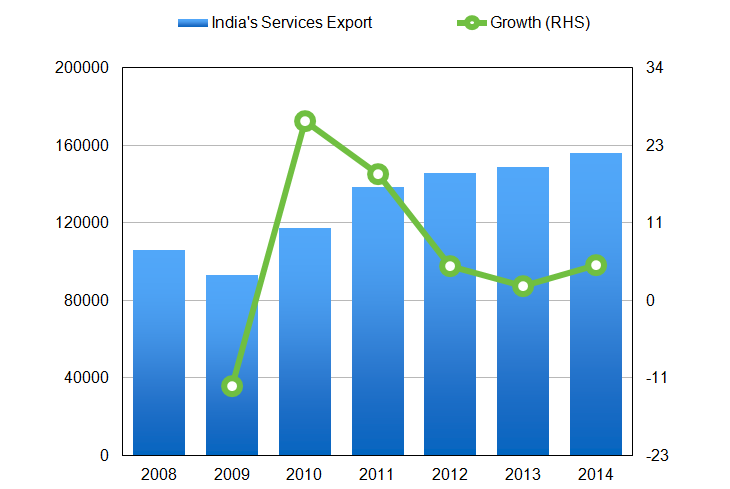
Yet, there are some oases of optimism— India’s trade in services for the first eight months of 2015-16 (April-November) showed a positive balance of $48.047 billion. In fact, this is one area in which India not only fares better than China (which has traditionally suffered a negative trade balance in services) but has also been able to stave off the China slowdown factor more effectively that merchandise trade.

This, then, points to another focus area for India’s future economic diplomacy, including its bilateral engagements with China or European Union (EU) and regional arrangements like Association of Southeast Asian Nations (ASEAN) or Regional Comprehensive Economic Partnership (RCEP).

The India and China example are instructive. India and China have multiple grounds for disagreement which occasionally drives a wedge between the two countries in multilateral negotiating forums. China’s overwhelming trade surplus with India and the festering border dispute are some of the legacy issues. Thesehave been joined by new contentions, such as India’s lack of response to China’s generous offer of building critical infrastructure.

But a common grouse should be uniting both countries’ interests at global negotiating platforms: services exports. This is because multilateral trade negotiations — such as those under World Trade Organisation (WTO) — or regional trade arrangements (examples being RCEP) and even bilateral agreements focus overly on goods trade. This is disadvantageous for India, which has competitive advantage in services but is denied level playing field in trade negotiations. China is likely to be in a similar situation when contracting exports of manufactured products forces its hand to provide a greater thrust to service exports.

India’s service sector has been a saviour for both domestic economic growth and for overall balance of payments. China’s trade in services is in negative zone because it’s a net spender on tourism and education: its trade balance was a negative $159.9 billion in 2014. This is ripe for change — a Chinese government policy document released in February 2015 set a target of $1 trillion of services trade by 2020, including accelerating services exports[iii] [iv].

With China expected to refocus economic efforts on strengthening its services sector and increasing its share in exports, both India and China need to coordinate their strategies and act in concert during multilateral trade and investment negotiations.

In fact, the UNCTAD Handbook of Statistics 2015, released recently[v] by the United Nations Conference on Trade and Development (UNCTAD), shows that services bailed out global trade during 2014. Data also shows the criticality of services exports for India, and its negative impact on China’s balance of payments. Given this strategic importance of services for both countries trade, and the continuing slowdown in demand for goods, overall global trade patterns are pointing towards the need for greater India-China cooperation in services trade.

References
[i] Department of Commerce, Ministry of Commerce and Industry, Government of India, India’s Foreign Trade (Merchandise): December, 2015;; <http://commerce.nic.in/tradestats/PressRelease.pdf>

[ii] Department of Commerce, Ministry of Commerce and Industry, Government of India, December, 2015;<http://commerce.nic.in/ftpa/rgn.asp>

[iii] The State Council; The People’s Republic of China, New guideline on boosting trade in services, ; 15 February, 2015; <http://english.gov.cn/policies/latest_releases/2015/02/15/content_281475056101818.htm>

[iv] Gerry Shih; China’s economic planners aim to boost service exports; Reuters, 14 February, 2015<http://www.reuters.com/article/china-exports-idUSL1N0VO09W20150214>

[v] UNCTAD;,International trade in services was main driver of growth in global trade in 2014 ; <http://unctad.org/en/pages/newsdetails.aspx?OriginalVersionID=1149&Sitemap_x0020_Taxonomy=UNCTAD%20Home>

Courtesy: Gateway House (http://goo.gl/cXKJYO)


Tuesday, 19 January 2016

Budget: It’s Now Or Never

The 2016 Budget could be the last chance for the government to redeem itself and find a way back into the common man’s heart.


It is that time of the year again. Newspapers, business channels, Internet sites are all full of ideas, suggestions and even advice for Finance Minister Arun Jaitley. The minister’s appointment diary is brimming with meetings scheduled with representatives from industry, trade unions and agriculturalists. They all come armed with wish-lists, hoping to influence the final design of this year’s Budget exercise. 

Jaitley is on track to present his third budget (for 2016-17) and, while patiently sticking to the routine of meeting various lobbies and representatives, he is aware of the criticism he faced for his first two Budgets and the challenges that lie ahead. It’s now or never; this might be his last opportunity to introduce bold reforms and sow the seeds of future growth. Next year might be too late; assembly elections for Uttar Pradesh and Punjab among other states are scheduled for 2017 and expedient politics traditionally triumphs sensible, hard-nosed economic measures in poll-bound years; the year also marks the beginning of the countdown to 2019 general elections.

To be fair, the FM does seem trapped in a cleft stick. Look at the hand he has been dealt: the global economy is struggling to emerge from a prolonged slowdown, leading to lower demand for Indian goods and services, and shrinking exports; China’s economic recalibration is spooking global capital flows and skewing the pitch for foreign direct investment (FDI) into India; indiscriminate past lending by banks (largely public sector banks) has impaired their ability to finance new projects, especially infrastructure projects; power generation and supply — essential for manufacturing activity — is stuck in a tangle of issues relating to fuel supplies, pricing, past regulatory infractions; agricultural output remains depressed due to sub-par monsoons, in addition to legacy issues of low productivity, inadequate credit and input supplies; this has dampened rural demand, thereby impacting a wide range of industries. 

In addition, the pre-election promises of fortifying the country’s manufacturing base, resulting in additional employment, fanned unrealistic expectations; when these did not materialise (as they were not expected to in such a short period), they spawned widespread disappointment with the regime’s economic managers.

It might be instructive to review the FM’s first two Budgets to decipher the tenor and direction of this government’s economic policy-making. In his debut (Budget 2014-15) innings, presented 45 days after taking office, the focus seemed to be on long-term, structural reforms: FDI up to 49 per cent in defence and insurance, guarantees of a stable and predictable tax regime, real estate and infrastructure investment trusts, incentives for foreign institutional investors (FIIs) and fillip to debt markets. The second outing continued policy thrust in the same direction: greater decentralisation and balanced regional growth through higher devolution to states, commitment to increased public expenditure to kick-start investment in the economy and a host of institutional reforms to attract fresh domestic and foreign investment.

But, expectations built up in the pre-poll season cannot be wished away easily and stakeholders have started voicing their disappointment. In short, Jaitley has to find ways to prod the economy into a higher growth trajectory immediately, without over-playing his hand or pushing the economy down a fiscal slope. On the other hand, the government is committed to certain expenditure — social sector allocations (especially in a year of agricultural distress and depressed rural incomes), a higher outgo because of Seventh Pay Commission recommendations and One Rank One Pension settlement (both are expected to result in combined outflows of about Rs 100,000 crore), interest burden on past government loans, capital infusion for state-owned banks and other PSU companies, plus a host of other obligations.

The Good News

Fortunately, revenue growth has been good. Data from the Controller General of Accounts shows net tax revenue for the first eight months (April-November) at Rs 4,64,864 crore, a growth of 12.5 per cent over the corresponding period last year. Non-tax revenues rose 35 per cent, helped primarily by spectrum auction proceeds and transfer of profits from public sector companies. There are three reasons behind tax revenue growth — higher duties on petroleum goods, the new service tax rates and the enhanced cess.

There are other encouraging signs as well. Bursts of public expenditure during June, July and September have taken the government’s total planned capital expenditure to Rs 97,788 crore during the first eight months of 2015-16, a 57 per cent jump over what was spent during the corresponding period last year. For example, funds allocated during 2015-16 to states and Union Territories for development of national highways, according to a PIB press release, is significantly higher than previous year: Rs 81,006.99 crore against Rs 31,495.20 crore in 2014-15, a jump of over 157 per cent. It remains to be seen how much of that allocation is actually spent. The National Highways Authority of India has so far awarded 43 projects in the current financial year for a total length of 2,624 kms.

The individual ministry-wise data provides greater insight. The ministries of road transport and highways, and rural development are among heavy-hitting ministries, with both having exhausted 74 per cent and 80 per cent of their budgeted plan expenditure for 2015-16 in eight months. Even the ministries of agriculture, health and family welfare and human resource development have spent a higher proportion of their budgeted plan expenditure than last year. More pointedly, among the large spenders seem to be ministries charged with key social sectors — such as, rural development and health. 

Clearly, the government is betting on higher public expenditure to shake the economy out of its torpor. This is classic text-book stuff. It is also in keeping with the FM’s undertaking in last year’s Budget speech to increase public investment outlay: “The total additional public investment over and above the RE (revised estimate) is planned to be Rs 1.25 lakh crore, of which Rs 70,000 crore would be capital expenditure from budgetary outlays.”

Clear & Present Dilemmas

The proverbial monkey-wrench is lack of revenue to finance public projects. While revenue generation has so far held up, largely on back of indirect taxes, there are multiple pressure points building up.

One, industrial activity as represented by the Index of Industrial Production shows 3.9 per cent growth during April-November 2015 over the same period last year, helped in large measure by festival shopping during October. Three among the top five items which contributed to October growth corroborates this — gems and jewellery, telephone instruments (including mobile phones) and passenger cars. On the flip side, what is worrying is stagnation in consumer non-durable items, which shrank by 0.5 per cent during April-November. In fact, consumer non-durable items stayed in negative zone in five of the eight months. In addition, the Nikkei Purchasing Managers’ Index also indicates manufacturing shrinking in December, affected partly by the Chennai floods. 

Two, the continuing fall in exports — close to 20 per cent by November — and its impact on overall manufacturing activity, is likely to dampen revenue generation in the coming fiscal. Worryingly, commerce secretary Rita Teotia was widely reported informing chambers of commerce that 2015-16 will end with $270-billion exports, markedly lower than $311 billion in 2014-15. The government and Reserve Bank of India (RBI) have allowed the rupee to depreciate, probably to keep exports competitive. This becomes especially critical when viewed against the Chinese central bank’s repeated devaluation of the yuan — in August 2015 and again on January 7, 2016.

This then, in short, is the FM’s dilemma. How does he meet the various expenditure demands — commitment to social sector schemes; need to keep investing in public investment to rekindle economic growth; allocations to agricultural sector to forestall distress; increase in salaries, wages and pension of government employees (including the armed forces); and, finally (but most importantly), increased allocation to states from the divisible central tax pool under the Fourteenth Finance Commission award. Worse, Jaitley has to fork out increased sums of money while staring down a diminishing exchequer.

The government seems to have reached the crossroads and needs to select a path that will help it emerge from this impasse. A few ineluctable options present themselves.

Feeling Fiscy

First, will the government be willing to take the fight to fiscal conservatives? In short, will it be willing to let the fiscal deficit slip just that wee bit to fire up animal spirits in the economy? 

This question goes to the heart of the Bharatiya Janata Party’s (BJP’s) economic philosophy, which has been morphing from its avowed “swarajya” policy in the 1970s and 1980s to pro-globalisation and support for foreign investment in the 1990s. Among the many consanguineous economic ideologies that exist within mainstream BJP, its affiliates and allies (such as Shiv Sena, Vishwa Hindu Parishad) and its mother organisation Rashtriya Swayamsevak Sangh, the umbrella right wing also includes economists of variegated hues — right-wing economists trained in Western universities (who find enlarged fiscal deficits and higher government debts anathema to the conservative notion of smaller government, low tax rates, and laissez faire economics) sitting cheek-by-jowl with free-market votaries who do not mind tweaking rules to protect domestic interests from competition (the lopsided FDI policy on foreign retail is a good example) or to suit local conditions. A lot will depend on who gets to monopolise airwaves in coming weeks.

There are other external pressures: credit rating agencies (especially the Big Two) are also wedded to fiscal orthodoxy and any deviation invites a rap on the knuckles or a downgrade, depending on the severity of the slippage. Interestingly, when the US allowed its fiscal deficit to expand to $1-trillion-plus between 2009 and 2012 — as it accelerated spending to stave off after-effects of the 2008 global financial crisis and the consequent economic slowdown — it did elicit censure from a section of Republicans in Congress, but that was pretty much it. It’s only in 2015, as the US economy continues to recover, that the deficit narrowed to $439 billion, the lowest since 2008.

Interestingly, while fiscal conservatism is considered an essential ingredient of the Republican ideological toolkit, even the Bill Clinton presidency adhered to large parts of this credo, attracting the new moniker “Liberal Democrats”. In a recent, cogent essay in The Atlantic Why America Is Moving Left, political scientist Peter Beinart, argues that President Barack Obama has pushed US economic policy dramatically to the left and it is likely to stay that way for some time to come. But, in India, conservative orthodoxy has slowly and insidiously sunk roots across ideological divides, thereby making fiscal deficits a dirty and contemptible term, even when sought to be used as a one-off, emergency measure. 

There are reasons to be wary of rising fiscal deficits; the reckless borrowing and spending of the 1980s brought India close to bankruptcy in 1990. Higher fiscal deficits and swollen debt levels could jeopardise the long battle that’s been waged to achieve fiscal stability, especially when the government’s inability to control wasteful spending or to execute expenditure rationalisation is well known. Relaxing vigil on the fiscal front is like a slippery slope: reining it back requires enormous political courage. 

If Jaitley, therefore, chooses to expand the fiscal gap a bit to finance all manners of expenditure (which increasingly look unavoidable now), he should expect commentators to look askance. To that extent, the FM seems to have already laid the foundation in his FY2016 Budget speech: “…insisting on, a pre-set time-table for fiscal consolidation pro-cyclically would, in my opinion, not be pro-growth…I will complete the journey to a fiscal deficit of 3 per cent in 3 years, rather than the two years envisaged previously…The additional fiscal space will go towards funding infrastructure investment.” But, between a paragraph in the budget speech and facing up to the risk lies a a wide chasm — and lots of criticism to boot.

Show Me The Money

The second tough call is raising revenue. As described above, higher tax revenues in the current economic environment increasingly seems difficult. There is no likelihood of an immediate increase in the number of tax payers which can compensate for the dip in revenues from existing tax payers. It will also be suicidal to increase tax or duty rates.

Part of the solution might lie in focusing on non-tax revenues, specifically non-debt capital receipts. The target for government disinvestment was Rs 69,500 crore and the achievement has been a paltry 18.5 per cent — Rs 12,852.90 crore. Evidently, the government’s policy of second-guessing the market has not paid off. It is also true that selling government assets in a falling market could invite Parliamentary condemnation, and the government may not wish to add this to its current list of woes. But, desperate times call for desperate measures. Jaitley might have to force the issue on this one. He does have some political capital in Delhi and he might have to expend chunks of it to push for disinvestment, regardless of how the Sensex behaves. 

Another partial solution exists in the balance sheet of numerous public sector units. The government is believed to have advised profitable PSUs to pay out higher dividend this year — 30 per cent of post-tax profits or of the government’s equity, whichever is higher. There must be some number-crunching behind this. Budget FY16 estimates Rs 36,174.14 crore inflows from PSU dividends. It is to be seen if the 30 per cent dividend diktat precipitates revenue inflows higher than budgeted. There is also a likelihood that the 30 per cent decree has been necessitated by a shortfall expected in dividends budgeted from RBI, nationalised banks and financial institutions — Rs 64,477 crore. Whatever might be the reason, the government’s revenue projections for the year-end, and the anticipated resource crunch in the next year, might have necessitated the 30 per cent order.

An alternative to leveraging PSU balance sheets also exists. At last count, PSUs were sitting on a cash chest of over Rs 2,00,000 crore. Some of this has already been committed to their expansion projects. But a large part is lying idle, invested in low-yielding assets, like bank fixed deposits. The FM has to marshal these funds for a part of his public investment exercise. 

A distinction might be necessary here. The PSU investible corpus should be used exclusively for creating productive assets closely aligned with the specific company’s business opportunities. Therefore, an engineering company’s cash reserves should be utilised for not only expanding existing manufacturing capacity but also creating new production capacity in the engineering industry. For example, this might be a good time to revisit India’s installed capacity for manufacturing turbines, boilers and generators. This is important because it is linked to another facet of Jaitley’s to-do list: energising Make In India. His boss, Prime Minister Narendra Modi, has been busy collecting air-miles over the past 20 months, soliciting foreign investment from various governments and corporations. The trips seem to have paid off with only a slight uptick in FDI — $16.631 billion during the first half of 2015-16, a 14 per cent increase over $14.691 billion in the same period of 2014-15 — and not the deluge expected.

One reason could be the continuing stress in the developing economies, thereby inhibiting capital flows. But, importantly, the trickle of FDI could also be related to India Inc’s lackadaisical investment propensity. Many large Indian corporations have not been entirely successful in shedding investment inertia acquired during the calamitous 2009-14 UPA-II regime. Domestic industry’s unconcealed lack of confidence invariably has a demonstration effect on potential foreign investors. This needs to be corrected and a beginning could be made by asking PSUs to invest in expansion and fresh capacity, which can crowd-in fresh private sector investment.

When In Doubt, Fly

With FDI continuing to remain important for India, PM Modi is expected to retain, if not increase, his itinerant routine. Apart from crafting a fresh foreign policy doctrine for India, which seeks to project the country as a new power (or, as foreign secretary S. Jaishankar calls it, “a leading power”), PM Modi is also actively trying to drum up investments for India. He sees economic diplomacy as the centre-piece of India’s foreign policy. 

But investments are only a part of economic diplomacy. Truth be told, economic diplomacy, which has a vital role in India’s desire to emerge as a “Leading” power, has twin responsibilities — opening up markets for Indian goods, services and capital (human and financial), as well as attracting foreign inward investments. In this task, he will need the unstinted support of the external affairs ministry. 

The Budget, shorn of inner party rivalry, can provide the necessary strategic impetus. One of the ways in which this can be achieved is through higher allocations to successful tools of development diplomacy (such as, the highly successful Indian Technical and Economic Cooperation Programme, under which 10,000 participants from 161 partner countries visit India to attend various capacity building courses). But, more can be achieved. With economic growth showing green shoots in the US but staying tentative in Japan and Europe, India needs to find new markets for its goods and services. After the 2008 global financial crisis, India was compelled to seek out the Latin American and African markets for increasing exports. But, performance has been desultory at best. The Budget should try to correct that.

At the end of the day, the Budget is a economic policy document and not just a statement of accounts. Or, a list of tax changes. It is expected to spell out a roadmap that indicates the direction of economic policy-making and galvanises the pace of economic growth. Too many opportunities have been lost in the past with policy architects focusing on minutiae; FM Arun Jaitley has the opportunity to make enduring course corrections. 

This article was published as cover story in Businessworld magazine, issue dated January 25, 2016, as part of a pre-Budget cover package titled 'A Make Or Break Budget'.

It can also be read here. 

Monday, 21 December 2015

A Gender Bender for India Inc

A new book tries to unravel legacy issues in largely conservative, family-run businesses, but falters

In the mid-1980s, the conservative and staid Indian business milieu was shaken up by a “breaking” story, front-paged by the Business Standard : a prominent Birla family member was carving up his business empire into three parts for his three daughters.

This incident was epochal for Indian businesses: one, because Indian family businesses abhorred sharing such details in public and, two, because this gentleman was breaking with tradition by not handing over his business to his nephews or other male members of the family. Also, from the standpoint of management practice, he was indulging in advance succession planning (well before it became a buzz-word in corporate boardrooms), and retiring to a life of active social service and politics.

Many business families since then have seen daughters take on the reins of family business, run it efficiently, add value as a custodian and leave a visibly richer company.

In fact, it is interesting to note that Marwari business families, considered deeply conservative and devoutly patriarchal, were first among all Indian business communities to allow women to run businesses. For example, the family constitution of a southern business family, with scions educated at universities overseas, still prohibit women from joining the family business. The example of Balrampur Chini Mills, an on-off stock market darling, is illustrative.

When Kamal Saraogi decided it was not possible for him to stay and work in remote Balrampur, Uttar Pradesh, his wife Meenakshi Saraogi — an educated housewife dedicated to running the household, rearing children and playing wife and hostess till then — decided to relocate herself to Balrampur and take over the running of the family-owned sugar company.

She had no prior experience but was able to transform the company — she expanded it by acquiring other sugar mills and adding other lines of business (such as cogeneration, production of ethyl alcohol and ethanol). Starting from a single mill sugar company, Balrampur Chini today has 11 factories with about 70,000 tonne per day crushing capacity. Succession planning is an integral part of a family business anywhere in the world.

Complex affair
In India, the family structure, given its overarching patriarchal framework, invests the process with an additional complexity. Negotiating this consumes enormous energy, requiring a combination of tact and politesse. One would have expected a book on Indian family business so late in the day to navigate through these choppy waters and provide some insight with the help of case studies and real-life examples. Instead, the book is an addition to the overcrowded shelf of jejune handbooks, masquerading as serious DIY guides to managing family business issues.

For example, on articulating values, the authors recommend: “Despite India favouring an oral tradition for transmitting family values across the generations, we recommend that family business people write these things down because it provides a focus for agreement and helps avoid confusion.”

Really? Sample some of the other colourless and sententious pieces of advice offered as “mantras”.

On professionalising family businesses: “The decision to professionalise should be clearly explained to everyone in the organisation. It should not be enforced or implemented in a top-down fashion — rather it should gradually become part of the work culture of the organisation.”

On succession planning: “Consideration of succession candidates from within the family can raise difficult issues. Before the process starts, however, it is important for the family to reflect upon its values, vision and goals, using these as a guide for decision-making.” To be fair, there are examples in the book, and some of them are indeed interesting.

But most of these do not illustrate or buttress any hypotheses or help in building up a credible and sustainable theoretical base for the practice of managing family businesses. Some of the examples do not even go any distance. For example, while fatuously expounding on how education “is a key factor in the evolutionary process underway in India’s family business sector…”, the authors argue that Aditya Mittal’s Wharton degree and stint with Credit Suisse helped him earn his stripes as a successful chief financial officer of Mittal Arcelor; such a generalisation doesn’t give him any credit as an individual, nor does it do any justice to father, Laxmi Niwas Mittal, who imparted the business knowledge.

A lot of talk

It is evident from the book’s tenor that the authors have sacrificed research in favour of tedious rhetoric. Nothing else explains why the book lacks relevant illustrations from Corporate India; a good example is “primogeniture”, or the unwritten ancient law under which the oldest sibling inherits the kingdom or the family business.

There are a profusion of contemporary examples where the family has foresaken the time-tested primogeniture formula and selected the younger sibling over the older one to run the family business. And, then there are the famous examples of the younger brother refusing to fade gently into the night.

It is mystifying what exactly the second author brings to the book, apart from some fresh, India-based examples relating to middle-sized companies, especially from southern India. His reputation as a Vedic scholar builds up expectations, but the surfeit of banal homilies soon shatters them.

The typical Indian business family — like many other business families around the world — is not usually like a pot on the boil, or a soap opera confection of intrigue and drama.

But they do have their interesting moments, which are inflection points in the history of that organisation. Mapping those would provide greater value to Indian family business students.

Book Review in The Hindu Businessline

Friday, 11 December 2015

COP21 Battle: from Paris to Nairobi

December 13 will bring curtains down on climate change talks at Paris, but the sharp ideological divides between rich countries and developing nations will continue to play out at World Trade Organisation’s 10th Ministerial Conference in Nairobi, beginning on December 15


Even as the Paris climate talks, or COP21, is likely to yield an agreement, albeit a weak one, governments are readying themselves to continue the battle in Nairobi, where they will converge again from 15-18 December for the World Trade Organisation’s (WTO) 10th Ministerial Conference (MC10). And, though the faces around the table will change, the positions adopted by various countries at Paris will only harden.

Take the stand that Western countries — led by the U.S. and Europe — are trying to force fit into all talks: that India and China deserve to be in a separate category since both have outgrown the “developing country” tag. This is being duly repeated by Western media and their think tanks. This implicitly requires India and China to make larger sacrifices than the rest of the developing countries.

In climate change negotiations, a “High Ambition Coalition” (comprising 100 countries, including the U.S.) has pitched for an “ambitious” deal that would require the world to limit global warming to below 1.5 degrees, against the earlier target of 2 degrees. This strategy achieves four things simultaneously.

One, it takes attention away from the pollution that industrialised countries continue to inflict upon the world. Two, it detracts from the package industrialised countries had promised to deliver but reneged — $100 billion of funding for developing and poor countries to help improve energy technologies. Three, it wins over island nations (which can be used in other negotiating forums), who have been complaining about rising water levels due to global warming. Four, it turns the needle of blame towards India and China, both of whom will obviously oppose the increased commitment expectations.

It is quite likely that the developed world lobby will try to replicate some of these strategies at MC10 talks as well.

For example, well ahead of the meeting, the U.S. has begun making noises (with some support from the U.S.-based think tanks and media) that India and China should not be included in the group of “developing countries”, especially when designing support for poor farmers. This, effectively, takes out the strongest proponents of the Doha Round of the WTO. Without these two, most other developing countries will find it difficult to resist pressure from the developed world lobby.

The conclusions are fairly predictable if the West is able to have its way. The U.S. will manage to achieve its goal of burying the Doha Development Agenda (DDA). In this endeavour, it has some help from WTO Director-General Roberto Azavedo, who has suggested on a deadline to finalise DDA and sees MC10 as the last opportunity to do so. This proposition was rejected by developing countries, including India. One reason for seeking to bury DDA is that the U.S. and other developed countries have already managed to swing Trade Facilitation Agreement (TFA). Uniquely, TFA was not part of original DDA but was shoe-horned into the Bali agreement of the WTO by the rich countries as a trade-off. Today, with TFA out of their way, the developed countries would want to bury the DDA.

It will also help torpedo WTO members’ plans to finalise a permanent solution for public food grains stockholding programme or a special safeguard mechanism (which allows developing countries to protect farmers from cheap imports or sharp price drops).

In fact, the U.S. has concurrently started pushing WTO for a deal on “new issues” — environment, labour, e-commerce, global value chains, investment, competition policy and transparency in government procurement — which will replace the development agenda.

As trade ministers congregate in the Kenyan capital next week, expect to see a reprisal of the Paris viewpoints.

Courtesy: Gateway House

Thursday, 26 November 2015

TPP & ISDS: New Tests For India

The U.S.-driven Trans Pacific Partnership agreement between 12 countries, which is aiming to become the new standard of world trade, impacts domestic systems globally. For India, it will skew investment and intellectual property rights, and especially the debate over the Investor State Dispute System which allows companies to challenge sovereign rights and public policy.


The closely-guarded Trans Pacific Partnership (TPP) agreement, which will up-end existing global trade standards, is now public[1]. The 30 chapters comprising 6,000 pages, will undoubtedly influence all future world trade talks — bilateral, plurilateral and multilateral. TPP aspires to become the “gold standard” for global trade – ‘WTO-plus’ standards. The clock has started ticking for the agreement, as legislators of the 12 signatory countries will be under pressure to ratify the agreement before President Barak Obama demits office a year from now.

This has multiple implications for India. In addition to potentially limiting India’s concessions to public sector units, is the issue of intellectual and property rights (IPR) contained with a controversial chapter on bilateral investment treaties (BITS) and the treatment of “investor-state dispute system” (ISDS) mechanism. Under this, foreign investors can sue sovereign countries in a third country through international arbitration.

ISDS was already a contentious issue, with many governments reviewing their ISDS mechanisms over the years in reaction to a growing trend of MNCs filing arbitration cases against host countries, seeking compensation for loss of potential revenue from changes inpublic policy. One of the most quoted cases is that of cigarette manufacturer Philip Morris Asia Ltd. finding the Australian government’s directive on health warnings prejudicial to its future revenues and seeking redressal in overseas arbitration. The arbitration of 2011 is still pending. India has faced its fair share[2] of arbitration cases on similar grounds, involving foreign companies such as — Cairn India, Vodafone, Bechtel and GE Structured Finance BNP Paribas, Deutsche Telekom.

Governments view such arbitration with skepticism. Many claim the system is being gamed, given the opacity of arbitration processes, its non-appellant provisions, its appointment of mostly private sector lawyers as arbitrators (thereby inducing an inherent bias in the judicial process) and its predilection for granting awards to private companies over governments[3].

Many experts also feel that ISDS mechanism creates economic distortions by reducing policy space for government and for the protection offered to investors. Prominent economists like Nobel laureate Joseph Stiglitz, oppose[4] the concept of ISDS as being unfair[5].

The public backlash probably has had a sobering effect. The preamble[6] to the TPP agreement acknowledges government’s rights: “Recognise their inherent right to regulate and resolve to preserve the flexibility of the Parties to set legislative and regulatory priorities, safeguard public welfare, and protect legitimate public welfare objectives, such as public health, safety, the environment, the conservation of living or non-living exhaustible natural resources, the integrity and stability of the financial system and public morals.”

But this self-correcting move seems only partial when viewed against the Investment chapter[7], which lists conditions to be followed by TPP signatory countries when soliciting foreign investment. Breach of these can result in ISDS being invoked. These are: offering foreign investors treatment equivalent to national companies (including state-owned enterprises), treatment equivalent to what’s accorded to companies from most favoured nations, minimum standard of treatment (which includes “fair and equitable treatment” and “full protection and security”), prohibiting expropriation or nationalisation (and, if in an extreme case it becomes necessary, then ‘fair value of compensation’ has to be paid which has been left undefined), free transfer of capital, no performance standards (such as minimum export commitment or minimum local content requirement), no restriction on nationality of senior staff or directors.

Other pernicious additions include a stretched definition of investment to include even IPR. This has opened up a rabbit hole of hidden clauses and tripwires. Contradictions abound between the chapters on Investment and Intellectual Property. For example, Article 9.7.5 exempts issuance of compulsory licenses (under the WTO’s Trade Related Aspects of Intellectual Property Rights (TRIPS) Agreement, host countries can permit a non-patent holder to produce a patented drug) from eexpropriation provisions. But it comes with an escape hatch: issuance of such license must be consistent with TRIPS or with the TPP’s chapter on Intellectual Property. Another insidious addition is that ISDS can also be initiated in cases of “indirect expropriation”, or if the corporation deems that a specific government action “interferes with distinct, reasonable investment-backed expectations…”[8] But here’s the catch: determining what indirect expropriation is will be decided on a case-by-case basis.

This open-ended definition gives arbitration tribunals a free hand to interpret TPP provisions. For example, any regulatory action that could, hypothetically, diminish the value of property/investment, without the government taking ownership of the property[9], could also be deemed to be “indirect”expropriation and invite action under ISDS.

These clauses will undoubtedly affect India’s quest for increased foreign direct investment as part of Make in India. India’s home-grown BITs version — called Bilateral Investment Promotion and Protection Agreement (BIPPA) — has been revised to allow foreign investors to opt for international arbitration only after exhausting all domestic legal options. The draft model agreement is awaiting finalisation. India’s draft BIT and its ISDS treatment is now being pulled in different directions by varied influences — TPP, the work-in-progress Trans-Atlantic Trade and Investment Partnership (TTIP) agreement being discussed between USA and European Union (EU) and the India-EU bilateral investment trade and investment agreement under negotiation. Contradictions are aplenty: While the EU has rejected[10] inclusion of ISDS in TTIP with the U.S., in its negotiations with India in the past, it has insisted on including ISDS[11]. In addition, India’s draft model text drops any reference to most-favoured nation treatment, while TPP includes it.

Clearly, internal and external pressure will be brought on the Indian government to amend its draft model agreement. Some U.S.-based think tanks[12] and administration-friendly publications[13] have already started the drumroll. As India’s Ministry of Finance prepares to finalise its draft agreement, two issues — moral and transactional — must be kept in mind.

The moral issue first. Allowing foreign investors to bypass local legal processes through ISDS creates a discriminatory structure. A transactional solution exists, one borrowed from the securities markets. Many companies offer different kinds of shares and each category is endowed with differentiated rights. For instance, preference shares are entitled to a fixed dividend every year, irrespective of the company’s performance, but forego the right to vote. Therefore, foreign companies wishing to appropriate special privileges over other investors should be willing to forego some rights.

As a test case, this should form the basis of the next round of BIT talks between India and the U.S.

References

[1] New Zealand Foreign Affairs and Trade, Government of New Zealand, Text of the Trans Pacific Partnership, 5 November 2015, <http://tpp.mfat.govt.nz/text#>

[2] United Nations Conference for Trade and Development, Database of Investor-State Dispute Settlement (ISDS) (reduced version); <http://unctad.org/en/Pages/DIAE/ISDS.aspx>

[3] Singhal, Rajrishi, ‘India-U.S. BIT: not a done deal yet’, Gateway House, 23 January, 2015; <http://www.gatewayhouse.in/india-u-s-bit-not-a-done-deal-yet/>

[4] Stiglitz, Joseph, ‘South Africa Breaks Out’, Project Syndicate, 5 November, 2015 <http://www.project-syndicate.org/commentary/joseph-e–stiglitz-on-the-dangers-of-bilateral-investment-agreements>

[5] Lise Johnson, Lisa Sachs and Jeffrey Sachs, Investor State Dispute Settlement, Public Interest & U.S. Domestic Law, CCSI Policy Paper, May 2015, <http://ccsi.columbia.edu/files/2015/05/Investor-State-Dispute-Settlement-Public-Interest-and-U.S.-Domestic-Law-FINAL-May-19-8.pdf

[6] New Zealand Foreign Affairs and Trade, Government of New Zealand, Text of the Trans Pacific Partnership – Preamble, 5 November 2015,http://www.mfat.govt.nz/downloads/trade-agreement/transpacific/TPP-text/0.%20Preamble.pdf

[7] New Zealand Foreign Affairs and Trade, Government of New Zealand, Text of the Trans Pacific Partnership – Investment, 5 November 2015, <http://www.mfat.govt.nz/downloads/trade-agreement/transpacific/TPP-text/9.%20Investment%20Chapter.pdf>

[8] Trans Pacific Partnership, Annex 9-B, Expropriation

[9] Intellectual Property Watch, ‘How The Leaked TPP ISDS Chapter Threatens Intellectual Property Limitations and Exceptions’, 26 March, 2015 <http://www.ip-watch.org/2015/03/26/how-the-leaked-tpp-isds-chapter-threatens-intellectual-property-limitations-and-exceptions/>

[10] Robert, Aline; translated from French by Samuel White; ‘European Parliament Backs TTIP, Rejects ISDS’, Euractiv, 9 July, 2015, <http://www.euractiv.com/sections/global-europe/european-parliament-backs-ttip-rejects-isds-316142>

[11] Mishra, Asit Ranjan, India Rejects Clause on Litigation, Live Mint, 4 July, 2011, <http://www.livemint.com/Home-Page/T8uMUbH7Psx9sJawlwtzvN/India-rejects-clause-on-litigation.html>

[12] Rossow, Richard M, ‘Going To Bat For The BIT’ U.S.-India Insight, Volume 5, Issue 9, September 2015, <http://csis.org/files/publication/150910_USIndiaInsight_September_Clean.pdf>

[13] Worstall, Tim, ‘Cairn Energy’s Indian Tax Dispute Shows The Value Of ISDS Provisions In Trade Treaties, Forbes, June 28, 2015, <http://www.forbes.com/sites/timworstall/2015/06/28/cairn-energys-indian-tax-dispute-shows-the-value-of-isds-provisions-in-trade-treaties/>

Courtesy: Gateway House

Thursday, 5 November 2015

India Resets Africa Strategy

Changes in how India plans to approach its relationship with Africa were evident at the recent India-Africa Forum Summit, including the wider representation of African countries, and Modi’s push to forge a united front with Africa at multilateral institutions on trade and other issues. But beyond these, gaps in the India-Africa alliance remain to be addressed.


Four changes or incipient trends were noteworthy at the third India-Africa Forum Summit last month. These spell out the contours of the engagement that India will pursue with the African continent, its constituent countries, and regional organisations, as well as the government’s desire for a course correction in the traditional trajectory of the India-Africa relationship.

In the first change, a departure from the approach of previous Indian governments, the October event dispensed with the practice of following the Banjul formula, under which only a few African countries participated in the summit [1]. This time, the government invited all 54 African countries to New Delhi, and among those who came were 40 heads of state. While the shift in policy could be ascribed to this government’s predilection for spectacular optics, it is also true that the multilateral summit gave India an opportunity to engage with each country—Prime Minister Narendra Modi and External Affairs Minister Sushma Swaraj held numerous bilateral discussions with individual leaders and representatives.

This extensive bilateral exercise is tied to a second new policy stance—Modi’s push to forge a united front with African nations for a common, but differentiated, negotiating framework in multilateral institutions. India’s previous desires to build such a platform had remained nebulous; the most long-standing of these relates to reforms in the United Nations Security Council. In his inaugural speech at the summit [2], Modi said: “…our global institutions reflect the circumstances of the century that we left behind, not the one we are in today…That is why India and Africa must speak in one voice for reforms of the United Nations, including its Security Council.”

Beyond this, PM Modi has sought African support on two other critical multilateral fronts — climate change negotiations and trade talks. For the first, Modi wants to create a club: “I also invite you to join an alliance of solar-rich countries that I have proposed to launch in Paris on November 30 at the time of the COP-21 meeting.” A combined front such as this will be necessary when negotiating with rich countries for resources to shift to clean energy technologies because, “the excess of [a] few cannot become the burden of many.”

Modi also wants to align African countries to India’s concerns with the global trading regime. This becomes important given the forthcoming World Trade Organisation (WTO) ministerial in Nairobi in December, where developing countries are likely to make a last-ditch effort to save the Doha Development Round. The threat comes from developed nations, specifically the U.S., which in October has signed the Trans Pacific Partnership with 11 other nations and is lobbying to bury the development round.

Modi said as much in his inaugural speech: “India and Africa seek also a global trading regime that serves our development goals and improves our trade prospects. We must ensure that the Doha Development Agenda of 2001 is not closed without achieving these fundamental objectives. We should also achieve a permanent solution on public stockholding for food security and special safeguard mechanism in agriculture for the developing countries.”

India’s desire to construct a common bargaining platform is probably driven by the embarrassment of July 2014, when it was isolated while blocking the Trade Facilitation Agreement at WTO’s General Council meeting. India’s other attempts to get developing countries on board—to provide Duty Free Tariff Preference (DTFP) to least developed countries on 98% of its tariff lines, including in services— have also produced mixed results, prompting the government to now fast-track the entire scheme.

These points of common and joint multilateral action have been re-emphasised in the India-Africa Framework for Strategic Cooperation, which was released at the end of the October summit [3].

The third outcome is a public acknowledgement of the partial success in implementing India’s marquee development cooperation programmes—concessional lines of credit (LOCs), grants, and capacity building through the Indian Technical and Economic Cooperation Programme as well as the Pan Africa E-Network—and the need to improve the current processes.

Modi announced enhanced allocations for the programme—$10 billion under concessional LOCs (double the $5 billion announced at the 2011 summit), $600 million of grants, and 50,000 scholarships in India—but also admitted, in a departure from convention, that, “There are times when we have not done as well as you have wanted us to. There have been occasions when we have not been as attentive as we should be. There are commitments we have not fulfilled as quickly as we should have.”

The problem with LOCs is well documented [4] including a widening gap between sanctions and disbursements. In a pre-summit media briefing [5] in New Delhi on October 17, Secretary (West) in the Ministry of External Affairs, Navtej Singh Sarna, gave an update on LOCs: of the $7.4 billion on offer so far, $6.8 billion has been approved and $3.5 billion disbursed. In effect, disbursals are only 51.47% of sanctions.

Both India and recipient African countries are responsible for the low disbursal rate. In India, a multi-tiered and multi-agency framework for sanctioning and disbursing these loans creates delays. Additionally, a non-transparent process engenders attendant distortions. Exim Bank, which finally disburses the loans, has complained to the Prime Minister’s Office about malpractices [6]. On the African side, capacity gaps in drawing up detailed project reports, essential for the Indian side to conduct a proper appraisal and assessment, cause enormous delays.

The Framework for Strategic Cooperation has promised to introduce a “regular formal monitoring mechanism” to review the implementation of, and progress in, areas of cooperation and identified projects.

The fourth change was the absence of an announcement of trade targets, a departure from the accepted practice at such forums. This was probably necessitated because India-Africa two-way trade has fallen short of the $90 billion 2015 target [7]. But such ambitious targets tend to overshadow otherwise admirable progress in trade relations. In fact, trade between India and Africa has been remarkable. According to government data [8], two-way trade touched $72 billion during 2014-15, which is a vast improvement over the $4.5 billion of 1996-97.

But beyond these four directional indicators, interlocutors still need to address some persistent gaps in the India-Africa alliance.

One, there is little data in the public domain about the development and progress of projects, especially those under the LOC umbrella or under other initiatives announced from time to time. For instance, there is no report card on the promise to help build 100 institutions that India made during the second India-Africa Forum Summit in Addis Ababa in 2011.

Two, with similar and competing summits being hosted by China, Japan, Turkey, and the U.S., India should work on upgrading the status of its India-Africa Summit by including sub-fora on labour representatives, think tanks, civil society, academia, and women’s rights groups, in addition to the existing India-Africa Business Forum.

References

[1] Chand, Manish, ‘India and Africa: Sharing interlinked dreams’, Ministry of External Affairs, Government of India, 28 January 2015, http://mea.gov.in/in-focus-article.htm?24742/India+and+Africa+Sharing+interlinked+dreams

[2] Modi, Narendra, ‘Inaugural Ceremony Speech’, speech delivered at the Third India-Africa Forum Summit, New Delhi, 29 October 2015, http://iafs.in/speeches-detail.php?speeches_id=276

[3] Third India-Africa Forum Summit, India-Africa Framework For Strategic Cooperation, 29 October 2015, http://pmindia.gov.in/wp-content/uploads/2015/10/p2015102903.pdf

[4] Qadri, Asgar & Rajrishi Singhal, ‘Development and Diplomacy Through Lines of Credit: Achievements and Lessons Learnt’, ORF Occasional Paper 53, August 2014, Observer Research Foundation,http://orfonline.org/cms/export/orfonline/modules/occasionalpaper/attachments/op_53_1411638542827.pdf

[5] Ministry of External Affairs, Government of India, Media Briefings, 17 October 2015,http://www.mea.gov.in/media-briefings.htm?dtl/25945

[6] Iyer, P V, ‘Exim Bank’s red flag: Why most Africa deals go to so few firms?‘, The Indian Express, 20 October 2015, http://indianexpress.com/article/india/india-news-india/exim-banks-red-flag-why-most-africa-deals-go-to-so-few-firms/

[7] Ministry of Commerce and Industry, Government of India, Joint Statement of 2nd India-Africa Trade Ministers Meet (2012),http://commerce.nic.in/trade/Joint_Statement_2nd_India_Africa_Trade_17_03_2012.pdf

[8] Ministry of Commerce and Industry, Government of India, Export Import Data Bank,http://commerce.nic.in/eidb/default.asp


Courtesy: Gateway House

Monday, 26 October 2015

Caught In The Web

The internet has transformed how public intellectuals engage, as AC Grayling’s writings testify


Title: The Challenge of Things: Thinking Through Troubled Times
Author: AC Grayling
Publisher: Bloomsbury
Price: ₹499


Democracy and technology nourish each other and are mutually dependent forces. Modernity brought in its wake the concept of nation-state and the notion of democracy. This required dismantling some antediluvian privileges, such as access to education, or barriers to simple tasks such as writing and reading. It also gave technology room to expand and explore.

In the late 20th century, this symbiotic relationship morphed into the form of the internet, a technological tool which can potentially democratise information and knowledge. The internet (through mobile technology) was the spark that fired a mini-revolution in North Africa and parts of West Asia in recent years. It fanned self-governance bushfires across artificial political boundaries, somewhat like the mistral on a hope-filled spring evening.

Change Agent


Facilitator, and perhaps agent provocateur , the internet is changing lives in science laboratories, school classrooms, farmer cooperatives and virtual chatrooms. It has even democratised the notion of a public intellectual: anybody with access to the internet and in possession of rudimentary knowledge of its content is qualified to comment on pretty much any subject in the universe. There are no eligibility requirements; no entry barriers. Have keyboard, can comment.

This does compel us to revisit the identity and role of the traditional “public intellectual”. Roughly sketched, a public intellectual is an academic, or a person from the creative pursuits, who reaches out to a non-specialist public on matters of importance, especially on issues related to public policy.

Names such as Bertrand Russell, Christopher Hitchens, Edward Said, Noam Chomsky, Richard Dawkins spring readily to mind when pushed for examples. The past 20 or so years has seen a mushrooming of public intellectuals as the internet spread its web of influence across society and liberated sections of academia stifled by the suffocating cloisters of academe, as academic activity no longer restricts itself to classroom pedagogy but engages in a wider debate, as combative Op-Eds in newspapers fill the time and spaces between the arcane stuff written for turgid, specialist journals.

Philosopher AC Grayling is the consummate example of a modern-day public intellectual and thanks the internet for reviving the grand old Hellenic tradition of public debates, though elsewhere he even derisively calls it as “biggest toilet wall in history.”

Trained and schooled in philosophy and pursuing teaching as a full-time vocation, Grayling has also segued into the traditional adjoining spaces of public advocacy and public debate, through the use of modern media (print, radio, television, internet). A prolific writer, Grayling has authored over 30 books, including a series on Things: The Meaning of Things , The Reason of Things , The Mystery of Things , The Heart of Things , and The Form of Things . The 2015 addition to Things , under review here, is a collection of Op-Eds and articles from a variety of newspapers and magazines, including transcripts of conversations in television studios.

As such, this ragtag collection lacks a central theme, though Grayling’s grudging acknowledgment of the fact comes laden with a qualifier in the Introduction: “The essays that follow are a miscellany unified by the effort to do that: to explore, and to suggest perspectives upon, different facets of this time in our world.”

This fleeting, common thread is often lost; what comes across is the urgency of variegated ideas with the sharp (but evanescent) pungency of a wasabi-coated snack — quick to hit the roof of the head but forgotten in the next instant.

Short And Lost


An Op-Ed is the modern-day public intellectual’s weapon of choice in the battle for mind-space, but it also has a short range and illusory kill-power; it can zap but it doesn’t leave any lasting effects. This shortcoming is inherent in the nature of the beast: lack of space forces brevity and a disappointing lack of depth. Grayling’s collected Op-Eds in the first half of the book wrestle with some interesting ideas but never quite go beyond just the two opening rounds, leaving readers thirsting for more.

The essays in the second half of the book are more engaging, designed like a gourmet meal that runs through all the zones of the palate — rejecting popular notions, arguing a point, bargaining for recognition of grey areas, dissing shallow and popular beliefs, constructing a logical sequence of thoughts.

Grayling offers another interesting but slightly disquieting distinction between the two segments: the first half deals with some of the “negatives” of our circumstances and the second with some “positives”.

But there is another distressing trend creeping up on internet-heavy public intellectuals: a tendency to view the non-Western world (including Russia) through cracked and grime-caked lenses.

This is a recurring flaw with most Op-Eds in the western media: they perpetuate highly prejudiced views, implicitly implying that Western society is superior, rational and developed. Grayling too succumbs to this unipolar and monochromatic view occasionally.

But he seeks redemption almost immediately: in grappling with history and the history of ideas, Grayling adopts a humanist approach to most issues tormenting this fragile world, places ethics in the middle of the room.

But, more importantly, Grayling performs one exemplary service: he initiates a pubic debate on multiple vexed topics, forcing people to think, search for answers, question established canons. That, and that alone, makes this book worthwhile.


This book review was published in the Business Line: http://www.thehindubusinessline.com/todays-paper/tp-opinion/caught-in-the-web/article7803791.ece

Wednesday, 7 October 2015

New Concepts For BRICS

At a recent international seminar on BRICS Studies, in addition to the predictable themes such as building a multipolar world order and the One Belt One Road project, fresh ground was also covered, including the contours of the New Development Bank and the potential impact of the refugee crisis on BRICS countries.


The focus of the conference was to deliberate and discover new development paradigms that are markedly different from the Bretton Woods doctrine, and how BRICS members can embed these in practice.

The opening day included numerous speeches, mostly by former Chinese ministers and diplomats. The overall thrust was predictable: the Bretton Woods’ ideological unipolarity has to end, a new development canon has to be developed, China is interested in fostering a new multipolar world order along with other BRICS countries (as well as other developing and emerging economies), and the world’s (especially western economies’) mistaken notions of China’s global ambitions need to be corrected urgently.

Another recurring theme was bewilderment at India’s inexplicable reluctance to partner in the One Belt One Road initiative.

One of the notable keynote speakers, Leslie Maasdorp, vice president, BRICS New Development Bank (NDB), made three critical points: the NDB will be driven by pragmatism and all changes to the existing paradigm of development financing will be gradual; the Bank will embrace innovation and unlock new technologies with help from civil society and young graduates; and it was working with a long-term horizon of 25-30 years.

Maasdorp also sought to allay three popular misconceptions—that the NDB will compete with the World Bank and the International Monetary Fund, that it will be dominated by China, and that its governance structures will be lax.

Among all the interjections, three stood out. In light of the refugee influx into Europe, BRICS members were requested to also frame a policy on migration. BRICS cannot remain insulated from this humanitarian issue, especially when the growth rate of some members is higher than that of their neighbouring countries. Second, if China wants to partner with BRICS and other emerging economies in articulating a new development theology, it will have to address internal social infirmities such as restrictive human rights, the bar on freedom of speech, and lax safety standards at its industrial complexes. Finally, China was advised to retrospect about why it was misunderstood by other countries, especially India, and make the necessary course corrections.


The seminar, titled ‘New Thinking on Development and BRICS Cooperation’, was organised by the Center for BRICS Studies at Fudan University, Shanghai, on 4-5 September 2015. The text of the full paper follows this blog post. 
The paper was originally published in Gateway House. Here is the link to my paper at the conference: http://www.gatewayhouse.in/wp-content/uploads/2015/10/Rishi_Fudan-full-report.pdf
NDB: A Pivot To Financial Alternatives

The BRICS Bank wants to complement existing multilateral arrangements while simultaneously creating an alternative architecture; it can begin by tying up with existing Asian liquidity support systems and forging a non-dollar clearing system 

Introduction 

The global financial crisis (GFC) of 2008 exposed numerous faultlines in the international monetary system and in the global financial architecture (GFA). In addition, globally trusted benchmarks, such as Libor and Brent, were found susceptible to manipulation and distortion. Also, the global financial system was subjected to unilateral geopolitical objectives, like the U.S.-imposed economic sanctions against Iran. 

Consequently, in 2008, the G20, an existing multilateral grouping, was transformed and upgraded—from an annual meeting of finance ministers and central bankers to a leaders’ summit—to handle the GFA’s infirmities[1]. However, the G20 has achieved only partial success, with no noticeable progress on either reducing global imbalances or on addressing the GFA’s weaknesses, as was promised in 2009. 

As a result, untrammelled portfolio capital flows from developed economies to emerging markets—considered dangerous, volatile, and unregulated—have now driven many emerging nations to seek regional initiatives. 

BRICS is such an initiative, though it is distinctive from other similar groupings—its member countries are not geographically contiguous. Another unique feature is the low intensity of trade and investment among each other, [2] even though economics was a primary motive for these countries forging a common platform. The other compulsion was to seek an alternative to the dominant GFA and the concomitant governance structure in various multilateral development banks. 

The formation of BRICS and its leaders’ intentions were initially met with scepticism. However, these leaders have delivered on some of their promises—BRICS nations formally launched the New Development Bank (NDB) and the Contingency Reserve Arrangement (CRA) at the Fortaleza Summit in 2014, [3] fulfilling a long-held promise. 

The NDB and the CRA are delivery platforms for development finance and emergency liquidity support, respectively. Both are designed to provide an alternative to the multilateral governance orthodoxy prevalent at the International Monetary Fund (IMF) and World Bank. All BRICS leaders (as well as newly-appointed NDB president K.V. Kamath) have emphasised that the NDB does not purport to replace the existing multilateral institutions, but will complement them, while offering an alternative financing model for sustainable development. 

The first steps to intensify economic relations have already been taken. The NDB has signed, in Ufa, Russia, a memorandum of understanding with five national development banks [4] from each BRICS country; it also signed agreements, in Fortaleza, with five export credit guarantee companies. The agreements are expected to “…enhance trade and economic relations between member countries”. 

The individual pieces 

The agreement to set up NDB, signed by the five BRICS leaders, states the bank’s mission: “The Bank shall mobilize resources for infrastructure and sustainable development projects in BRICS and other emerging economies and developing countries, complementing the existing efforts of multilateral and regional financial institutions for global growth and development.” [5] 

This has three components: one, the NDB will finance infrastructure and sustainable development projects; two, the financing will be done in BRICS and “other emerging economies and developing countries;” three, the NDB will complement the efforts of existing multilateral institutions. 

Each of these components encapsulates BRICS’s philosophy and strategy. It is important to note that, apart from infrastructure projects, there is an emphasis on financing sustainable development—and on this front western financial institutions and civil society in emerging economies diverge widely in terms of approaches and ideologies. Perhaps the NDB will provide a different approach to financing sustainable development. 

The CRA agreement—expected to provide liquidity support to BRICS members during balance of payments crises, a service that even the IMF provides—echoes similar sentiments: “…this contingent reserve arrangement shall contribute to strengthening the global financial safety net and complement existing international monetary and financial arrangements.” [6] 

Interestingly, both agreements contain phrases that subscribe to furthering the global cooperation framework while simultaneously trying to create alternative arrangements. 

What are the potential new frameworks and how they can be strengthened further? 

First leg: a monetary union 

Challenging the governance framework will require creating an alternative to the existing international monetary system, including the reserve currency mechanism. BRICS summit communiques also mention this. The Durban Declaration of March 2013 states: “We support the reform and improvement of the international monetary system, with a broadbased international reserve currency system providing stability and certainty. We welcome the discussion about the role of the SDR [special drawing rights] in the existing international monetary system including the composition of SDR's basket of currencies.” [7] 

It might be worth examining whether the concept of an Asian monetary union or a single Asian currency are options that can be revived. This currency, if it materialises, could rank alongside the dollar and euro as a globally significant unit, given the underlying trade volume. Many scholarly discussions have toyed with the idea of currency internationalisation and what it will mean for BRICS in general and for all emerging economies in particular. In reality, an Asian currency union is still some distance away, but some building blocks have already been put in place. 

There is, for example, a move to form an ASEAN Economic Community (AEC) which, according to the ASEAN’s website, will have the following characteristics: a single market and production base, a highly competitive economic region, a region of equitable economic development, and a region fully integrated into the global economy. [8] According to audit and consulting firm KPMG: “The AEC project could lead to an even more effective integration into the global value chains. And this will continue to make ASEAN a strategic economic region that is expected to exceed the global growth average for the foreseeable future.” [9] 

The AEC was a reaction to the 1997-98 financial crisis. The crisis also prompted some additional structural changes. ASEAN+3 [10] implemented a liquidity support mechanism, the Chiang Mai Initiative Multilateralisation (CMIM) and, in the process of multilateralising the arrangement, it created the ASEAN+3 Macro-economic Research Office (AMRO). These two initiatives are discussed later in this paper. 

Two other initiatives were added as a fallout of 1997-98: the Asian Bond Markets initiative (ABMI), supported by the Asian Development Bank, which also now includes a Credit Guarantee and Investment Facility (CGIF). The ABMI was born at a 2003 meeting of ASEAN+3 finance ministers, primarily to avoid the 1997-98 currency and maturity mismatches from short-term foreign currency borrowings. [11] The CGIF was established in November 2010 to provide credit guarantees for local currency denominated bonds issued by investment grade companies in ASEAN+3 countries. [12] 

The Asian crisis also prompted the Japanese government’s Research Institute of Economy, Trade and Industry [13] to moot an Asian currency union. Since then, much has been written and debated about the proposal, though little progress was made. 

The U.S. and Europe had opposed the idea when it was first proposed. Numerous other hurdles—such as the lack of an institutional framework (for example, an external independent central bank like the European Central Bank, which might require member countries to cede control of their monetary and fiscal powers)—have delayed implementation of the currency union. 

A political consensus is also missing. Plus, while the currency union model encompasses ASEAN+6 (ASEAN+3 along with India, Australia and New Zealand), all the other institutions or mechanisms—CMIM, AMRO, ABMI, CGIF, or even plans for AEC—are still stuck at ASEAN+3. Therefore, the integration of Asia’s economic community is still partial, and not representative of the region’s economic flows. 

Even if launched in the near future, it is unlikely that all BRICS members will be in a position to, or agree to, adopt a common Asian currency. There are three other choices: 

One, BRICS countries launch their own currency, which would be used exclusively by the five members. But this is not without its attendant problems. A common BRICS currency will also require the setting up of an institutional framework like the Asian currency union. This is unlikely to be favoured soon. In addition, the spectre of Eurozone’s current economic travails is likely to be a big deterrent. 

The second option, widely favoured, is to expand the scope of IMF’s Special Drawing Rights (SDR) and make it representative of the world’s changing trade and economic imperatives. But the IMF’s recent review to include the Chinese renminbi—in addition to the dollar, euro, yen, and pound sterling—once again ended in status quo, with a decision postponed to September 2016. [14] Unless the IMF decides to review its eligibility criteria for including other currencies, the objective of reforming the SDR mechanism and using it as an alternative international reserve currency will remain elusive. 

The interim answer may, therefore, lie in trading and settling in local currencies. [15] ABMI and CGIF have already created the infrastructure for the launch, subscription, and trading of local currency bonds. The infrastructure for settlement of local currencies also exists, though it might need some resuscitating: the Asian Clearing Union (ACU), which saw diminished volumes after economic sanctions were imposed on Iran, could be the right vehicle. Some academics, such as monetary theorist Ashima Goyal, also favour the idea of reviving regional payments systems like the ACU, which can then provide a counterbalance to the dollar. [16] 

The NDB may explore the option of creating an infrastructure for settlement of local currency trading beyond the current ACU members, or provide a thought leadership role in expanding the ACU mechanism to a larger catchment area, even though its current mandate does not explicitly mention it. But there are clauses in the agreement that also implicitly allow the NDB to interact with other regional institutions. 

In any case, the NDB agreement empowers the institution to also lend in local currency: “The Bank in its operations may provide financing in the local currency of the country in which the operation takes place, provided that adequate policies are put in place to avoid significant currency mismatch.” [17] Combined with the Delhi Summit decision to start invoicing intra-BRICS trade in local currencies, there is a potential for dovetailing this effort with the work already done by the ACU. 

The NDB then should later explore methods of integrating its local currency settlement framework, bond issuance platform and credit guarantee programme with non-BRICS ASEAN+6, as well as with other similar platforms in Africa and South America, such as the South African Development Community (involving South Africa, Lesotho, Namibia and Swaziland). 

This might help create some momentum in non-dollar and non-euro trade, which will lead to lower transaction costs. This is critical for increasing global trade and investment volumes. 

Second leg: strengthening the safety net 

The second leg of a future NDB-based governance structure involves the liquidity support mechanisms, CRA and CMIM. Both owe their birth to similar needs and analogous concerns raised by East Asian countries and BRICS nations. In sum, both are similar in intent and design. There is another similarity: an inability to sever the umbilical cord with the IMF. In that sense, the CRA continues with the ASEAN trend of using plurilateral monetary arrangements to complement, and not supplant, the IMF. 

Both the arrangements allow countries to borrow only a small percentage without entering into an arrangement with the IMF. [18] In CMIM and CRA, only 30% can be borrowed from the pool without reference to the IMF. The CMIM is believed to be working towards increasing this to 40%. Over time, this has to obviously grow further till the IMF-linked portion becomes insignificant. 

The reasons for the IMF linkage have not been explained. There are conjectures though: that a liquidity crisis in any country is likely to be triggered by structural problems and not speculative forces, which would then require structural adjustments that the IMF is best qualified to provide. Another view is that the CMIM does not have the capacity to differentiate between a liquidity and a solvency problem. [19] 

There is another probability: the CMIM as well as CRA not only lack the fundamental capability to assess structural flaws in an economy, but both might also be diffident about dictating a structural adjustment programme to another sovereign. The two arrangements are plurilateral groupings and lack the political or moral authority to impose conditions, especially after criticising the IMF for frequently undermining sovereignty. The IMF, on the other hand, is still seen as an independent multilateral organisation despite the lack of shareholding reforms in the institution. 

However, both CMIM and CRA also have an equal chance of failure given their inherent structural flaws. The CMIM has already faltered once—in the aftermath of the 2008 GFC —even though it has been in existence since 2000. South Korea approached the U.S. and Japan, instead of tapping the CMIM, for liquidity swaps post-2008. The problem was a proliferation of bilateral swap lines; that has now been replaced with a multilateral structure, under which all the different swap lines are governed by a single agreement. In cognisance, CRA has started off by pooling its funds. But the efficacy of both will be tested during the next global crisis; and, given the general unpredictability of financial upheavals, the two arrangements will have to be prepared for all eventualities. 

There is, thus, an urgent need to make both CMIM and CRA relevant and battle-ready. This can be achieved if some kind of bridging arrangement is drawn up between both the schemes—an agreement that allows members to access both pools in a crisis. At a later stage, this arrangement can be extended to other new members as well. 

The first reason for the bridging arrangement is the insufficient size of the IMF-delinked funds. In a payments crisis, the non IMF-linked amount will not be adequate to achieve stabilisation. This defeats the purpose of the framework. It is probably early days to judge the CRA’s efficacy on the basis of the initial funds; it is likely that there is a tacit agreement to induct more members later, like the NDB, and enhance the pool. The agreement with CMIM should then form the first stage of that proposed expansion. 

China is a common member in both CMIM and CRA. India is a part of ASEAN+6, the logical extension path for CMIM, which started off with ASEAN and was later extended to ASEAN+3. Pooled together, the CMIM and CRA combine will have $340 billion ($240 billion plus $100 billion), making it a formidable alternative to other existing multilateral arrangements. 

There is another reason for the CRA to seek combined pooling: the CMIM has already created a regional macro-economic surveillance unit, AMRO. Its purpose, according to AMRO’S website, is “…to monitor and analyse regional economies and to contribute to early detection of risks, swift implementation of remedial actions and effective decision-making of the CMIM.” AMRO can become a credible surveillance unit, and deliver independent macro-economic surveillance and analysis, only if its membership expands, leading to deeper diversity and capacity. [20] Therefore, expanding with the CRA makes eminent sense since the structure is already in place. 

The pooling of resources will, of course, not be easy; there will be numerous political obstacles. Even assuming some kind of linkage is achieved, associated headaches could arise. Friction is bound to grow between what is a regional grouping (ASEAN+3) and the growing role of BRICS as the sole representative of emerging economies and the visible face of an alternative governance architecture. However, if the BRICS leadership has so far managed to overcome its own inherent incompatibility through consensus and discussions, it should also be able to manage contradictions with the CMIM. Also, as mentioned above, China is a common member; it can play a vital role in bringing the two together. 

In conclusion, there are no set formulae or established norms. The NDB will have to debate and discuss internally—as well as cooperate, coordinate, and consult with civil society—for building an alternate financial architecture, even if it has to be done within the confines of the existing framework. This is its mandate, this is what the developing countries require from the NDB. 

References

[1] G20 Information Centre, G20 Research Group, Munk School of Global Affairs, University of Toronto, http://www.g20.utoronto.ca/g20whatisit.html

[2] Singhal, Rajrishi, How Culture and Education Can Bind BRICS, Gateway House, 7 July 2015, http://www.gatewayhouse.in/brics-needs-new-binding-factors/

[3] BRICS Information Centre, Treaty for the Establishment of a BRICS Contingent Reserve Arrangement, 15 July 2014, Fortaleza, Brazil, http://brics.utoronto.ca/docs/140715-treaty.html

[4], Banco Nacional de Desenvolvimento Econômico e Social, Bank for Development and Foreign Economic Affairs, Export-Import Bank of India, China Development Bank Corporation, http://www.brics.utoronto.ca/docs/150709-NDB-memorandum-en.pdf

[5] BRICS Information Centre, Agreement on the New Development Bank, 15 July 2014, Fortaleza, Brazil, http://www.brics.utoronto.ca/docs/140715-bank.html

[6] BRICS Information Centre, Treaty for the Establishment of a BRICS Contingent Reserve Arrangement, 15 July 2014, Fortaleza, Brazil, http://brics.utoronto.ca/docs/140715-treaty.html

[7] BRICS Information Centre, BRICS and Africa: Partnership for Development, Integration and Industrialisation; eThekwini Declaration, 27 March 2013, Durban, South Africa, http://brics.utoronto.ca/docs/130327-statement.html

[8] Association of Southeast Asian Nations, ASEAN Economic Community, 7 August 2003, http://www.asean.org/communities/asean-economic-community

[9] Zhao, Abe and Vinod Kalloe, The ASEAN Economic Community 2015: On the road to real business impact KPMG Asia Pacific Tax Centre, , June 2014, https://www.kpmg.com/SG/en/IssuesAndInsights/ArticlesPublications/Documents/TaxItax-The-ASEAN-Economic-Community-2015.pdf

[10] Bangko Sentral ng Pilipinas, Chiang Mai Initiative Multilateralization, June 2015, http://www.bsp.gov.ph/downloads/publications/faqs/cmim.pdf 

[11] Ministry of Finance, government of Japan, Chairman’s Press Release on Asian Bond Markets Initiative, http://www.mof.go.jp/english/international_policy/convention/asean_plus_3/20030807_02 .htm

[12] Credit Guarantee and Investment Facility, Catalyzing more stable and efficient mobilization of Asian savings in the Region, http://www.cgif-abmi.org

[13] Research Institute of Economy, Trade & Industry, Asian Monetary Unit & AMU Deviation Indicators, http://www.rieti.go.jp/users/amu/en/

[14] International Monetary Fund, SDR Basket—Proposed Extension of the Valuation of the SDR, August 2015, http://www.imf.org/external/np/pp/eng/2015/080415.pdf

[15] Mathur, Akshay, Incubating A Non-Dollar Architecture, Gateway House, 18 July 2014, http://www.gatewayhouse.in/incubating-a-non-dollar-architecture/

[16] Goyal, Ashima, Payment systems to facilitate South Asian integration, WP-2015-021, July 2015, Indira Gandhi Institute of Development Research, Mumbai, http://www.igidr.ac.in/pdf/publication/WP-2015-021.pdf

[17] BRICS Information Centre, Annex, Art24, Provision of Currencies, Agreement on the New Development Bank, 15 July 2014, Fortaleza, Brazil, http://brics.utoronto.ca/docs/140715-bank.html

[18] Joyce, Joseph P, BRICS and the Bretton Woods Twins: Capital Ebbs and Flows, 29 July 2014, https://blogs.wellesley.edu/jjoyce/2014/07/29/the-brics-and-the-bretton-woodstwins/

[19] Cattaneo, Nicolette, Mayamiko Biziwick and David Fryer, The BRICS Contingency Reserve Arrangement and Its Position In The Emerging Global Financial Architecture, South African Institute of International Affairs, Policy Insights 10, Economic Diplomacy Programme, March 2015, http://www.saiia.org.za/doc_view/752-policy-insights-10-thebrics-contingent-reserve-arrangement-and-its-position-in-the-emerging-global-financialarchitecture

[20] Hill, Hal and Jayant Menon, Financial Safety Nets in Asia: Genesis, Evolution, Adequacy, and Way Forward, Working Papers in Trade & Development, No 2012/17, Arndt-Corden Department of Economics, Crawford School of Public Policy, Australian National University; September 2012, https://crawford.anu.edu.au/acde/publications/publish/papers/wp2012/wp_econ_2012_17 .pdf

This was originally published in Gateway House: http://www.gatewayhouse.in/wp-content/uploads/2015/10/Rishi_Fudan-full-report.pdf